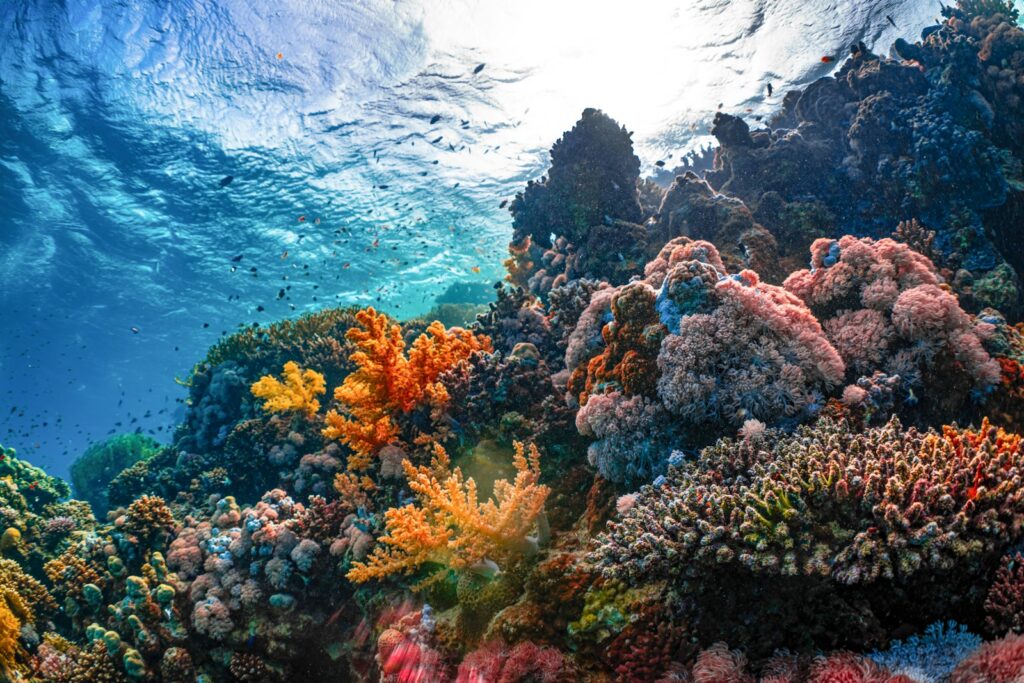
A Labuan Bajo phinisi liveaboard diving trip in Komodo National Park puts you on a traditional Indonesian wooden vessel that overnights directly at the dive sites — so your first entry of the day is often made before the day-trip boats arrive and the current is still running clean. These are purpose-configured dive charters: onboard compressors, Nitrox fills, hard-bottom tenders for site transfers, and resident dive guides who read Komodo’s notoriously variable currents for a living. No other format gets you this combination of access, comfort between dives, and the flexibility to stay an extra hour at a site that’s firing.
Why Komodo Rewards the Liveaboard Format
Komodo National Park is not a gentle, predictable reef system. It sits at the confluence of the warm Flores Sea and the cooler Indian Ocean upwellings, which drives extraordinary marine density — but also the swift, shifting currents that define almost every site here. Castle Rock and Crystal Rock in the north can run at 3–5 knots on the wrong tidal window; Batu Bolong’s signature wall dive requires reading a brief slack before it clocks from drift to washing-machine. Day-trip diving from Labuan Bajo town is possible, but you’re spending 45–90 minutes each way in a speedboat, arriving mid-morning when the current is often already peaked, and competing with half a dozen other groups at the same time.
A dive phinisi sleeps at anchor off Sebayur or in the northern bay near Crystal Rock. Your dive guide checks the tide tables the night before. You enter the water at the right window — not at the scheduled time on someone else’s itinerary. That operational flexibility is the core argument for the liveaboard format in Komodo, and no vessel delivers it more comfortably than a well-equipped phinisi.
Komodo Dive Sites: What Each One Actually Requires
Operators list the same seven or eight sites on every dive itinerary, but they’re not interchangeable. Certification level, current experience, and depth comfort matter site by site.
Batu Bolong
A seamount pinnacle that rises from around 30 m to about 5 m below the surface. The wall on the south side is stacked with sea fans and soft corals, and the fish life — schooling fusiliers, trevally, Napoleon wrasse, white-tip reef sharks resting on ledges — is among the most concentrated in the park. The catch: Batu Bolong is current-exposed from nearly every direction, and the flow reverses unpredictably. This is an Advanced Open Water minimum site, and experienced guides treat it as such. Entry timing is everything; arrive ten minutes late on a flooding tide and you’re hanging on your finger for five minutes before you can make the top of the wall. When conditions line up, it’s the best dive in the park.
Castle Rock
Located in the northern sector near Gili Lawa Laut, Castle Rock is a submerged pinnacle complex sitting between 3 m and about 25 m. It earns its reputation from sheer biomass: clouds of snapper and batfish orbit the structure, grey reef sharks patrol mid-water, and manta rays pass through regularly on the right days. Currents here tend to run hard and predictably — mostly horizontal drift rather than the pin-wheel chaos of Batu Bolong — so experienced drift divers actually find it more manageable than its reputation suggests. Still, this is AOW territory, and any guide worth listening to will refuse to put Open Water-only divers here when the flow is up.
Crystal Rock
The companion site to Castle Rock, sitting a short tender ride away. Crystal Rock runs slightly shallower and generally more gently, which makes it the more accessible of the two northern pinnacles — though “gentle” is relative in Komodo. On calm days it’s an excellent site for divers who have completed their AOW but haven’t yet built a big drift-diving log. The visibility in the north tends to run warmer and clearer (water temperatures roughly 27–29°C) than central and southern Komodo, where cold upwellings pull temperatures down to 24–26°C but drive the plankton blooms that attract mantas and large pelagics.
Manta Point (Karang Makassar)
The shallow cleaning station in the southern sector is the reason many travelers book a Komodo liveaboard in the first place. Reef manta rays (Mobula alfredi) — wingspans reaching 4–5 m — circle the bommie at 5–15 m, queuing patiently to be cleaned by small wrasse and cleaner fish. This is fundamentally a hover-and-observe dive. Depth and current are manageable for Open Water divers on a settled day, though the guide will assess conditions on the morning. The etiquette here is strict: approach from the side, never from directly below or above, maintain at least 3 m distance, and absolutely no chasing. Manta rays that get harassed stop using the station. Operators who follow good practice enforce this without exception.
Manta presence is strongest roughly May through September, with another peak around October–November as southern Komodo’s waters warm slightly. They’re resident year-round, so encounters outside peak months are common — just less predictable.
The Cauldron (Shotgun)
One of the more technically demanding sites in the park, and one of the most exhilarating when it works. A channel between two landmasses funnels tidal flow into a narrow passage; when the tide runs, divers are shot through the channel at speed — controlled chaos is the honest description — and then deposited into a large bowl where upwellings create a swirling washing-machine effect. The site is advanced divers only, requires solid buoyancy control, and demands a guide who knows exactly when to enter so the group exits into calm water rather than being pinned against the rock face. Most operators reserve this for guests with meaningful drift and current experience, not just an AOW card.
Batu Cermin Area and Siaba Besar
Siaba Besar is the turtle site — resident hawksbill and green sea turtles graze the shallow reef, and the gentle conditions make this one of the most accessible dives in the itinerary. Depths stay mostly within 15 m, current runs mild, and Open Water divers handle it comfortably. It serves as an excellent warm-up dive on Day 1 or a recovery dive after the intensity of the northern pinnacles. If your group includes a mix of Advanced and Open Water certified divers, Siaba is where everyone can be in the water at the same time without the guide managing asymmetric risk.
Tatawa Besar
A gently sloping reef in the central sector with good hard coral cover and a reliable cast of reef species. Tatawa sees less tidal surge than the pinnacle sites and suits Open Water divers on most days. It’s frequently included in the final morning of a 5D4N trip as a relaxed, unhurried dive before the return sail to Labuan Bajo.
Certification Requirements and Honest Expectations
Across most Komodo dive liveaboards, the baseline entry requirement is Open Water certification. That will get you onto Manta Point, Siaba, Tatawa, and several other central-sector sites without restriction. For Batu Bolong, Castle Rock, Crystal Rock, and the Cauldron, reputable operators require Advanced Open Water at minimum — and most guides will additionally want to see a logged dive count above 30–50 dives before taking you to the most current-exposed conditions.
This is not bureaucratic box-ticking. Komodo’s currents are unpredictable in a way that gentle tropical reefs are not. A diver who has never managed a meaningful drift dive can be genuinely dangerous to themselves and to the group if they panic and surface in a fast-running channel. Ask your operator before booking: which sites require AOW, and will guide assess current before each dive rather than following a fixed checklist? The answer tells you a lot about operational standards.
If you’re traveling with a mix of certified and non-certified guests, most dive-equipped phinisi accommodate snorkelers in parallel with divers on the same tender deployment. The guide manages the groups separately. It’s not seamless — you’ll notice the diver briefings take longer, and snorkelers sometimes wait while the dive group surfaces — but it works on vessels configured for it.
Dive-Equipped Phinisi: What the Setup Actually Looks Like
Not every phinisi that offers “diving” is a true dive liveaboard. There’s a meaningful difference between a charter boat that carries a set of rental BCDs and a dedicated dive vessel with a purpose-built equipment room, a proper compressor, and guides who do nothing else on the trip.
Compressors and Nitrox
Dedicated dive phinisi carry onboard compressors — typically one or two high-pressure electric or petrol-powered units capable of filling standard 12L aluminium cylinders overnight. Nitrox (enriched air, typically 32% EAN) is increasingly standard on quality dive charters. It extends your no-decompression limits at Komodo’s typical depths of 15–25 m, reduces surface interval fatigue across four dives a day, and — frankly — is expected by most advanced divers booking multi-day liveaboards at this price point. When enquiring, ask specifically: do you carry a Nitrox membrane system or fill from a pure O₂ blend? Membrane systems producing 32% EAN are the most common; pure-oxygen blending producing higher percentages is rarer on phinisi but available on some premium boats.
Nitrox certification (PADI Enriched Air Diver or equivalent) is required to use it. If you’re not yet certified, many operators offer an add-on online theory course that you complete before departure.
Tenders and Entry Points
Site transfers on a well-equipped dive phinisi use a rigid-inflatable or hard-bottom tender — not the main vessel. This matters at exposed pinnacle sites like Batu Bolong and Castle Rock where the phinisi anchors in calmer water and the tender shuttles divers to the entry point. Entry is typically backward roll or giant stride from the tender’s side; exits use a rope ladder at the stern. On sites with current, the tender follows the dive group on the surface, keeping track of the dive flag and picking up divers wherever they surface.
Equipment Rental and Storage
Most quality dive phinisi carry full rental sets: BCD, regulator, wetsuit (3mm is usually sufficient for Komodo’s warmest months; 5mm is recommended if you’re diving central and southern sites in July–September when the cold upwellings are strongest), mask, fins, and computer. Computer rental is less universal — bring your own if you have one. Tank valves are typically DIN or INT-compatible, but confirm before booking if you travel with your own regulator. Equipment is rinsed and stored in a dedicated gear room or on a shaded deck rinse station; leaving BCDs in the sun between dives on a Komodo liveaboard is not a practice good operators tolerate.
How Many Dives Per Day on a Phinisi Liveaboard?
On a typical 5D4N or 6D5N dive-focused phinisi itinerary, you can expect 3 to 4 dives per day on full dive days — generally a morning dive, a mid-morning dive, a post-lunch afternoon dive, and occasionally a sunset or night dive at anchor. The exact count depends on site conditions, surface interval requirements if you’re on air, and whether the itinerary includes a land activity (Padar sunrise trek, Komodo dragon ranger trek) that displaces a dive slot.
A realistic 5D4N schedule looks roughly like this: Day 1 is a transit and check-out dive; Days 2 and 3 are full dive days targeting the northern pinnacles and central-sector sites; Day 4 adds Manta Point and a southern site; Day 5 is a morning dive before the return sail to Labuan Bajo to catch afternoon flights back to Bali. Total dive count for the trip: typically 14–18 dives depending on conditions and the group’s pace.
The no-fly window after the final dive is a practical constraint that needs to be built into your booking. Standard guidance recommends at least 18–24 hours between your last dive and flying; conservative operators recommend 24 hours. If you’re catching the afternoon Bali flight, make sure your final dive finishes by mid-morning at the latest. Morning flights from Labuan Bajo are rarely compatible with a final-day dive — factor this into your itinerary planning, especially if you’ve booked separate connecting flights.
Dive vs Snorkel Phinisi: Choosing the Right Boat
There’s a category distinction worth making clearly. Some phinisi are fundamentally leisure or snorkel boats that carry basic scuba gear as an add-on. Others are configured primarily for diving, with the compressor, gear storage, and dive team as the operational core of the vessel. If diving is the reason you’re booking — not an optional extra — you want the second type.
- Dedicated dive phinisi
- Onboard compressor, Nitrox-capable, dedicated equipment room, 2+ certified dive guides (not just a single divemaster shared with snorkelers), safety oxygen kit, and a dive tender separate from the main vessel tender. These boats structure their itinerary around dive windows, not snorkel stops. Dive briefings are detailed and site-specific. Guide-to-diver ratios are typically 1:4 or better at complex sites.
- Leisure phinisi with dive option
- Carries tanks and BCD/regulator rental for guests who want to dive, but the dive guide is typically one person managing divers and snorkelers simultaneously. Shore fills from a local compressor in harbor may be necessary for multi-day trips. Nitrox often unavailable. Guide-to-diver ratio at exposed sites can run 1:8 or higher. These boats are fine for easy reef dives; they are not appropriate for Batu Bolong or Castle Rock on a running current.
When you’re evaluating a phinisi for a dedicated dive charter, ask the operator directly: How many certified dive guides will be on board? Do you carry a Nitrox membrane system? What is your maximum diver-to-guide ratio at advanced sites? What safety equipment is carried on the dive tender? Operators running genuinely dive-configured vessels will answer these without hesitation. Vague responses about “experienced staff” or “full equipment available” are signals to keep asking.
Ready to match with a properly equipped dive phinisi? Our concierge can shortlist boats based on your certification level, group size, and target sites — plan your charter and we’ll respond within one business day.
Itinerary Options: 5D4N vs 6D5N
The standard leisure phinisi itinerary runs 3D2N or 4D3N. Dive-focused liveaboards extend to 5D4N and 6D5N to accommodate the dive-site density and the no-fly buffer.
A 5D4N itinerary covers the core dive sites — Batu Bolong, Crystal Rock, Castle Rock, Manta Point, Siaba — with one land excursion (usually the Padar sunrise trek and/or the Komodo dragon trek at Loh Liang or Rinca’s Loh Buaya). This is the most popular format for divers who want comprehensive site coverage without extending travel time excessively. Total dives: 14–18.
A 6D5N itinerary adds a full day that usually goes north to the Gili Lawa area for multiple dives on Castle Rock and Crystal Rock in different tidal conditions, or extends south to include Tatawa and the deeper central sites. Groups who want to spend serious time at the northern pinnacles — or who want a relaxed pace with longer surface intervals and no schedule pressure — generally prefer the 6D5N format. Total dives: 18–22.
Both formats require an early morning arrival at Labuan Bajo on Day 1. Fly in the morning from Bali (the Denpasar–Labuan Bajo sector runs roughly 1 hour 10 minutes on airlines including Garuda, Wings Air, Batik Air, and Lion Air) to allow time for harbor check-in and the afternoon departure sail. Park and conservation fees — typically IDR 600,000–1,200,000 per person across a 5–6 day trip for park entrance, marine fees, trekking, and ranger charges — are almost always charged separately from the base boat rate. Confirm this clearly before booking.
Current Management: The Skill That Separates Good Dive Guides from Great Ones
Komodo’s current patterns are driven by tidal exchange between the Indian Ocean and the Flores Sea, modulated by the irregular geography of dozens of channels between islands. At any given site, the current direction, speed, and depth gradient can shift within a single dive. This is not a predictable Caribbean drift — it’s a dynamic, three-dimensional flow system that experienced local guides read using a combination of published tide tables, visual surface observations, and frankly, accumulated pattern recognition from hundreds of dives at the same site.
The best local guides brief divers on the specific tidal window for each site that day, identify the likely exit point before entry, and position the tender accordingly. They plan for current reversals mid-dive. They know which parts of Batu Bolong’s wall provide shelter if the flow accelerates unexpectedly, and they can hold a group together on a rocketing drift through the northern channels without losing anyone to the surface. This level of site knowledge is not something a visiting divemaster can replicate; it accumulates over seasons of diving the same sites in varying conditions.
When evaluating a dive phinisi, ask how many seasons the lead dive guide has worked specifically in Komodo, not just their total divemaster experience. A guide with 2,000 logged dives including four Komodo seasons is a fundamentally different proposition from a divemaster who completed their certification in Bali and is on their first Komodo charter season.
Marine Conservation and Responsible Diving in Komodo
Komodo National Park is a UNESCO World Heritage Site and Marine Protected Area. The park rules are not suggestions: no touching or standing on corals, no collecting specimens, no feeding wildlife, and use mooring buoys rather than anchoring on reef. For manta rays specifically, approach from the side — never from directly below — and hold distance of at least 3 m. Mantas that feel harassed abandon their cleaning stations; sites that lose their cleaning station function stop attracting mantas.
These rules depend on enforcement at the boat level. When you’re evaluating operators, ask specifically about their briefing protocol for manta sites and their response if a guest violates the approach distance. Operators who have internalized conservation practice don’t need to be asked twice; they brief it as naturally as they brief the emergency ascent procedure.
The conservation fee component of park entrance charges directly funds ranger patrols and marine monitoring — it’s a reasonable cost and worth understanding as a line item rather than treating as an irritating extra. Ranger accompaniment on land treks (mandatory on Komodo and Rinca) similarly funds the infrastructure that keeps the dragon population protected and the tourism experience intact.
Booking a Dive-Focused Phinisi Charter: What to Confirm Before You Pay
Dive liveaboard bookings have more variables than standard charter bookings, and the details matter. Before any deposit changes hands, confirm in writing:
- Onboard compressor capacity and whether Nitrox is available (and at what percentage)
- Number of certified dive guides and their Komodo-specific experience
- Maximum diver-to-guide ratio at advanced sites
- Whether the itinerary includes all named target sites or treats them as weather-dependent optional additions
- The cancellation and weather-delay policy — Komodo’s seas can close sites on short notice, particularly in shoulder season
- What park and conservation fees are excluded from the advertised rate
- The no-fly window protocol and how the final-day schedule accommodates it
- Whether rental equipment meets your cylinder valve type (DIN vs INT)
Booking six or more months in advance is advisable for peak season (July through September). Dive-configured phinisi at the quality tier that can handle Castle Rock and Batu Bolong safely have limited berths, and they fill from repeat clients and referral networks before they reach the general market. If you’re planning around manta season, the May–September window books out predictably.
Our concierge works directly with operators across the quality spectrum. If you want an independent assessment of which dive phinisi currently meets the standards described above for your dates and certification level, get in touch via WhatsApp or our contact form — the vetting is what we’re here for, and the advice is genuinely independent.
Frequently Asked Questions
Do I need Advanced Open Water certification for a Komodo dive liveaboard?
It depends which sites you want to dive. Manta Point, Siaba Besar, and Tatawa are accessible with a basic Open Water certification on settled days. Batu Bolong, Castle Rock, Crystal Rock, and the Cauldron require Advanced Open Water at minimum, and most reputable guides will additionally want to see a reasonable logged dive count — typically 30 to 50 dives — before taking you to the most current-exposed conditions. If you only have Open Water certification, you can still have an excellent Komodo liveaboard; you’ll be working from a more limited site menu on complex current days. Many guests use a Komodo trip as the motivation to complete their AOW before booking.
How many dives per day is typical on a phinisi liveaboard?
On full dive days, most dedicated dive phinisi offer three to four dives: a morning dive, a second dive before lunch, an afternoon dive, and sometimes a sunset or night dive at anchor. Days that include land activities — the Padar sunrise trek, for instance, or the Komodo dragon ranger trek — typically reduce the dive count to two or three. Over a 5D4N itinerary you can realistically plan for 14 to 18 dives in total, depending on conditions and group pace.
Is Nitrox available on phinisi liveaboards in Komodo?
Yes, on properly equipped dive charters. Most quality dive phinisi carry onboard Nitrox membrane systems producing 32% enriched air (EAN32). This is increasingly standard at the mid-range and above tier, and is particularly valuable in Komodo because it extends your no-decompression limits at typical site depths of 15–25 m and reduces fatigue across a multi-dive day. Nitrox certification is required to use it; if you’re not certified, some operators offer online pre-trip courses. Confirm Nitrox availability explicitly before booking — not every boat that markets diving carries a Nitrox system.
When is the best time for diving on a Komodo phinisi liveaboard?
The core dive season runs April through October, with July through September delivering the best underwater visibility — commonly 20 to 30 metres at the northern sites — and the strongest manta presence at Manta Point. The May–June window is a strong alternative: the seas are calmer, the islands are still green, boat traffic is lighter, and conditions are excellent. October and early November form a quieter shoulder window with good visibility and fewer boats competing for the same sites. January and February are the roughest months; some operators reduce or suspend sailings, and site conditions are often unsuitable for the exposed northern pinnacles.
What is the difference between a dive phinisi and a snorkel phinisi?
A dedicated dive phinisi is configured with onboard compressors, Nitrox capability, a gear storage and rinse station, multiple certified dive guides, and a hard-bottom tender for site transfers. The entire itinerary is structured around dive windows and tide tables. A snorkel-focused phinisi may carry a set of tanks and a single divemaster as an add-on service, but guide ratios, briefing depth, and site flexibility are fundamentally different. If diving is the primary reason you’re booking — particularly if you intend to dive Batu Bolong, Castle Rock, or the Cauldron — verify that the vessel is a true dive-configured boat before committing. The distinction matters most at the complex, current-driven sites that define Komodo’s reputation.