How we stay independent: Phinisi Atlas does not own boats or sell a fixed catalogue. When you book a charter we recommend, we may receive a referral fee from the operator at no extra cost to you. This never changes our vetting or the pricing we publish.
Knowing how to choose a Labuan Bajo phinisi for Komodo National Park matters far more than most travelers realize before they book — and far less than the marketing language would have you believe. A phinisi is a traditional two-masted wooden sailing vessel built by the Bugis, Makassar, and Konjo people of South Sulawesi, and boats bearing that name now range from sun-bleached open-trip hulls carrying ten backpackers to 35-meter expedition yachts with ensuite marble bathrooms and a crew of twelve. The gap between those two extremes is not just about comfort. It is about safety margins, realistic daily access to the park, and whether the experience you actually get matches what you paid for.
At Phinisi Atlas we do not take operator fees, commissions, or sponsored listings. What follows is the framework we use — and the specific questions we ask every boat operator before recommending a vessel — so you can apply the same logic yourself, or ask us to apply it for you.
What a Phinisi Actually Is (and Why It Varies So Wildly)
The word phinisi describes a hull form and a cultural lineage, not a specification. The Konjo boatbuilders of Ara, Tana Beru, and Lemo-Lemo in Bulukumba regency have been constructing these ships on open beaches, without blueprints, for generations. In 2017 UNESCO inscribed the tradition — officially titled Pinisi, art of boatbuilding in South Sulawesi — on its Representative List of the Intangible Cultural Heritage of Humanity. That inscription covers the craft knowledge, the ritual stages of construction, and the community structures around it. It does not certify the seaworthiness of any individual vessel.
Hulls are built from tropical hardwoods — primarily ironwood (kayu besi, also called ulin) for the keel and structural framing, and teak for planking, decks, and joinery. Both species are exceptional at resisting saltwater degradation, which matters when you are asking a wooden hull to spend years anchoring in the pass currents of Komodo. The rig is technically a gaff-ketch carrying seven or eight sails, though few modern charter phinisi sail under canvas with any regularity; most run on diesel and treat the masts as a signature aesthetic.
That tension — traditional form, widely variable execution — is precisely why a vetting framework exists. No two phinisi are built to the same template, no regulatory body publishes a standardized grading system, and the tier names (Standard, Superior, Deluxe, Luxury, VVIP) are marketing labels that different operators apply inconsistently. Our framework replaces the labels with measurable criteria.
The Five Phinisi Boat Tiers Explained: From Standard to VVIP
The difference between luxury and standard phinisi in Labuan Bajo is not simply about price per night. It runs through engine reliability, cabin privacy, generator capacity, safety equipment, and the ratio of crew to guests. Below is how we define each tier after inspecting vessels across all categories.
| Tier | Hull length | Cabin bathrooms | AC hours | Crew-to-guest ratio | Generator backup | Approx. private charter range (per night, USD) |
|---|---|---|---|---|---|---|
| Standard | ~20–24 m | Shared (1–2 bathrooms for all cabins) | Nighttime only, single generator | ~1:3 or lower | None or improvised | $300–700 |
| Superior | ~24–28 m | Shared or partial ensuite | Nighttime + midday rest, single generator | ~1:3 | Limited | $600–1,200 |
| Deluxe | ~26–30 m | Ensuite in master cabin; shared for others | Full 24-hour on dual generator | ~1:2.5 | Dual generator (no blackout risk) | $1,000–2,200 |
| Luxury | ~28–35 m | All cabins ensuite, hot showers | Full 24-hour, often soundproofed | ~1:2 or better | Dual generator + inverter backup | $2,000–5,000+ |
| VVIP / Expedition | ~35–50 m+ | All ensuite, some with private deck access | Full 24-hour, climate-controlled throughout | ~1:1.5 or better | Redundant systems, stabilizers | $5,000–25,000+ (quote only) |
A few things worth unpacking in that table. The AC hours figure is not cosmetic — on a 3D2N trip in August, when ambient temperatures in the anchorage hit 33°C by 10am, a single generator that only runs at night means a genuinely uncomfortable boat from roughly 6am to 10pm. Families with young children and guests prone to heat sensitivity should treat 24-hour dual-generator AC as a non-negotiable minimum, not a luxury upgrade. Similarly, the crew-to-guest ratio shapes everything from dining pace to safety response time. A crew of four managing twelve guests on a Standard boat cannot deliver a meaningful safety briefing, serve meals with any calm, and keep watch simultaneously.
How We Vet Phinisi in Komodo: The Eight-Point Inspection Framework
Our vetting protocol for Komodo phinisi covers eight dimensions. We do not accept operator self-reporting on any of these criteria without corroboration from inspection photos, booking records, or direct crew interviews.
1. Hull Material and Year Built or Last Refit
Ask for the keel year and the most recent structural refit year — these are two different things. An ironwood-and-teak hull built in 2008 with a full structural refit in 2022 is a safer bet than a 2018 hull that has never had its planking inspected below the waterline. Ironwood is exceptionally durable but no wood is maintenance-free in tropical saltwater. We look for hull inspection records and, ideally, evidence of antifouling treatment within the past eighteen months.
2. Main Engine and Generator Configuration
The main propulsion engine is your passage insurance. Ask the make, horsepower, and year of last service. Then ask the same questions about the generator. On Standard and many Superior boats, there is one of each; if either fails in the current-swept straits between Komodo and Rinca — where tidal flows reach three or four knots — you are in a difficult position. Luxury-tier and above should have a backup generator at minimum; VVIP vessels should carry redundant propulsion. We consider dual-generator configuration a hard requirement for any private charter carrying more than eight guests.
3. Stabilizers
Phinisi are beamy, shallow-draft vessels, which gives them reasonable stability at anchor but can produce an uncomfortable rolling motion when running across a swell. Stabilizers — either active fin stabilizers or paravane-type outriggers — make a material difference on the overnight passages between departure points and the outer islands. They are common only on VVIP and high-end Luxury vessels. If motion sickness is a concern for any guest in your group, stabilizers should be on your must-ask list.
4. Cabin Layout: Ensuite vs. Shared Bathrooms
This is the single most frequently misrepresented specification in Labuan Bajo. We have seen "luxury phinisi" listings where only the master cabin has an ensuite and four other cabins share one bathroom below the waterline — a configuration that creates a genuine bottleneck at 5:30am when eight guests are preparing for the Padar Island sunrise hike. Our rule: on a private charter, every occupied cabin should have direct ensuite access. On a sharing/open-trip boat, the shared-bathroom arrangement is a known tradeoff you accept at booking; just be clear about the ratio before you commit.
5. Safety Certification and Equipment
Indonesian maritime regulations require commercial passenger vessels to carry life jackets for all passengers and crew, fire extinguishers, distress signals, and a working VHF radio. Beyond the regulatory minimum, we check for: a life raft rated for the full passenger capacity (not just crew), an EPIRB (emergency position-indicating radio beacon), a first-aid kit that includes oxygen, a tender or dinghy capable of carrying all guests to shore in an emergency, and evidence that the captain holds a current SKK (Indonesian coastal master certificate) or equivalent. Ask to see the vessel’s Surat Izin Berlayar (sailing permit) and its passenger capacity endorsement. Any operator that deflects these questions is giving you information.
6. Crew-to-Guest Ratio and Crew Qualifications
The crew-to-guest ratio on a phinisi shapes the entire texture of the trip. At the Luxury tier, a well-run boat typically carries a captain, first mate, two or three deckhands, an onboard chef, and one or two service crew — roughly seven to eight crew for eight to ten guests, giving a ratio close to 1:1.25. At the Standard tier, four crew for twelve guests is common. The difference shows in every meal service, every briefing, and every shore excursion transfer. For dive-focused charters, ask specifically whether the dive guide is a certified PADI or SSI Divemaster or Instructor, distinct from the boat crew; good boats carry at least one dedicated dive professional per four or five divers.
7. Dive and Snorkel Equipment Condition
Many Luxury and VVIP phinisi carry their own compressors, and the better ones can fill Nitrox. Ask when the BCD and regulator sets were last serviced, and whether the boat carries a dedicated oxygen kit for dive emergencies. On Standard and Superior boats, equipment condition is highly variable; if you are bringing your own gear you sidestep the question, but mask, fins, and BCD fit matter most to guests who do not own kit. We check wetsuit availability too — water temperatures in the central and southern Komodo zones can drop to 24–26°C on cold upwelling days, and a 3mm wetsuit that has been bleached white with age offers negligible thermal protection.
8. Food, Water, and Waste Systems
Freshwater capacity and onboard water treatment determine whether the boat can reliably offer potable water, hot showers, and laundry rinsing across a four-day trip. Ask whether the boat carries a reverse-osmosis water maker or relies entirely on tank capacity. For waste, ask directly how blackwater and greywater are handled; responsible operators hold waste for pump-out at Labuan Bajo harbor or use certified treatment systems. Anchoring over coral and discharging waste in Komodo National Park is prohibited under the park’s marine protected area rules. We consider this a sustainability screen, but it is also a practical indicator of how the operator thinks about their broader responsibilities.
Ready to find a phinisi that passes all eight checks? Plan your charter with our concierge — we vet vessels on your behalf and match you to the right tier for your group.
Matching the Tier to Your Trip: A Practical Decision Guide
The phinisi boat tiers from VVIP to Standard represent genuinely different travel experiences, not just different price points. Here is how to think about the match.
Standard and Superior: Open-Trip Culture and Budget Private Charters
Standard boats dominate the open-trip market, where you purchase a per-person cabin berth alongside other travelers — typically four to twelve people on a 3D2N Komodo route. This format suits solo travelers and couples on a budget who are comfortable with communal bathrooms, limited AC, and a more improvised daily rhythm. Shared-trip prices run roughly $100–250 per person per day depending on boat quality and inclusions, though park fees are almost always extra and represent a meaningful additional cost (budget approximately IDR 600,000–1,200,000 per person for a 3D2N trip to cover park entrance, ranger, and marine fees — verify current rates with your operator, as these are revised periodically).
For a private group charter on a Standard or Superior boat, the economics can actually be attractive: a private 3D2N charter for ten people on a Superior boat at $1,000–1,500 per night works out to $100–150 per person per night, competitive with some open-trip rates while giving you schedule flexibility and exclusivity on itinerary decisions.
Deluxe: The Practical Sweet Spot
Deluxe boats sit at the pivot point in the market. You get 24-hour air conditioning from dual generators, ensuite bathrooms in at least the master cabin, improved crew ratios, and noticeably better food. For families and small groups of four to eight guests who want comfort without the six-figure charter fee of a top-end vessel, Deluxe is typically the tier where the marginal comfort per dollar is highest. Hull lengths in the 26–30 meter range also mean a more stable overnight motion than the shorter Standard boats.
Luxury and VVIP: When the Details Are the Trip
At the Luxury tier, the phinisi itself becomes a destination. Purpose-built expedition vessels in the 30–40 meter range carry full ensuite cabins, dedicated sun decks and dining areas, professional chef menus — sometimes including freshly caught local seafood supplemented by produce brought from Labuan Bajo — and the kind of crew-to-guest ratio that means a gin-and-tonic appears before you have finished thinking about wanting one. VVIP and expedition-class boats may add stabilizers, master suites with private deck access, dive compressors with Nitrox capability, and in-water water toys.
The honest tradeoff at this tier is that the largest vessels — some pushing 45 meters — cannot access every anchorage that a nimbler 24-meter boat can reach. Shallow-draft anchorages off Taka Makassar’s sandbar or the inner reef approach to Kanawa may require you to take the tender rather than anchoring close. This is not a dealbreaker; it is simply a tradeoff worth knowing in advance.
What the Park Fees Actually Cost (And Why They Matter to Boat Selection)
Komodo National Park fees are almost universally listed as "excluded" in charter quotes, yet they are a meaningful line item that no vetting framework should ignore. The park is both a UNESCO World Heritage Site and a Marine Protected Area, and fees fund ranger operations, trail maintenance, and marine conservation programs.
Current approximate per-person fees for a typical 3D2N private charter (foreigners, weekday; figures are approximate and subject to revision — always confirm with your operator):
- Park entrance (national park entry)
- ~IDR 150,000–200,000 per person per day (higher on Sundays and public holidays)
- Marine / snorkel fee
- ~IDR 50,000–100,000 per person per activity day
- Ranger and trekking fee
- Variable; typically a group ranger charge split across guests, plus a per-person trekking fee; budget ~IDR 50,000–100,000 pp
- Practical total for 3D2N
- ~IDR 600,000–1,200,000 per person (~$40–80 USD at mid-2026 exchange rates)
Why does this matter for boat selection? Because Standard boats often collect fees informally and inconsistently, and guests sometimes arrive at ranger stations to find they owe fees the operator said were included. Luxury and VVIP operators typically handle park permitting cleanly and transparently; ask for a written fee breakdown before you book.
Reading the Komodo Itinerary Honestly
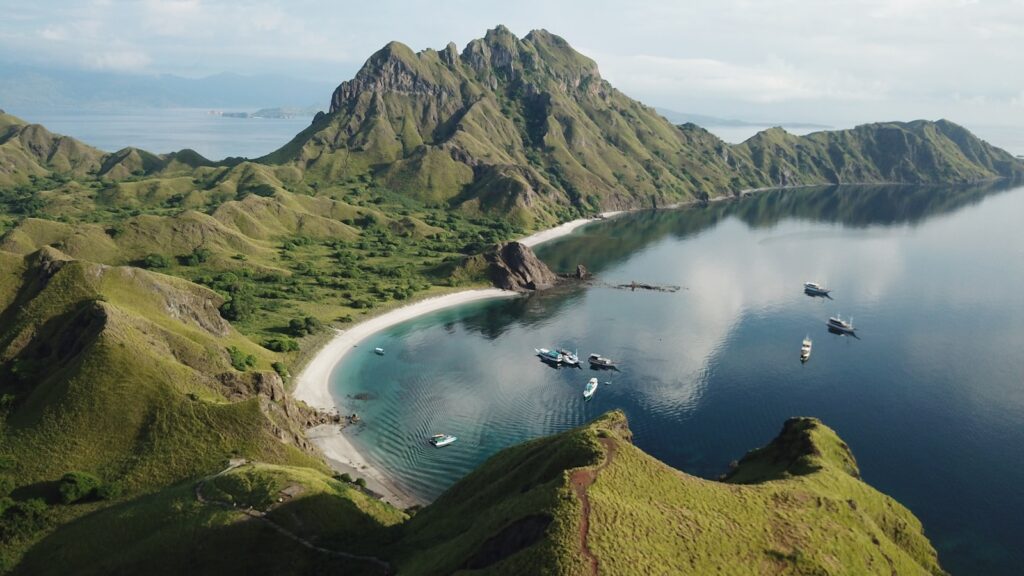
A 3D2N itinerary visiting Padar Island, Komodo Island for the dragon trek at Loh Liang, Pink Beach (where the sand’s pink hue comes from crushed Foraminifera shells mixed with white coral sand), Manta Point at Karang Makassar, and Taka Makassar’s sandbar is the standard commercial route — and it is genuinely excellent. The 4D3N version adds a weather buffer, more reef time, and a second sunrise or sunset anchorage, which makes a real difference to the pace of the trip. Below that, a 2D1N trip is compressed to the point where most guests feel they are rushing; we rarely recommend it for first-time visitors unless logistical constraints are unavoidable.
The outer reefs — Batu Bolong, Castle Rock, Crystal Rock — and the cold-water upwelling dive sites in central and southern Komodo tend to appear only on dive-focused itineraries of 4D3N or longer. These sites are some of the highest-biomass reefs in the Indo-Pacific and are worth planning for specifically if your group includes serious divers.
The best sailing window is late April through October, with May–June offering calm seas and still-green hillsides on Padar, and July–September delivering peak underwater visibility of 20–30 meters and peak boat traffic. October and early November are a quiet shoulder period with excellent conditions. January and February are the roughest months; many operators reduce sailings, and we advise against booking those months unless you are specifically seeking the dramatic landscape of a wet-season Padar, which is genuinely beautiful in its own way, or unless you are on a vessel with stabilizers and a captain with Komodo wet-season experience.
The Questions No One Asks But Should
After a decade of placing clients on vessels across this region, the questions that separate a well-matched charter from a disappointing one are rarely the ones people ask unprompted.
Has this vessel ever had a structural or mechanical incident at sea? Legitimate operators will answer this honestly and explain what was learned from it. Evasion is itself an answer.
What is the protocol if a guest requires medical evacuation? Komodo National Park is an hour or more by fast boat from Labuan Bajo’s basic medical facilities. Serious cases require air evacuation to Bali or Jakarta. A responsible operator has a written emergency protocol, knows the nearest coast guard frequency, and carries a first-aid kit with oxygen. Ask to see the emergency contact list.
What happens if the weather is bad? A good captain will modify the itinerary proactively, avoiding exposed outer passages when conditions are above a certain sea state. Ask what threshold the operator uses, and whether any itinerary modifications affect pricing. Flexibility clauses matter most in October–November shoulder season and any time you are considering a trip close to the December–March wet season.
Who actually operates this vessel? The Labuan Bajo market has a layer of brokers and agents between travelers and the boats they book. This is not inherently a problem, but it creates accountability gaps when something goes wrong. Ask directly: do you own this vessel, and are the captain and crew employed by you year-round? Owner-operated boats with permanent crews typically have lower turnover, better-maintained equipment, and more consistent service quality.
We can help you get honest answers to all of these. Reach us via the planning form or send a message on WhatsApp — we respond to charter enquiries personally, usually within a few hours, and we will not match you to a boat we would not board ourselves.
Frequently Asked Questions
What is the difference between a luxury and standard phinisi in Labuan Bajo?
The core differences are cabin privacy (ensuite bathrooms vs. shared facilities), air conditioning availability (24-hour dual-generator on luxury vs. nighttime-only on standard), crew-to-guest ratio (roughly 1:2 or better on luxury vs. 1:3 or lower on standard), safety equipment depth, and hull length. Standard boats typically run 20–24 meters and suit budget travelers comfortable with communal facilities; luxury boats run 28–35 meters and offer a fundamentally different level of service and comfort. The price gap is substantial — roughly $300–700 per night on a standard private charter versus $2,000–5,000 or more per night for a true luxury vessel — but for a group of eight or more adults the per-person math can be closer than it looks.
What crew-to-guest ratio should I expect on a phinisi charter?
On Standard boats the ratio is often around 1 crew member per 3 guests or lower, meaning a team of four managing twelve passengers. At the Luxury tier, expect closer to 1:2 — typically a captain, first mate, two or three deckhands, an onboard chef, and one or two service staff for eight to ten guests. VVIP and expedition-class vessels often achieve 1:1.5 or better. For a dive-focused charter, ask specifically whether a certified dive guide is included in addition to the boat crew; the two roles are distinct and the best operators treat them that way.
Are park fees included in the phinisi charter price?
Almost always no — Komodo National Park fees are excluded from the vast majority of charter prices and are charged additionally, either collected by the operator on your behalf or paid directly at ranger stations. Budget approximately IDR 600,000–1,200,000 per person for a 3D2N trip covering park entrance, ranger/trekking, and marine fees, though exact figures change periodically and the operator should provide a current written breakdown before you book. Sunday and public holiday rates are higher than weekday rates.
How many days do I need on a phinisi from Labuan Bajo to see the main highlights?
A 3D2N (three days, two nights) itinerary is the widely recommended minimum for a satisfying experience — it allows time for the Padar Island sunrise hike, a ranger-guided Komodo dragon trek on Komodo or Rinca Island, Pink Beach snorkeling, a Manta Point visit, and a Kalong Island bat-colony sunset without feeling relentlessly scheduled. A 4D3N itinerary adds a weather buffer, more reef time, and a calmer pace that most guests find meaningfully better. The 2D1N format exists but is genuinely compressed; we only recommend it for repeat visitors or those with tight flight connections.
What should I ask an operator before booking a Komodo phinisi charter?
Seven questions cover most of the ground: (1) What is the hull year and most recent structural refit year? (2) Does the vessel have dual generators — and is AC available 24 hours? (3) Are all cabins ensuite, or only the master? (4) What is the passenger-to-crew ratio, and does the crew include a dedicated dive guide? (5) Can I see the vessel’s sailing permit and passenger capacity endorsement? (6) What safety equipment is carried, including life raft, EPIRB, and oxygen kit? (7) Are park fees included, and can I see a written fee breakdown? An operator who answers all seven clearly and specifically is an operator worth trusting with your trip.