How we stay independent: Phinisi Atlas does not own boats or sell a fixed catalogue. When you book a charter we recommend, we may receive a referral fee from the operator at no extra cost to you. This never changes our vetting or the pricing we publish.
The best time of year to book a Labuan Bajo phinisi Komodo trip is the dry season from approximately April through October, with May to October delivering the most consistent sailing conditions, clearest underwater visibility, and the highest chance of manta encounters. Within that window, the month you choose matters more than most guides admit — July and August are peak season for good reason, but April through June and October can serve experienced travelers better: fewer charter boats at the same sites, greener hillsides on Padar, and prices that have not been pushed to peak-season ceilings.
I have sailed and guided these waters for most of my adult life. What follows is how conditions actually shift month by month — not a polished summary, but the kind of reading you get from someone who has anchored at Manta Point in a January squall and watched the cleaning station go quiet, and who has also been aboard in late September when the visibility at Castle Rock stretched past 25 metres and a school of hammerhead sharks crossed beneath the boat. Both experiences taught me something. The goal here is to give you the information to pick the right window for your specific priorities.
Understanding the Komodo Seasonal Pattern
Komodo National Park sits in a corridor between the Java Sea and the Indian Ocean where two distinct seasonal regimes collide. The dry season — broadly April through October — brings southeast trade winds that push relatively cool, nutrient-rich water north through the park’s channels. This upwelling is the reason visibility can reach 20 to 30 metres at sites like Batu Bolong and Crystal Rock: the cooler water is denser, cleaner, and less prone to the algal blooms and plankton soup that low-season conditions produce.
The wet season runs from roughly November through March, with January and February the most difficult months. Northwest monsoon winds churn the surface, swells arrive from the Indian Ocean, and daily rain reduces topside visibility even when you’re not diving. That does not mean the park closes — some operators run year-round, and genuinely experienced sailors can handle the conditions — but it does mean a meaningful portion of guests spend their first morning aboard seasick, and the underwater views that draw most people to these waters are partly obscured by suspended sediment.
There is no single perfect month. There are tradeoffs, and the right answer depends on whether you are optimising for manta rays, dive clarity, price, landscape photography, or simply the fewest crowds at Padar’s summit.
Month-by-Month Conditions: The Honest Calendar
April and May — The Green Season Sweet Spot
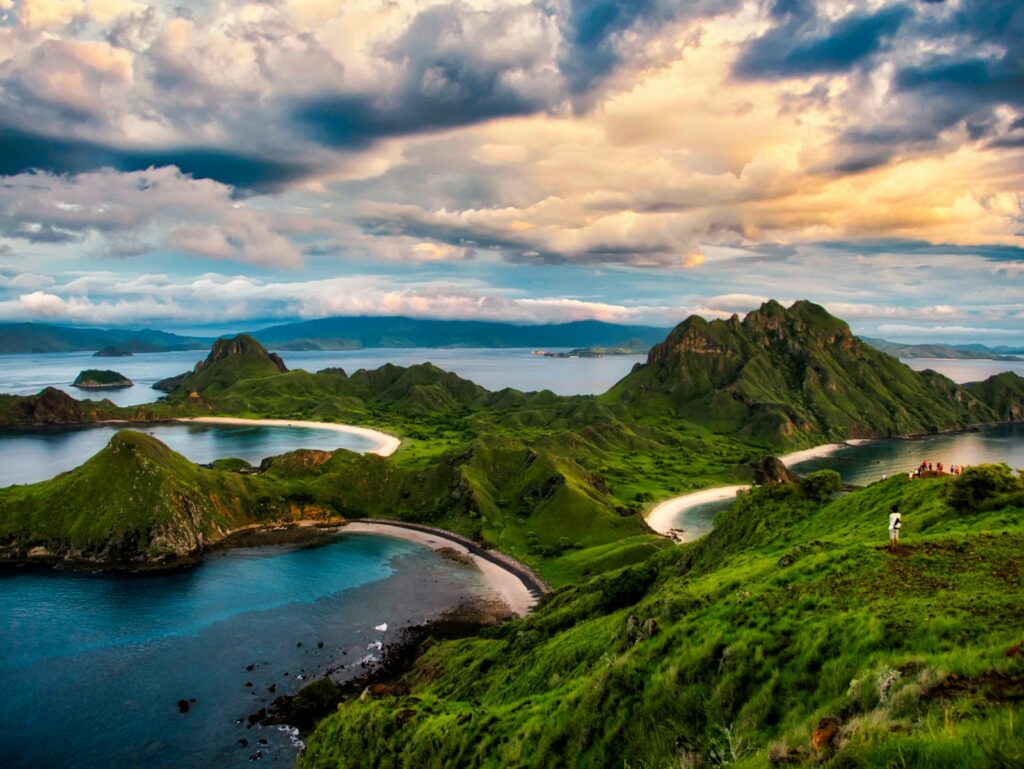
April is when the dry season establishes itself across the park, though the transition is not perfectly clean. Early April can still carry residual northwest-wind energy, and you might encounter a grey sky on one of your three days. By mid-April, the shift is usually reliable: calmer seas, moderate southeast breezes, and islands that are still dramatically green from the wet season rains. Padar’s hillsides are a deep olive at this time of year, which is a different photograph than the golden-brown slopes you get in August. Both are beautiful, but they are entirely different images.
May is one of the months I would most readily recommend to a traveler who has not been before. The manta aggregations at Manta Point (Karang Makassar) are building toward their annual peak, the park has not yet filled with the July–August flotillas, and underwater visibility is typically in the 15 to 25 metre range at most sites. Water temperatures in the central and southern park hover around 24 to 27°C — cool enough for reef manta rays to be active and visiting cleaning stations consistently.
Practical note: phinisi availability in April and May is good. You can often book a quality private charter with four to six weeks’ notice, which is essentially impossible in July and August. Prices are below peak-season rates, sometimes meaningfully so for private whole-boat charters.
June — Calm Before the Peak
June sits at an interesting inflection. The dry season is fully established; seas in the park are generally calm; and the manta season is well underway. At the same time, June is when the school holiday market in several European and Australian source markets starts to move, so demand picks up compared to May. You will see more charter boats at popular anchorages than in April, but nothing close to the July crunch.
Dragon activity on Komodo and Rinca is good throughout the dry season. The leaner vegetation and lower water availability concentrate wildlife near ranger-station water sources, which means treks tend to produce sightings. The roughly 3,000 Komodo dragons across the park do not disappear in any season, but dry-season treks — led by mandatory official rangers at Loh Liang on Komodo or Loh Buaya on Rinca — consistently deliver closer encounters than wet-season walks through dense brush.
July and August — Peak Season: Highest Visibility, Most Company
July and August are when Komodo National Park operates at full intensity. Dive visibility at the park’s current-swept sites regularly reaches 20 to 30 metres. Castle Rock, Crystal Rock, and Batu Bolong are at their spectacular best — the cold upwelling that peaks in the southeast-monsoon months pushes baitfish aggregations up through the channels, and everything from reef sharks to trevally follows. If you are booking a dive-focused phinisi liveaboard, this is the clearest window.
The tradeoff is straightforward: everyone knows it. Padar’s summit trail has a queue for the sunrise photo before 5 a.m. The Pink Beach anchorage can hold a dozen boats on a busy afternoon. Premium private charter phinisi book out months in advance, and prices at every tier are at their ceiling. If you plan a July or August departure for a private whole-boat charter, booking three to six months ahead is not overcaution — it is the standard lead time for a decent boat.
Water temperature in the southern and central park drops further in these months due to strong upwelling, sometimes to around 24°C at depth. Bring a 3mm wetsuit minimum; at some sites, experienced divers pack a 5mm. The thermal shock is real but so is the visibility payoff.
September and October — The Underrated Window
October is the month I keep recommending to people who want the experience without the peak-season noise. The southeast trades begin to ease, the sea surface calms further, and the dive conditions remain excellent through most of October. Visibility holds in the 18 to 25 metre range at well-positioned sites. Crucially, the manta season has its secondary peak running from roughly September through November as a distinct southward migration pattern adds to the resident population at Manta Point.
The park is perceptibly quieter than August. Padar’s sunrise at this time of year is fully worth the climb — the landscape has its dry-season golden palette — but you are not navigating a crowd to get to the viewpoint. The approximately 800-step climb to the summit (figures range from 700 to 900 steps depending on who is counting) is the same work, but the reward at the top feels more private.
September carries a small asterisk: it is still peak season in the charter market, so prices and availability mirror August more than they mirror October. If the calendar permits flexibility, lean toward October over September.
November — Transition Month
November is genuinely mixed. The first half of the month often extends October’s conditions reasonably well; the second half can introduce the first northwest-monsoon swells. Manta encounters remain a realistic expectation — the secondary migration peak extends into November — and operators experienced with the park can read the weather windows and route accordingly. A well-chosen, weather-aware private charter can deliver a very good November trip. A budget open-trip phinisi with a tight fixed itinerary is more vulnerable.
Visibility begins to drop at some sites, particularly in the south where upwelling weakens and warmer, murkier Indian Ocean water starts to dominate. Northern Komodo sites — warmer water, roughly 27 to 29°C year-round — are less affected by the upwelling reduction and can hold reasonable visibility later into the transition.
December and January — The Monsoon Months: A Candid Assessment
December brings the northwest monsoon in earnest. Combined with Christmas and New Year holiday demand, it creates a peculiar market condition: prices for the final weeks of December are elevated — arguably the highest of the year for premium boats, because affluent travelers lock in holiday weeks regardless of conditions — but the sailing experience is materially compromised compared to the dry season. Swells from the northwest, afternoon squalls, and choppy channels are the norm rather than the exception.
January is the most difficult month in the Komodo calendar. Northwest monsoon winds are at their most consistent, seas in the open channels can be genuinely rough, and dive visibility at many sites drops to single-digit or low-double-digit metres. Many reputable operators reduce their sailing schedule significantly. Some suspend phinisi operations between Labuan Bajo and southern Komodo sites entirely during January’s worst weeks. February is comparable, with rough conditions typically persisting until mid-March.
This does not mean nothing is available. Day trips closer to Labuan Bajo — Kelor Island, Kanawa, the protected northern bays — are more manageable. Some operators run abbreviated routes that shelter behind Komodo Island’s eastern coast and avoid the exposed southern channels. But if you are imagining a relaxed four-day liveaboard reaching Pink Beach, Manta Point, and Padar, January and February are the wrong months unless you have strong sea legs and a high tolerance for plans being altered by weather.
February and March — Patience Rewarded
February is widely considered the lowest point in the Labuan Bajo phinisi calendar. March begins the transition back toward dry season, but the shift is gradual and unreliable in the first half of the month. By late March, conditions start to stabilize, and April is reliably dry-season territory again.
If your only available travel window falls in February or March, it is worth contacting operators directly and asking specifically about their current routing — some have detailed knowledge of which sites are protected enough to work even in monsoon conditions. A credible operator will tell you honestly what to expect rather than oversell the trip.
Manta Season in Komodo: What the Calendar Actually Looks Like
Manta rays are one of the primary reasons international travelers book a Komodo phinisi trip, and the seasonal picture is more nuanced than the common shorthand of “May to October.” The reef mantas (Mobula alfredi) that frequent Komodo National Park are year-round residents. They do not disappear in the wet season. What changes is the density of activity at cleaning stations like Manta Point (Karang Makassar), where shallow water — 5 to 15 metres — allows mantas to hover above coral heads while smaller cleaner fish work on their gill plates.
The two strongest aggregation windows are roughly May through September (primary peak, tied to the cold-upwelling plankton bloom that the mantas follow) and September through November (secondary peak, with mantas from a southward migration pattern adding to the resident population). In practice, September and October sit at the overlap of both patterns, which is part of why those months consistently deliver good manta encounters alongside high dive visibility.
During peak manta aggregations, it is common to count 10 to 20 individuals at the cleaning station during a single snorkel or dive session. Outside the peak but still within the dry season, single-digit counts are more typical. In the wet season, encounters happen but are less predictable and sometimes involve rougher surface conditions that make the boat ride to Manta Point genuinely uncomfortable.
One practical note on etiquette: Komodo National Park regulations require maintaining at least around 3 metres from manta rays and prohibit swimming directly above or chasing them. Responsible operators enforce this. At a well-managed cleaning station, a patient approach — settle into the water and let the mantas come to you — consistently produces better encounters than an aggressive one.
Dive Visibility by Season: What to Expect at the Main Sites
Visibility in Komodo is site-specific and current-dependent, not just seasonal. That said, the seasonal pattern sets the ceiling.
- Batu Bolong
- Small pinnacle west of Komodo, swept by powerful currents. Peak visibility July–September: 20–30 m. Requires intermediate to advanced certification. Can produce thermoclines and dramatic current reversals even in dry season.
- Castle Rock and Crystal Rock
- North Komodo area, exposed to the most consistent upwelling. Peak visibility May–September: 18–28 m. Year-round fish density makes these productive even in reduced visibility. Northern position means slightly warmer water (~27–29°C) than southern sites.
- Manta Point / Karang Makassar
- Shallow cleaning station; visibility 10–20 m in dry season, 6–12 m wet season. Current can run hard and unexpectedly. Snorkeling is accessible and often more productive than diving at this specific site because mantas prefer the surface-oriented cleaning layer.
- Pink Beach reefs (Komodo Island)
- Fringing reef, moderate current. Visibility 10–20 m dry season; drops to 5–12 m in wet season. Good for less experienced snorkelers and divers. Colourful macro life year-round.
- Kanawa Island house reef
- Shallow fringing reef starting at 1–2 m from the beach, dropping to around 5–10 m. Low-current site, good for beginners. Visibility 8–18 m dry season. Closest quality reef to Labuan Bajo.
- Siaba Besar / Sebayur
- Turtle cleaning stations, calmer waters. Visibility 8–20 m. More forgiving in light monsoon conditions than southern exposed sites.
Season and the Landscape: Padar, Dragon Activity, and Bat Island
The visual character of Komodo National Park shifts significantly with the season, and it is worth factoring into your expectations — particularly if landscape photography matters to you.
Padar Island viewpoint — The ~800-step climb to the summit delivers the park’s most reproduced panorama: three distinct bays separated by ridgelines, with black-sand, white-sand, and pink-sand beaches visible from the top. In the green season (April–June), the hillsides are richly vegetated and the colour contrast between the lush slopes and turquoise water is striking. By July–August, the vegetation dries to gold and brown, which many photographers prefer for its warmth. Both palettes are legitimate; neither is “wrong.” The summit is most impressive at sunrise, so plan for a pre-dawn departure from your overnight anchorage — most phinisi itineraries build this in automatically.
Komodo dragons — The approximately 3,000 Varanus komodoensis distributed across Komodo, Rinca, Gili Motang, and Nusa Kode are easier to observe in the dry season. Lower groundwater and sparse vegetation push individuals toward the water sources near ranger stations at Loh Liang (Komodo) and Loh Buaya (Rinca). In the wet season, dragons disperse more widely through dense brush and are genuinely harder to find on short treks. All land exploration requires official ranger accompaniment — that is a park rule with no exceptions.
Kalong Island (Bat Island) — The nightly exodus of the resident flying-fox colony at sunset is a year-round spectacle. A colony estimated in the thousands — some informed counts suggest 10,000 or more — launches from the mangrove-edged island in a dramatic black ribbon against the evening sky. This is a standard overnight anchorage stop in most 3D2N and 4D3N itineraries regardless of season. In the wet season, rain during the exodus reduces the visual impact; in dry season, a clear sky at golden hour is the norm.
Taka Makassar sandbar — This crescent of white sand rises at low tide and nearly vanishes at high tide. The timing of your visit matters more than the season: a low-tide pass at 10 a.m. in August delivers the classic isolated-sandbar photograph; the same spot at high tide in any month is just a patch of slightly paler water. Good operators plan the routing around tidal windows.
Holiday Crowds and Booking Lead Times
The Labuan Bajo charter market has two distinct crowd patterns: the predictable dry-season peak (July–August) and the holiday-driven spikes in late December and early January. The latter is particularly important for travelers who assume that choosing a “wet season” month means low prices — premium private phinisi for Christmas week and New Year can be priced at or above peak-season dry-season rates because demand from affluent travelers who have no scheduling flexibility outstrips supply.
If your dates are flexible, the booking-lead-time calculus looks roughly like this:
| Month | Recommended lead time (private charter) | Conditions summary |
|---|---|---|
| April–May | 4–8 weeks | Dry season establishing; green landscape; manta season building; fewer boats |
| June | 6–10 weeks | Fully dry; demand picking up; good all-round conditions |
| July–August | 3–6 months | Peak: best visibility, most crowded, highest prices, books earliest |
| September–October | 6–10 weeks | Excellent conditions; secondary manta peak; thinning crowds from October |
| November | 4–6 weeks | Transition; mixed but workable with right operator |
| Late December | 3–5 months | Holiday premium pricing; rough seas; high demand regardless |
| January–February | 2–4 weeks (low demand) | Worst sea conditions; many operators reduce schedules; not recommended |
| March | 2–4 weeks | Improving but still transitional; late March much better than early |
If you are planning a private whole-boat charter — whether a standard luxury phinisi at roughly $1,000 to $5,000 per night or a larger premium vessel in the higher bracket — the earlier you contact operators, the more boat choice you retain. The best boats go to clients who ask first, not to those who pay most at the last minute.
Ready to sort availability for your preferred window? Plan your charter with our concierge and we will match you to boats that have genuine availability in your dates and suit your priorities — diving, landscape, mixed, or family. We also handle initial enquiries and availability checks via WhatsApp if that is easier when you are mid-planning.
Practical Packing Notes by Season
The dry season packs list is fairly consistent: lightweight linen or quick-dry clothing for deck time, a light fleece or windbreaker for pre-dawn Padar hikes (the ridge gets cooler than you expect at 5 a.m.), reef-safe sunscreen (standard mineral zinc formulations are reef-safe; chemical filters are not appropriate for Komodo’s marine protected area), and a wetsuit if you plan to dive. A 3mm shorty works for most people in July–August central-park conditions; a 3mm full suit is more comfortable at deeper sites and in the cooler upwelling zones.
If you are traveling in shoulder season — April, October, November — pack a lightweight waterproof jacket. Afternoon squalls are occasional, and being on deck in a wet shirt at 6 p.m. after the breeze picks up is uncomfortable in a way that a small packing investment prevents entirely.
Our Honest Summary: Which Month for Which Traveler
Best dive visibility: July and August, with September close behind. Visibility at 20–30 m is realistic at exposed north-park sites in these months.
Best manta encounters: May through September for the primary season; September through November for the secondary migration peak. September–October gives you both.
Fewest crowds, still good conditions: April, May, and October. These are the months I personally enjoy most when I am guiding a group that wants quality over having the most “optimal” conditions on paper.
Best for landscape photography: April–June for green hillsides; July–August for golden dry-season tones. Padar is dramatic in both — pick your palette.
Avoid for first-time visitors: January and February. Not impossible, but the sea conditions genuinely degrade the experience and most itinerary highlights become weather-dependent rather than expected.
Budget traveler’s shoulder window: April, May, and October offer the best combination of real dry-season conditions and below-peak charter pricing. If cost matters and conditions matter equally, these three months are the answer.
Whichever window you are considering, the calculation changes slightly depending on your boat. A well-found private phinisi with an experienced captain who reads the weather daily can deliver a good trip in November or early December that a cheaper boat on a fixed route cannot. Independent vetting of the vessel and operator — not just the season — is what separates a memorable Komodo liveaboard from a frustrating one. Get in touch and we will tell you candidly whether the boats available in your dates are ones we would actually put our own guests on.
Frequently Asked Questions
Is April too early for a Labuan Bajo phinisi trip?
April is well within the dry season and a genuinely good month, not a compromise. The southeast trades are establishing, seas are calm, and the park is noticeably greener than the peak-summer months — which suits travelers who prefer lush hillsides over the golden-brown dry-season palette. Manta activity is building toward its May–September peak, and you will encounter far fewer charter boats at popular sites than in July or August. Booking lead time is shorter, and private-charter prices are typically below peak-season rates.
When is manta season in Komodo for phinisi trips?
Reef manta rays are present in Komodo National Park year-round, but the two strongest aggregation windows at Manta Point (Karang Makassar) run from approximately May through September (primary peak) and September through November (secondary migration peak). September and October overlap both patterns and consistently deliver the best manta-encounter rates alongside still-excellent dive visibility. Outside these windows, encounters are less predictable, and wet-season conditions from December through March make the boat ride to Manta Point genuinely rough on difficult days.
How bad are the seas in January and February — can you still sail?
January and February are the roughest months in the Komodo calendar. Northwest monsoon winds drive swells into the park’s open channels, and many reputable operators reduce their phinisi sailings significantly or suspend routes to exposed southern sites entirely. Some more sheltered routes — northern bays, sites close to Labuan Bajo like Kelor and Kanawa — remain accessible. But for a full 3D2N or 4D3N itinerary covering Padar, Manta Point, Pink Beach, and Komodo dragon treks, January and February carry a real risk that weather will alter or curtail the itinerary. First-time visitors should avoid these months if the schedule permits.
What is the best month for dive visibility on a Komodo phinisi liveaboard?
July through September delivers the most reliable peak visibility — 20 to 30 metres at well-positioned north-park sites like Crystal Rock, Castle Rock, and Batu Bolong, driven by cold-water upwelling at the height of the southeast trade season. May, June, and October are only marginally behind in visibility but are noticeably less crowded. If you are specifically chasing the best dive conditions, July and August are the textbook answer; if you want excellent diving without the peak-season flotilla, May and October are the months most experienced liveaboard divers choose.
Should I worry about Komodo National Park being crowded? Does the time of year help?
Crowd pressure at the main sites — Padar summit trail, Pink Beach, Manta Point — peaks in July and August and spikes again over Christmas week and New Year. The best tools for managing this are: choosing April–June or October rather than July–August if your schedule allows; booking a private charter rather than an open-trip shared boat, so your itinerary and timing at each site is controlled; and working with an operator who knows how to sequence sites before the mid-morning crowd builds. A good private charter captain knows to reach Padar’s anchorage by 4:30 a.m. — not because it is scenic to be up at 4:30 a.m., but because the summit is genuinely quiet for the first hour after sunrise. No booking tip compensates for a fixed itinerary on a crowded peak-season weekend.