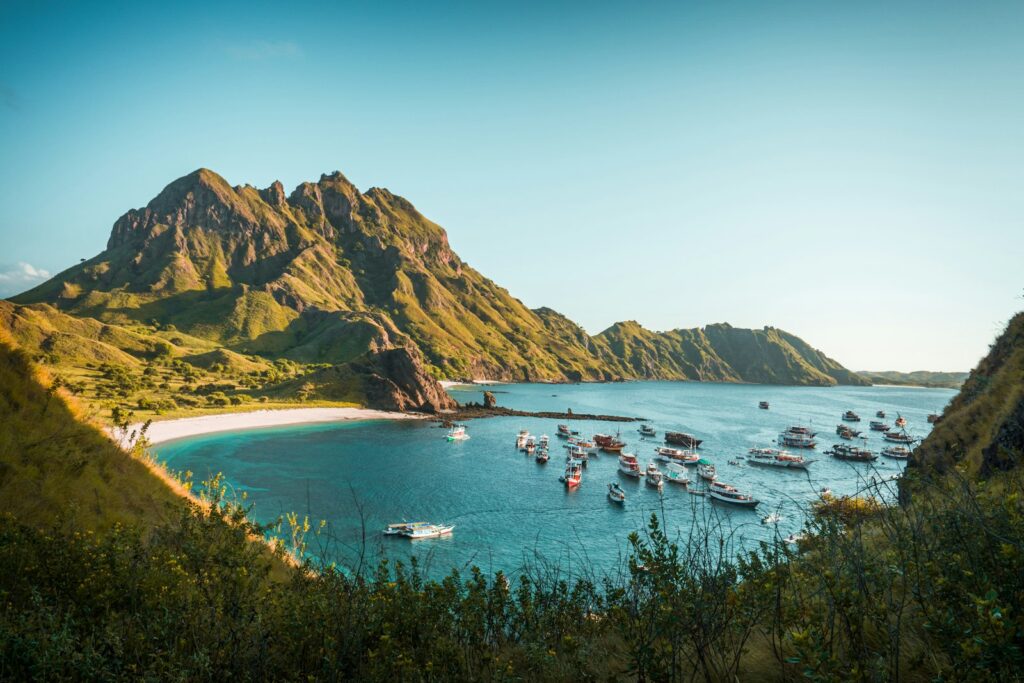
Komodo National Park fees and tickets for phinisi passengers are made up of several separate charges—park entrance, marine and dive levy, ranger trekking fee, and a conservation component—that together typically add up to roughly IDR 600,000–1,200,000 per person on a standard 3D2N or 4D3N charter as of 2026. No single “all-in” ticket exists. Each component is collected differently, and if you book a phinisi without understanding how these layers work, you will arrive at the dock either underprepared with cash or surprised by a charge your operator neglected to mention.
We have worked these waters for years—guiding hikes up Padar’s switchbacks, standing at the Loh Liang ranger desk on Komodo Island in the early morning while the list gets checked, watching the marine fee slip get filled out before guests go over the side at Manta Point. What follows is how it actually works, not how a brochure says it does.
Why Komodo Park Fees Are Not a Single Ticket
Most national parks in the world sell one entrance pass. Komodo National Park does not. The fee structure reflects the park’s dual nature: it is simultaneously a terrestrial wildlife reserve (Komodo dragons on Komodo and Rinca Islands) and a marine protected area (world-class reefs, manta cleaning stations, soft corals at sites like Batu Bolong and Castle Rock). The administrative bodies overseeing land trekking, marine activity, and broader conservation each levy their own charge.
Add weekday versus weekend and public-holiday pricing, a separate domestic versus foreigner tariff, and occasional local tourism levies, and you have a layered system that confuses even experienced travelers. The operator handles most of it on your behalf—but you should know exactly what you are paying for.
The 2026 Fee Components: What Each Charge Covers
All figures below are approximate and in Indonesian Rupiah (IDR). Exchange rates fluctuate; at recent rates, IDR 150,000 is roughly USD 9–10. Park authorities revise tariffs periodically—confirm specifics with your operator in the weeks before departure.
1. Park Entrance Fee (Foreigner vs Domestic)
The core entrance fee grants access to the national park zone for one day. For foreign nationals in 2026, the working figure is approximately:
- Weekday (Monday–Saturday): around IDR 150,000–175,000 per person per day
- Sunday and national public holidays: around IDR 225,000 per person per day
Indonesian citizens pay a substantially lower rate—roughly IDR 5,000–15,000 per person per day at similar tier—which is standard practice across Indonesian national parks. The gap between the foreigner and domestic tariffs is significant, and it is worth being direct about this: it exists, it has always existed, and it funds park operations in a country where conservation budgets are tight relative to the scale of what needs protecting.
If your phinisi trip spans three days inside the park boundary, the entrance fee applies for each day you are within park waters. On a 3D2N itinerary departing Labuan Bajo in the morning, you are typically inside the park for two full days. A 4D3N extends that to three. Some itineraries include a day at Kanawa Island or Kelor Island, which sit closer to Labuan Bajo and outside or at the park edge—your operator will know which stops trigger the fee and which do not.
2. Marine and Dive Fee
Separate from entrance is the marine activity levy, which applies when guests enter the water—snorkeling, freediving, or scuba diving. The approximate range in 2026 is IDR 50,000–100,000 per person per day of water activity. For a trip that includes snorkeling at Pink Beach, a drift past the cleaning station at Manta Point (Karang Makassar), and reef snorkeling at Siaba or Tatawa, you can assume this fee applies on each active day in the water.
Scuba divers may encounter a slightly higher rate or a separate dive permit component depending on the current tariff schedule; confirm with your operator if you are on a dive-focused charter. Operators running certified dive programs keep the paperwork in order as a matter of standard practice—your dive guide will not let you enter the water without the permit sorted.
3. Ranger and Trekking Fee
This is the fee travelers most often forget to account for. Every land trek in Komodo National Park—Padar Island’s viewpoint hike, the dragon-watching walk at Loh Liang on Komodo Island, the circuit at Loh Buaya on Rinca—requires a mandatory official ranger escort. You cannot walk unaccompanied in dragon habitat. The fee covers the ranger’s service for that specific trek and is typically charged per group, with a per-person component or a group minimum.
The practical cash cost per person for ranger fees across a 3D2N trip that includes Padar plus either Komodo or Rinca is roughly IDR 50,000–150,000 per person depending on group size. Smaller groups pay proportionally more because the group minimum is split fewer ways. Larger parties of eight or more spread the cost and often find the ranger fee per head falls toward the lower end of that range.
Rangers are employed by the park authority, not by your phinisi operator. They board at the ranger station—Loh Liang on Komodo Island, Loh Buaya on Rinca—and return when the trek concludes. The crew’s job is to bring you there safely; the ranger’s job is to know the terrain, read the dragon’s body language, and position the group correctly. Both matter.
4. Conservation and Local Tourism Levy
A smaller, variable conservation or local tourism levy rounds out the fee stack. This covers broader park management, marine patrol, and waste removal programs. The amount varies—IDR 10,000–50,000 per person per visit is a reasonable working estimate—and is sometimes bundled administratively with the entrance or marine fee by the operator rather than itemized separately on your bill. Ask your operator how they handle this component.
Weekday vs Weekend Komodo Park Fee: Does It Matter for Phinisi Planning?
Yes, and more than most travelers realize. If your 3D2N trip includes a Sunday inside the park, expect the entrance fee for that day to run roughly 30–50% higher than a weekday. On a boat of eight guests, that differential adds up. When you are working with a fixed trip budget, scheduling your main park days on weekdays is a small optimization that costs nothing.
High season (July–August) packs both weekend boats and weekday boats into the same anchorages. Padar at sunrise on a Saturday in August has dozens of vessels—the fee does not change the crowd, but your operator can sometimes steer toward Wednesday or Thursday departures that give you weekday rates on the main park days while keeping the itinerary identical.
The Fee Hike That Did Not Happen: Clearing Up the 2022 Confusion
In 2022, the Indonesian government proposed a dramatic increase in Komodo National Park entrance fees for foreigners—a figure of around IDR 3,750,000 per person (approximately USD 250 at the time) as a bundled annual conservation pass. The proposal triggered immediate protests in Labuan Bajo, with local boat operators, guides, and tourism workers arguing it would price out the mid-market entirely and collapse livelihoods built over decades.
The mega-hike was postponed and, for practical purposes, cancelled. The park reverted to the existing lower tariff structure. As of 2026, there is no evidence that the IDR 3.75M fee was implemented. If you read articles from late 2022 quoting that figure, they reflect a proposal that did not proceed—not the current reality. We flag this because that number still circulates in blog posts and forum threads and causes genuine confusion.
That said, park authorities retain the right to revise tariffs. We always recommend your operator confirm the exact figures in the month before your departure.
Fee Summary Table: 3D2N and 4D3N Phinisi Trips
The table below consolidates the approximate per-person fee stack for foreign nationals in 2026. These are working estimates for planning purposes—not officially fixed figures.
| Fee Component | Approx. Per Person / Day (IDR) | Days Applied (3D2N) | Days Applied (4D3N) | 3D2N Estimate (IDR) | 4D3N Estimate (IDR) |
|---|---|---|---|---|---|
| Park entrance (foreigner, weekday) | 150,000–175,000 | 2 | 3 | 300,000–350,000 | 450,000–525,000 |
| Park entrance (foreigner, Sunday/holiday premium) | 225,000 | If applicable | If applicable | +50,000–75,000 per Sunday day | +50,000–75,000 per Sunday day |
| Marine / dive activity fee | 50,000–100,000 | 2 | 3 | 100,000–200,000 | 150,000–300,000 |
| Ranger / trekking fee (per group, split) | 50,000–150,000 (variable by group size) | 1–2 treks | 1–3 treks | 50,000–150,000 | 75,000–200,000 |
| Conservation / local levy | 10,000–50,000 | 1–2 | 1–3 | 20,000–100,000 | 30,000–150,000 |
| Estimated Total (foreign national) | — | — | — | ~IDR 570,000–800,000 | ~IDR 705,000–1,175,000 |
The practical budgeting range operators quote—IDR 600,000–1,200,000 per person for a 3D2N or 4D3N trip—reflects these layers plus a small buffer for variance in group size and day-of-week. It is a reasonable planning figure.
Who Pays Komodo Park Fees on a Phinisi—and How
This question comes up in every pre-trip briefing. The short answer: your operator collects the money from guests and pays the fees at each ranger station or park checkpoint as the trip progresses. You do not individually queue at a ticketing window.
In practice, most operators either:
- Include fees in the charter price (less common, usually clearly stated as “all-inclusive”), or
- Collect fees separately in cash from guests at or before boarding, then handle all payment to the park on your behalf throughout the trip.
Cash is the dominant payment method at park checkpoints. Carry IDR. Some boats collect the full estimated fee amount upfront on Day 1; others itemize as each stop is reached. Ask your operator before you board which system they use and whether they carry float cash on your behalf or expect exact amounts from guests.
The captain and crew have long-standing relationships with the rangers at Loh Liang and Loh Buaya. The administrative process at the dock takes minutes when it is well-organized. Where it sometimes gets slow is when a group of twelve guests with different amounts of cash are all trying to sort themselves out on a narrow gangway at 6:30 in the morning. Pre-organize your fee cash the night before.
At Phinisi Atlas, we pre-arrange and fully itemize all park fee components before you board—so you know the exact cash to carry and there are no surprises at the ranger station. Reach us on WhatsApp for a per-trip fee breakdown matched to your specific itinerary, dates, and group size.
Fees at Individual Park Sites: What You Will Encounter
Komodo Island (Loh Liang)
The main entry point on Komodo Island, where the senior rangers are stationed, is Loh Liang. The boat anchors in the bay and guests are ferried ashore by tender. Rangers are assigned here; the trek options range from a short loop that takes under an hour to longer trails covering more of the island interior. Dragon sightings near the ranger station itself are common—the animals are habituated to the area and sometimes rest in the shade of the visitor buildings. The entrance and ranger fees are paid or confirmed at this checkpoint.
Rinca Island (Loh Buaya)
Rinca’s ranger base at Loh Buaya has the reputation—deserved, in our view—for more reliable dragon encounters in the open than Komodo Island in peak season. The mangrove walk near the jetty is where females are often seen in the late morning. The same fee structure applies as at Komodo Island. Some 3D2N itineraries include Rinca rather than Komodo Island, or both, depending on the route and available time.
Padar Island
Padar is included within the national park boundary. The hike to the summit viewpoint—commonly described as around 800 steps, though the actual count varies with the trail condition—requires ranger accompaniment. The payoff is the panorama of three bays with contrasting sand colors: black, white, and the pink-tinged cove below the southern ridge. The ranger fee here covers the summit trek. Most phinisi operators time this for pre-dawn departure to catch the sunrise, which means rangers are on the boat or waiting at the landing before first light.
Manta Point (Karang Makassar)
There is no ranger station at Manta Point—it is a shallow seamount and cleaning station in open water. The marine activity fee covers snorkeling here. Reef mantas (Mobula alfredi) with wingspans up to four or five meters circle the cleaning station at five to fifteen meters depth. The standard instruction is to stay at the surface and drift with the current; diving toward them or cutting off their cleaning circuit scatters the group. At least three meters of clearance from the animals is the accepted minimum—park guidelines may state further. Your crew will brief you before entry.
Pink Beach
Pink Beach (Pantai Merah) on Komodo Island gets its color from the crushed shells of Foraminifera—microscopic organisms with red-pigmented tests—mixed into the white sand. The marine fee covers snorkeling from this beach. The reef directly offshore is a mix of hard corals and rubble; the best snorkeling is to the right of the main beach looking out to sea. Park rules prohibit collecting sand, shells, or coral. This is enforced.
Fees vs What They Fund: The Conservation Argument
It is reasonable to ask whether park fees are well spent. Komodo National Park is a UNESCO World Heritage Site and Marine Protected Area covering roughly 1,733 square kilometers of land and sea. The fee revenue funds ranger salaries, patrol vessel operations, waste management (removing plastic from anchorages and beaches), trail maintenance, and ongoing Komodo dragon population monitoring. The ~3,000 dragons distributed across Komodo, Rinca, Gili Motang, and Nusa Kode are not self-maintaining in a system under this level of visitor pressure without active management.
The marine conservation fee specifically funds patrol enforcement against illegal fishing and dynamite fishing—both of which still occur on the park’s perimeter. The reefs phinisi passengers snorkel at are in far better condition than comparable sites in Indonesia without this kind of active protection. From the water, you can see the difference.
That is not an argument to accept opaque or arbitrary fee increases. It is context for understanding what the charges are actually buying.
Practical Checklist: Park Fees on a Phinisi
- Ask your operator before boarding: are park fees included in the charter price, or collected separately in cash?
- If cash collection: how much IDR per person should you carry? Get the exact figure, not an estimate.
- Carry IDR in mid-denomination notes (IDR 50,000 and IDR 100,000). Rangers at Loh Liang and Loh Buaya do not always have change for large notes.
- If your itinerary includes a Sunday, budget the higher entrance fee for that day.
- Confirm whether ranger fees for Padar, Komodo, and Rinca are included in the operator’s fee estimate or charged additionally at each stop.
- For scuba divers: confirm the marine fee schedule for dive days specifically.
- Verify figures with your operator in the month before travel—tariffs are subject to revision.
Ready to get the exact fee breakdown for your specific itinerary, travel dates, and group size? Plan your charter with us and we will itemize every park fee component before you confirm. We also handle pre-trip WhatsApp briefings for guests who want to arrive at the harbor with everything sorted.
Frequently Asked Questions
Are Komodo National Park entrance fees included in my phinisi charter price?
Usually not. Most phinisi operators in Labuan Bajo price their charters excluding national park fees, which are then collected from guests in cash and paid to park rangers at each stop. Some higher-end all-inclusive charters do bundle fees into the quoted price—always confirm in writing before booking. If an operator’s price includes fees, verify the breakdown so you know what is covered and for how many days.
How much cash in IDR should I bring specifically for park fees on a 3D2N trip?
Budget approximately IDR 700,000–900,000 per person for a foreign national on a standard 3D2N itinerary covering Padar, Komodo or Rinca, Pink Beach, and Manta Point on weekdays. Add IDR 50,000–75,000 if any park day falls on a Sunday or public holiday. Bring the cash in IDR 50,000 and IDR 100,000 notes—ranger checkpoints do not reliably carry change for large denominations.
Do children pay the same Komodo National Park entrance fee as adults?
Children under a certain age are often charged a reduced or waived entrance fee under the domestic tariff structure, but foreign children typically still pay the foreigner rate or a reduced version of it. The exact child tariff is not always clearly published and can vary by ranger station. Ask your operator to confirm the current child rate when planning a family trip—it is not always the same as the adult foreigner fee.
What was the IDR 3.75 million Komodo fee and is it in effect?
In 2022, the Indonesian government proposed raising the park entrance fee for foreigners to approximately IDR 3,750,000 per person as an annual conservation pass—roughly USD 250 at the time. The proposal was met with strong opposition from Labuan Bajo’s tourism community and was postponed, then effectively cancelled. It was not implemented. As of 2026, the park operates on the prior lower fee structure. If you encounter that figure in older travel articles or forum posts, it describes a proposal that did not proceed.
Can I pay Komodo National Park fees by credit card or digital transfer, or is it cash only?
Cash remains the standard payment method at park ranger checkpoints. Loh Liang on Komodo Island and Loh Buaya on Rinca do not reliably accept card payments. Some operators collect fees digitally from guests during pre-trip communication and then pay the park in cash on their behalf—but the end transaction at the checkpoint is almost always cash. Bring IDR in physical notes. Your operator will specify exactly how much and in what format when they confirm your booking details.