A Labuan Bajo phinisi sailing to Komodo Island to see Komodo dragons is, in practical terms, a multi-day liveaboard trip aboard a traditional Indonesian wooden vessel that departs the harbor town of Labuan Bajo and threads through Komodo National Park — a UNESCO World Heritage Site and Marine Protected Area — stopping at Komodo Island itself along with a rotating cast of reef, beach, and viewpoint sites. The phinisi is the vessel type of choice because no road connects these islands; the sea is the only highway, and an overnight liveaboard lets you reach sites before day-trip speedboats and stay until the afternoon crowds clear.
What that route actually contains, stop by stop, is where most travelers arrive with only vague ideas. They know there are dragons. They know there is a pink beach. They may have seen the Padar panorama on a phone screen. But the texture of each place — the logistics, the physical demands, the honest wildlife odds, the snorkeling realities — rarely reaches them before they board. This page fixes that. Consider it a site-by-site briefing for anyone planning a serious phinisi charter through the park.
Padar Island: The Panorama That Earns Its Reputation
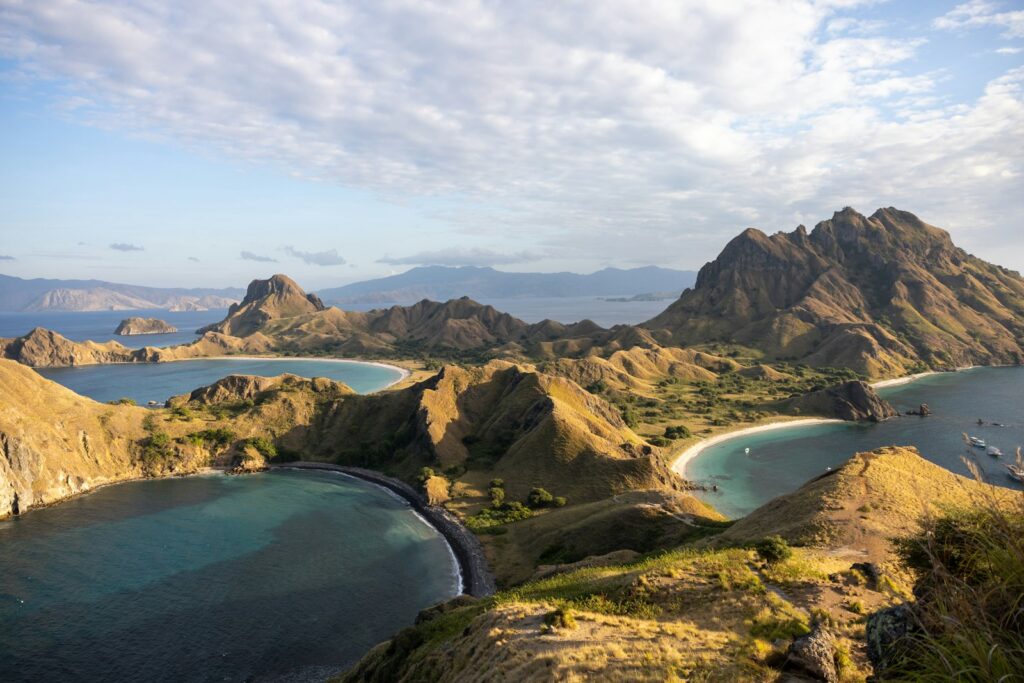
Every 3D2N and 4D3N route through Komodo National Park puts Padar first, and for defensible reasons. The viewpoint at the island’s central ridge delivers something genuinely rare: three bays in a single frame, each carrying a different colored beach — one black volcanic sand, one white coral sand, one with a pink-tinged shoreline. No photograph, however widely shared, quite prepares you for the scale of it when you arrive at the summit and turn around.
Getting there requires effort. The trail from the beach to the ridge covers roughly 800 steps — some published figures land between 700 and 900, but 800 is the number most operators and guides use. The lower section is a loose stone path that catches heat fast; the upper section turns steeper, with exposed ridgeline. Allow 45 minutes to an hour for the ascent if you move at a thoughtful pace. Flip-flops are not appropriate footwear. Most phinisi anchor off Padar before dawn for a sunrise hike, which means you leave the boat in darkness, the cooler pre-dawn air working in your favor before the sun crests the ridge.
Padar has no Komodo dragons, worth knowing — the island’s deer population collapsed years ago, eliminating the prey base. Rangers are still present at the entry point and the trek is ticketed as part of the park fee structure. Most operators build this into the itinerary as a morning stop, with the boat moving to the next site while guests eat breakfast on deck.
Pink Beach: The Sand Explained Honestly
Pink Beach — Pantai Merah in Indonesian — sits on the northern coast of Komodo Island. The pink coloration is real, not a filter or a marketing choice. The sand gets its hue from crushed shells of Foraminifera, single-celled marine organisms whose red-pigmented shells break down and mix with the white coral sand over time. The shade varies meaningfully depending on the light. Early morning, when the sun is still low and the sand is damp from high tide, it reads a more saturated terracotta-rose. By midday, bleached by direct overhead sun, it lightens considerably. If the Foraminifera pink is the specific reason you’re coming, plan your beach time for the first hour after arrival, not after lunch.
The snorkeling directly off the beach is the other draw. The reef starts close — within 50 to 100 meters of the shoreline — and the shallow sections hold healthy coral garden and a reliable mix of reef fish. Currents here are generally mild by Komodo standards, making Pink Beach one of the more accessible snorkel sites in the park for guests with limited experience. It will not challenge an advanced diver, but it is genuinely pretty and appropriate for the entire boat. The beach itself is narrow and partially shaded by tree cover at one end.
One candid note: Pink Beach is on most standard itineraries, which means it draws significant boat traffic during peak season (July through September). If you are on a private charter with a flexible itinerary, arriving in mid-afternoon — after the majority of day-trip groups have departed — will give you a materially quieter experience.
Komodo Island and Loh Liang: Dragon Trekking on the Main Stage
Komodo Island is where the largest concentration of visitor infrastructure sits within the park. The main ranger station and entry point is called Loh Liang, and all trekking on the island departs from here under mandatory ranger escort. You cannot walk the trails unaccompanied — that rule is enforced, not just recommended, and it reflects the genuine danger of proximity to an animal that can run at short bursts and whose saliva and oral bacteria make even a minor bite potentially life-threatening.
The park holds an estimated 3,000 Komodo dragons (Varanus komodoensis) across Komodo Island, Rinca Island, Gili Motang, and Nusa Kode; the total cited in most current park documentation falls between 2,500 and 3,000 plus. Adults reach around 3 meters in length and 70 kilograms or more. They are ambush predators, patient and cryptic, and they move with deceptive speed when motivated. Rangers carry a forked wooden staff — less a weapon than a visual deterrent and a tool to redirect a dragon’s trajectory if it decides to investigate your legs.
Three trek lengths are typically offered at Loh Liang: a short loop (around 1 kilometer, 30–45 minutes), a medium trek, and a long route that covers more of the island’s interior ridge. The short loop reliably passes the area near the ranger station where dragons habitually rest in the shade, particularly around the kitchen waste area where they are drawn by scent. Sightings on the short loop are genuinely consistent, not guaranteed but close. The longer routes offer more depth, some altitude, and better chances of encountering deer, wild horses, and occasionally a dragon in a less staged context.
Ranger and park fees apply per person for each landing and trek; your operator should manage the paperwork, but confirm this in advance and bring IDR cash as backup.
Rinca Island and Loh Buaya: The Quieter Dragon Encounter
Rinca Island’s main ranger station, Loh Buaya, sits closer to Labuan Bajo — roughly 2 to 3 hours by phinisi versus 4 to 5 hours to reach Komodo Island’s Loh Liang, depending on conditions and vessel speed. That proximity makes Rinca the default dragon stop on tighter 2D1N and shorter 3D2N itineraries, and many experienced guides prefer it for reasons beyond logistics.
Rinca tends to attract fewer day-trip groups than Komodo Island at peak season. The ranger station sits in a drier, more open landscape — a combination of savannah and dry monsoon forest — and the dragons at Loh Buaya are habitually present around the kitchen and ranger accommodation, sometimes in larger numbers and in more active postures than their Komodo Island counterparts. The island also has a denser population of water buffalo and long-tailed macaques, which can add a wildlife-watching dimension to the walk that Komodo Island’s more forest-heavy terrain sometimes obscures.
Some luxury charter operators run both islands on a 4D3N — dragons on Rinca on the way out, a Komodo Island trek before the return — which gives guests a genuine comparison of habitats and ranger styles. If your itinerary lists only one dragon stop, ask specifically whether it is Rinca or Komodo. The experience differs, and the distinction is worth knowing before you book.
Manta Point and Karang Makassar: The Best Snorkeling in the Park
Manta Point — more precisely named Karang Makassar on nautical charts — is a shallow submerged reef on the southern edge of Komodo Island where reef manta rays (Mobula alfredi) gather at a cleaning station. The cleaning station dynamic is the key: smaller wrasse and cleaner fish remove parasites from the mantas’ skin and gills, and the mantas are drawn reliably to the site across most months of the year, circling slowly at depths of roughly 5 to 15 meters.
Reef mantas here can reach wingspans of 4.5 to 5 meters — large enough that you feel their displacement in the water as they pass overhead. They do not avoid snorkelers in the way that spooked pelagic animals do; they are focused on the cleaning process, not you. That said, responsible engagement matters: park codes call for keeping at least around 3 meters of distance, not swimming directly above or below a manta, and never chasing one or attempting to touch it. Those rules exist because harassment disrupts the cleaning behavior that makes the site worth visiting.
Currents at Karang Makassar range from gentle to strong depending on tidal phase; your captain and crew will know the windows. Manta sightings are not guaranteed — no honest operator should tell you otherwise — but on-site odds during dry season (May through October) are strong enough that most guests on a 3D2N or longer charter encounter them. The manta season has two peaks: a primary window roughly May through September and a secondary pulse around September through November as northern migrations pass through. Outside those windows, sightings drop but do not disappear entirely, as the reef manta population here is resident rather than strictly migratory.
For divers, Karang Makassar is a relatively accessible site. For snorkelers, it is arguably the single best wildlife encounter the park offers from the surface.
Kelor Island: The Easy First Stop
Pulau Kelor sits close enough to Labuan Bajo that many itineraries use it as the afternoon warm-up stop on Day 1 — a practical choice that lets guests get comfortable in the water and shake off travel fatigue before the boat moves into deeper park territory overnight. The island is small and conical, covered in dry grass, with a short steep hill that most guests climb in 10 to 15 minutes to reach a viewpoint over the bay. The view is modest by Padar standards but satisfying for the effort it costs.
The real reason Kelor matters is its fringing reef. Snorkeling starts immediately off the beach — drop in from the stern of the tender and the coral is under you within meters. The reef is shallower and more protected from open-ocean current than sites deeper in the park, making it a good place for first-time snorkelers to calibrate their gear and comfort level. On a 4D3N itinerary with more time to spend, Kelor is a relaxed afternoon; on a rushed 2D1N, it gets cut.
Kanawa Island: Shallow Reefs and a Half-Day Rhythm
Kanawa Island lies roughly 10 to 15 kilometers offshore from Labuan Bajo, accessible in about 45 to 60 minutes by boat. It is more developed than Kelor — there is a small resort on the island with bungalows and a dive shop — but the phinisi experience here is purely the surrounding reef and the beach.
The house reef runs from 1 to 2 meters off the beach and drops to 5 to 10 meters, with a diverse mix of hard and soft coral and strong populations of juvenile fish. The shallower sections make it particularly well-suited for guests snorkeling with young children or guests who are uncomfortable in open water. Deeper on the reef slope, turtles are a common sighting, and the fish diversity — parrotfish, surgeonfish, butterflyfish, the occasional reef shark at the drop-off — holds up well compared to more heavily trafficked sites. Some itineraries finish at Kanawa on the return leg, timing the stop to align with a late-afternoon swim before the final sail back to Labuan Bajo.
Taka Makassar: A Sandbar That Appears and Disappears
Taka Makassar is one of those places that photographs identically across every account of the park: a crescent of white sand, impossibly thin, surrounded by turquoise water that shifts through four shades from shore to deep. The defining characteristic of the sandbar is that it is tidal. At low tide it expands to a walkable strip that you can traverse end to end in a few minutes. At high tide, significant sections submerge entirely — you wade knee-deep where you were standing dry an hour earlier.
This tidal rhythm is not a problem; it is the point. A good captain times the anchor here to catch the low-tide window. Most charter guests spend 30 to 60 minutes wading, swimming, and doing what the site was made for: standing in shallow warm water surrounded by nothing but open sea. The snorkeling off the sandbar’s edges can be decent in calm conditions, though Taka Makassar is not a marquee dive site. Its value is entirely experiential — a moment of spaciousness in a park full of activity — and a 4D3N itinerary handles it better than a rushed 3D2N, simply because the pacing allows you to be still for a while.
Kalong Island: Sunset Bats and Overnight Anchorage
Kalong means bat in Indonesian, and Pulau Kalong earns the name. At dusk, a colony of large flying foxes — fruit bats with wingspans considerably wider than a human hand — lifts from the mangroves in a streaming exodus that can last twenty minutes or more. Estimates of the colony size range from several thousand to over ten thousand individuals; whatever the precise count, the visual effect when they funnel out against a Flores sunset sky is one of those genuinely disorienting natural spectacles that travel writing tends to over-describe. See it from the deck of a phinisi at anchor, with a drink in hand, and form your own opinion.
Kalong appears on standard 3D2N itineraries as the sunset-into-dinner anchorage at the end of Day 1 or Day 2, giving the boat a protected overnight spot before the next morning’s early departure. It is not a snorkeling or hiking stop; it is a transition moment that the itinerary uses well. The mangroves at the island’s edge are worth noting as marine nursery habitat — a reminder that the ecology of this park extends well beyond the charismatic megafauna.
Park Fees, Ranger Costs, and What to Budget
Every operator in Labuan Bajo excludes Komodo National Park fees from their headline price. That is not concealment — it reflects the fact that fee structures are set by the park authority and are subject to change, and the per-person cost depends on how many sites you visit and whether your trip falls on a weekday or a weekend or public holiday.
- Park entrance fee (foreign national, per person per day)
- Approximately IDR 150,000–200,000 (weekday / Sunday-holiday brackets vary)
- Marine/dive-snorkel fee (per person per day)
- Approximately IDR 50,000–100,000
- Ranger/guide fee for dragon trek
- Group-based ranger charge, typically split per head; plus a per-person trekking component of roughly IDR 50,000–100,000 depending on trek length
- Practical total for a 3D2N or 4D3N trip
- Budget approximately IDR 600,000–1,200,000 per person for combined park, marine, and ranger fees. Bring IDR cash — card payments are not reliable at park ranger stations.
- Important caveat
- Fee structures are revised by Indonesia’s Ministry of Environment and Forestry on irregular schedules. The significant proposed hike to approximately IDR 3.75 million per person (around $250 USD) that circulated in 2022 was shelved following public and industry pushback and was not implemented as of 2024–2026 — but confirm current figures with your operator close to your travel date.
How Each Stop Fits Into a Route
The stops above do not all appear on every itinerary. The route your boat takes depends primarily on duration, and on whether a private charter’s guests want to weight the experience toward wildlife, snorkeling, hiking, or some combination. Here is how the distribution typically works:
| Stop | 2D1N | 3D2N | 4D3N | Primary Activity |
|---|---|---|---|---|
| Padar Island | Yes | Yes | Yes | Sunrise hike, viewpoint photography |
| Pink Beach | Yes | Yes | Yes | Swimming, snorkeling, beach time |
| Komodo Island (Loh Liang) | Sometimes | Yes | Yes | Ranger-led dragon trek |
| Rinca Island (Loh Buaya) | Yes (often instead of Komodo) | Yes (often instead of or in addition to Komodo) | Both possible | Ranger-led dragon trek |
| Manta Point / Karang Makassar | Unlikely | Yes | Yes | Snorkeling or diving with mantas |
| Kelor Island | Often Day 1 afternoon | Yes | Yes | Easy snorkeling, short viewpoint hike |
| Kanawa Island | No | Sometimes | Yes | Reef snorkeling, relaxed beach stop |
| Taka Makassar | No | Sometimes | Yes | Sandbar wading, photography |
| Kalong Island | Sometimes | Yes | Yes | Sunset bat exodus, overnight anchorage |
Private charters have the meaningful advantage here: you can negotiate the sequence, cut a site you have no interest in, and request stops at less-trafficked reefs or anchorages that open-trip boats rarely visit. On a shared open-trip phinisi, the route is fixed and shared with eight or more strangers. That is a genuine tradeoff, not a trivial one, and it is worth naming before you commit to a booking format.
If you want help matching these stops to a specific itinerary or duration, our planning team works through the site options with each traveler individually. Plan your charter with us, or reach us directly via WhatsApp — we keep the conversation factual and pressure-free.
Conservation Conduct Across All Sites
Komodo National Park’s rules for visitor conduct are not guidelines; they are enforced conditions of access. A few that directly govern behavior at the sites above:
On land: stay with your ranger at all times in dragon habitat. Do not approach dragons closer than the ranger directs, do not feed any wildlife, and do not attempt to photograph a dragon by stepping off the designated path for a better angle. The animals’ camouflage is effective in dry brush and their acceleration is faster than most people expect.
In the water: no touching corals or marine creatures. Keep the recommended distance from manta rays — at least around 3 meters, without positioning yourself directly above or below them, and without pursuing one that moves away. The cleaning-station dynamic at Karang Makassar depends on the mantas choosing to return repeatedly; repeated harassment over time degrades the site for everyone.
At anchor: responsible operators use mooring buoys wherever provided and do not drop anchor on live coral. Ask your operator directly whether their fleet moors on buoys at Manta Point and Pink Beach — a simple question that tells you something real about how they operate.
Planning Your Route: A Note on Timing
The dry season running from approximately April through October is the operative window for most of what is described above. May and June offer green islands after the wet season with relatively thin crowds. July through September is peak: maximum visibility underwater (often 20 to 30 meters), consistently calm anchorages, and Padar’s vegetation at its dry golden-brown best for photography — but also the highest boat density and the highest prices. October into early November is genuinely good: crowd levels drop, manta activity remains strong, and the sea is still calm enough for confident passage.
January and February are the roughest months. Heavy rain, short sharp seas, and reduced underwater visibility are reliable enough that some operators reduce sailings to weekends-only or suspend them entirely in February. If your travel dates are fixed in the wet season and you are committed to the trip, a larger, more stable vessel and a realistic adjustment of expectations on photography days are both prudent preparations.
How many days do I actually need to see Komodo dragons AND snorkel well?
Three days and two nights is the minimum that does both without rushing. A 2D1N trip can technically include a dragon trek on Rinca and one or two snorkel stops, but the pace is compressed enough that you spend much of it moving rather than being somewhere. Four days and three nights adds a more humane rhythm — a proper morning hike, a full afternoon at Manta Point, time to actually sit on Taka Makassar at low tide — and is the duration most experienced guides recommend for guests who want to engage with the park rather than tick sites off a list.
What is the difference between a Komodo Island dragon trek and a Rinca trek?
Both islands use mandatory ranger escorts, both hold healthy dragon populations, and both offer short, medium, and long trek options. The main practical differences are distance from Labuan Bajo (Rinca is closer, roughly 2–3 hours by phinisi), visitor volume (Rinca tends to quieter at peak season), and habitat character (Rinca is more open savannah; Komodo Island has more dry forest and ridge terrain on the longer routes). Some 4D3N charters include both; a 3D2N typically chooses one. Either visit provides a genuine, ranger-supervised encounter with the world’s largest living lizard.
Is Manta Point snorkeling or only for divers?
Snorkeling is entirely appropriate at Karang Makassar, and it is the way most phinisi guests experience it. The reef mantas circle at cleaning depths of roughly 5 to 15 meters, but they frequently come to within 3 to 4 meters of the surface — close enough to observe clearly from above. Currents at the site can be strong depending on tidal timing, so non-swimmers or guests with limited ocean experience should discuss conditions with the crew before entering. On a calm incoming tide, the site is accessible to confident beginner snorkelers. Divers get a more prolonged and intimate encounter at depth, but they do not see dramatically more mantas than snorkelers do.
Are park fees included in the phinisi price?
Almost never, and not by convention or operator negligence — park fees are set and collected by the national park authority, not the charter operator, and they fluctuate. The practical expectation for a 3D2N or 4D3N trip is approximately IDR 600,000–1,200,000 per person for combined park entrance, marine activity, and ranger fees, payable in IDR cash at ranger stations. Your operator should handle the paperwork; you should bring the cash. Verify the current fee structure with your operator in advance, as the figures above reflect conditions through 2024–2025 and are subject to revision.
Can I visit all these sites on a single phinisi trip?
Not all in three days — the full list above (Padar, Pink Beach, Komodo, Rinca, Manta Point, Kelor, Kanawa, Taka Makassar, Kalong) represents roughly five or six days of relaxed sailing. A 3D2N trip covers five or six stops well; a 4D3N covers seven or eight at a pace that does not feel rushed. Private charter guests can prioritize and sequence; open-trip passengers sail a preset route. The clearest advice is to decide in advance whether dragons or underwater life is your primary priority, tell your operator, and let the itinerary be built around that hierarchy rather than trying to fit everything into a compressed window.
When you are ready to map specific stops against dates, vessel tiers, and realistic budget, plan your charter through our concierge — or start the conversation on WhatsApp for a faster back-and-forth on what the park actually looks like during your travel window.