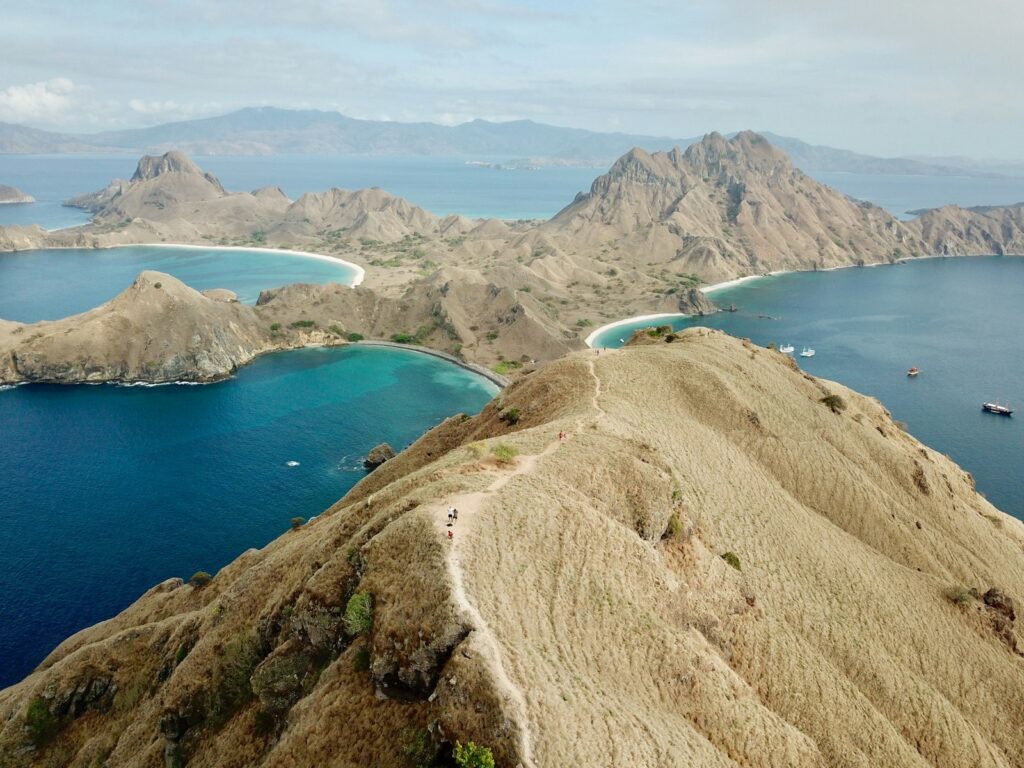
An open trip phinisi in Labuan Bajo is a shared-boat charter where individual travelers purchase a cabin berth — or sometimes just a bunk — on a fixed-departure vessel sailing through Komodo National Park, rather than booking the whole boat. For solo travelers, couples, and anyone who prefers splitting costs across strangers, it is the most accessible way to spend two or three nights at sea among the Flores islands. It is also, if you pick the right boat, one of the more genuinely social experiences Indonesia has to offer.
That caveat matters. Not every open-trip vessel delivers the communal atmosphere the format promises. Boat quality, group composition, and operator attitude vary enormously — and the difference between a trip you describe to friends for years and one you endure for three days can come down to details you could have checked before you booked. This guide covers the social mechanics, the practical realities, and the vetting questions worth asking.
What Open Trip Actually Means Here
In the Labuan Bajo market, open-trip operators fill a fixed number of cabin berths — typically six to twelve passengers across three to six double-cabins — then depart on a pre-set schedule regardless of whether every spot is sold. You are buying a seat, not the boat. The itinerary is set in advance; you agree to it when you book, and the captain runs it for the whole group.
This is different from a private charter, where a group hires the entire vessel and can negotiate stops, meal preferences, and departure times. On an open trip, you trade flexibility for price. Depending on boat quality and whether park fees are bundled, shared-cabin berths currently run roughly $100–250 per person per day (2026 market rates, quoted here as ranges — verify with operators at time of booking). A private luxury phinisi covering the same route costs $1,000–5,000+ per night for the whole boat, so for a solo traveler or couple the open-trip math is obvious.
Who You Actually Meet
The passenger mix on a Labuan Bajo open trip skews heavily international and, at the better-run boats, leans toward independent travelers in their late twenties to early forties — people who have already done Southeast Asia and are specifically here for the diving or the dragons. Europeans make up a reliable core: French, German, Dutch, and British travelers in particular tend to navigate directly to Komodo rather than stopping at package-tour ports. You will also find Australians in consistent numbers (the flight from Darwin is short), and increasingly South Korean and Japanese independent travelers who discovered the park through dive forums and travel media.
What this mix produces on a well-run boat is something close to an instant expedition crew. By the end of day one — after a shared sunrise hike up the roughly 800 steps to the Padar Island viewpoint and a communal breakfast back on deck — the social ice is usually long gone. Shared physical experience accelerates introductions in a way a hostel common room never does.
You will sometimes land a less cohesive group. A boat with four solo travelers, one couple who keeps to themselves, and two friends who only speak to each other can feel oddly fragmented despite the proximity. We have been on both kinds of trip. The single biggest variable, beyond group composition, is how the crew handles the social environment — whether the guides eat with guests, whether the dive briefings invite questions, whether there is a space on deck for people to gather in the evenings.
The Cabin-Sharing Question
Most open-trip phinisi have double-occupancy cabins. Solo travelers are typically assigned a cabin partner by the operator, usually someone of the same gender, or they pay a single-supplement to occupy a cabin alone. On budget boats, the cabins are small — two narrow berths, shared fan, shared bathroom in the passageway — and there is no illusion of privacy. On better boats, the cabins are still compact but have en-suite bathrooms, individual air conditioning, and enough storage to keep two people comfortable for three days without negotiating over floor space.
It is worth asking, when you book, whether the operator pairs cabin-shares by gender as a default and what the supplement is to go solo. A good operator has a clear policy; a vague answer is a signal about how much advance planning went into the trip overall.
Fixed Departures: The Schedule That Runs the Trip
Open trips run on fixed departure calendars — typically Friday and Monday departures for the popular 3-day/2-night format, though schedules vary by operator and season. The most common itinerary covers the park’s headline stops: the Kelor Island viewpoint, ranger-led dragon trekking at Rinca Island (Loh Buaya station) or Komodo Island (Loh Liang station), the Pink Beach snorkel (the sand is colored by fragmented Foraminifera shells, not coral — a detail worth knowing before someone tells you otherwise), Manta Point for manta ray encounters, Taka Makassar sandbar, and the bat-island sunset at Kalong. Manta Point is a cleaning station for reef manta rays (Mobula alfredi) in five to fifteen meters of water; the cleaning behavior is reliably present on most dry-season trips but is weather and current-dependent, not guaranteed.
Because the schedule is fixed, there is no negotiating a later departure if you sleep through your alarm, and there is no skipping a stop because half the group is seasick. Both of these things happen. The dry season window — roughly May through October, with July through September as the busiest period — gives the calmest seas and best underwater visibility (generally 20–30 meters at the reef sites). The wet season, particularly January and February, brings real waves; open trips still run but the itinerary can be compressed, and a significant minority of passengers discover they are more susceptible to motion sickness than they expected.
- Most popular duration
- 3 days / 2 nights (3D2N) — covers Padar, Komodo or Rinca, Pink Beach, Manta Point, Kalong
- Shorter option
- 2 days / 1 night (2D1N) — compressed highlights; achievable but rushed at most stops
- Longer option
- 4 days / 3 nights (4D3N) — adds weather buffer, more reef stops, second sunrise anchorage
- Typical departure point
- Pelabuhan Labuan Bajo (main harbor); most operators include hotel pickup
- Recommended arrival into Labuan Bajo
- Morning of departure day; flights from Bali (Denpasar) take approximately 1 hour 10 minutes to 1 hour 25 minutes
- Park fees
- Almost always charged separately; budget approximately IDR 600,000–1,200,000 per person for a 3D2N/4D3N trip (foreign visitor, 2026 approximate — verify at booking as fees are periodically revised)
The Social Architecture of a Phinisi
A traditional phinisi is a two-masted wooden sailing vessel rooted in the boatbuilding traditions of the Bugis, Makassar, and Konjo peoples of South Sulawesi — the craft was inscribed on UNESCO’s Representative List of Intangible Cultural Heritage of Humanity in 2017. The hull design, built from tropical hardwoods like ironwood and teak, gives the boat a silhouette that is immediately distinctive on the water. For a shared trip, the layout is as important as the heritage.
On most open-trip phinisi, the functional social spaces are: the main deck (where meals happen, where the dive briefing happens, where the group congregates between stops), the sun deck above the cabin level (where people read, apply sunscreen, and debrief the morning’s snorkel), and the bow (where, inevitably, someone is always sitting at anchor watching the light on the water). The communal nature of these spaces means that introverts on a three-day trip should plan for real social density — there is no room to disappear. That is not a complaint, just a description.
Meals are served communally, typically at a long table on the main deck. On better boats, the chef produces genuine Indonesian cooking — fresh fish grilled on charcoal, sambal, steamed rice, vegetable dishes — and meals become a natural anchor point for conversation. On budget boats, food quality is more variable; the question worth asking at booking is whether the chef is a permanent crew member or a rotating contractor.
Vetting a Good Open-Trip Boat
The open-trip market in Labuan Bajo ranges from well-run, properly equipped vessels with trained guides to boats that are frankly not fit for the conditions in Komodo National Park. The price spread within the open-trip bracket is real, and the differences go beyond cabin comfort.
Questions to Ask Before You Book
Ask the operator these directly — a well-run operation answers all of them without hesitation:
- How many passengers maximum on this departure? A boat with six cabins taking twelve passengers will feel different from one taking eight. Smaller groups mean more space per person, faster zodiac transfers, and more relaxed snorkel entries.
- Are cabins air-conditioned? In Komodo’s dry season, nights at anchor are warm. Budget boats often have fan-only cabins; AC matters more than some travelers expect until they try sleeping without it in July.
- Do cabins have en-suite bathrooms? This question sorts the market quickly. Budget open trips have shared passageway bathrooms serving multiple cabins; mid-range and above have private bathrooms, which eliminates a meaningful category of morning logistics stress when twelve people are up before sunrise.
- What safety equipment is aboard? Life jackets for all passengers, a VHF radio, flares, and a first-aid kit are baseline. Ask specifically — not just a general assurance that safety is a priority.
- Are park and ranger fees included or separate? This is the most common source of unexpected cost on a Labuan Bajo open trip. Many operators quote cabin price and list fees as extra. Know before you go.
- How is cabin pairing handled for solo travelers? A clear gender-matching policy and a stated single-supplement rate indicates the operator thinks through the passenger experience.
- Who guides the dragon treks? All trekking on Komodo and Rinca islands requires official park rangers — that is non-negotiable. Ask whether the operator’s guide accompanies the group or whether guests are handed off to rangers at the dock with no continuity.
Red Flags Worth Taking Seriously
Evasive answers about passenger counts, no-show websites that show boats but no contact details, operators who cannot tell you which actual vessel is used for a given departure date, and prices significantly below the market floor (below roughly $100 per person per day) all deserve scrutiny. The Labuan Bajo phinisi market has operators who cut costs on maintenance and safety equipment; the consequences in Komodo’s strong currents are not trivial.
If you want guidance on which open-trip boats we have personally evaluated, plan your charter with our concierge — we have inspected boats across the spectrum and can give you specific recommendations based on your dates, group size, and budget.
Open Trip vs. Private Charter: When Does the Math Tip?
For a solo traveler or a couple, the open trip price advantage is substantial. But groups of six or more passengers should run the arithmetic carefully. A private mid-range phinisi chartering at $1,500–2,500 per night split among eight travelers can land at a per-person-per-night cost that overlaps with or beats the open-trip rate — with the added benefits of full itinerary control, no strangers in the mix, and the flexibility to linger at Manta Point for an extra hour if the mantas are performing.
| Format | Typical Per-Person Cost (3D2N) | Group Size | Itinerary Flexibility | Social Mix |
|---|---|---|---|---|
| Budget open trip | $300–450 pp | 8–12 passengers (mixed) | Fixed | Strangers; variable chemistry |
| Mid-range open trip | $500–750 pp | 6–10 passengers | Fixed | Strangers; smaller group, better facilities |
| Private mid-range phinisi (whole boat) | $400–700 pp (split among 6–8) | Your group only | Negotiable | Your people, your pace |
| Private luxury phinisi (whole boat) | $700–1,500 pp (split among 6–8) | Your group only | Fully flexible | Private; highest comfort level |
All figures are approximate, pre-park-fee, and subject to seasonal variation. Verify current rates at booking. Park fees — typically IDR 600,000–1,200,000 per person for a 3D2N trip — are additional in most cases.
The full breakdown of this decision, including the break-even group-size calculation, is covered in our dedicated private charter vs. open trip guide.
What the Social Experience Actually Feels Like
Day one establishes the group quickly. The Padar summit hike, before sunrise, sorts out who talks and who is somewhere else in their head. By the time you are back on deck watching the Padar panorama in the early light — three bays in different sand colors laid out below — the mood on a well-selected open trip tends toward genuine enthusiasm. That enthusiasm carries through the dragon trek at Rinca or Komodo, where the rangers lead the group on foot through dry savannah and you are, genuinely, walking among wild animals that can sprint at speed and have been known to take an interest in slower-moving humans.
Afternoons tend toward quiet. People read on the sun deck, dry out after the snorkel, charge cameras. The gear-swap conversations that start at Pink Beach — "do you have a wider lens?", "who made your wetsuit boots?" — are how half the lasting connections on these trips actually form. Sunset at Kalong Island, watching the large flying-fox colony lift off in waves numbering in the thousands, usually lands the whole boat in a state of collective awe that does not require conversation at all.
Dinner ends late because the chef takes his time. This is not a complaint. Most nights there is wine or Bintang and at least one person has a speaker. The social gradient by day three is the same on every good open trip we have been part of: strangers on the harbor pier, cabin-neighbors who have swapped Instagram handles and dive certifications by the final morning anchorage.
Practical Tips for Getting the Most From a Shared Trip
- Book at least eight weeks ahead in high season (July–September). Reputable open-trip departures fill a month or more out; last-minute availability in peak season usually means either a budget boat or an operator who cannot sell their spots, neither of which is a great sign.
- Bring your own snorkel mask. Rental masks on open-trip boats are shared, poorly fitting, and often fogged. A decent mask bought before arrival costs $25–40 and earns its value on the first snorkel.
- Confirm your travel insurance covers water activities. Komodo’s currents are real. Most standard travel policies cover snorkeling; diving usually requires a specific add-on.
- Pack lightly and bring a soft bag. Phinisi cabins have limited storage. Hard-shell luggage creates genuine logistics problems in narrow passages. A 20–25 liter day pack plus a soft duffel is the correct configuration.
- Prepare for limited connectivity. Cell signal disappears within an hour of leaving Labuan Bajo harbor. This is not a problem to solve — it is part of the value.
- Budget for cash tips. Crew on open-trip phinisi work hard and are paid modestly. A tip of IDR 50,000–100,000 per crew member per day is a reasonable and appreciated gesture; the captain and chef typically receive more.
If you are weighing dates, boats, or whether to book a shared or private departure, our planning team can answer specifics over WhatsApp — fast, no-obligation, and based on actual on-the-water experience with the boats we recommend. Reach out here and we will get back to you within a few hours.
Frequently Asked Questions
Is an open trip phinisi suitable for solo travelers who want to meet people?
Yes — it is genuinely one of the better social travel formats in Southeast Asia for independent travelers. The combination of shared physical experiences (sunrise hikes, group snorkels, communal meals) and the physical intimacy of a 25–35 meter wooden boat accelerates connection in ways that hotel common rooms and hostel bars do not. A well-run boat with a group of eight to ten people produces real friendships with regularity. Solo travelers who are anxious about the social dynamic should look for boats that explicitly market to independent travelers and have positive solo-traveler reviews — these operators actively manage group composition and cabin pairing.
What happens if I book an open trip and the other passengers are difficult to travel with?
It does happen, though less often than anxious pre-trip reading might suggest. The practical reality is that most people who seek out a Komodo open trip are self-selecting for a certain kind of adventurous, low-maintenance attitude. That said, if a group dynamic is genuinely poor, the boat is small enough that there is no escape for three days. This is the strongest argument for choosing a well-vetted operator who curates their passenger mix and runs smaller group sizes (six to eight passengers rather than twelve), and for reading recent reviews specifically about group experience rather than just itinerary coverage.
How much should I budget total for an open trip phinisi in Labuan Bajo?
Start with the cabin price quoted by the operator ($300–750 per person for a 3-night trip depending on boat quality), then add park and ranger fees (approximately IDR 600,000–1,200,000 per person for a 3D2N itinerary — confirm with your operator and verify current rates, as these are periodically revised), round-trip flights from Bali (Denpasar to Komodo Airport, roughly 1 hour 10 minutes; fares vary significantly by booking lead time and airline), one or two nights in Labuan Bajo before and after, gear rental if needed, meals before/after the boat, and tips for crew. An honest all-in budget for a 3D2N mid-range open trip, including flights from Bali, typically lands somewhere between $700 and $1,200 per person.
Can I request a specific cabin or cabin partner on an open trip?
On most well-run operators, yes — within the constraints of what is available. Solo travelers can often request a same-gender cabin partner at booking, or pay a single-supplement (usually 30–50% of the cabin price) to have the cabin alone. Couples are typically assigned to a cabin together automatically. Specific cabin requests — upper deck vs. lower deck, proximity to the bathroom — are worth asking about at booking time; operators who run their trips professionally will either accommodate or explain honestly why they cannot.
What is the best season to book an open trip phinisi to actually meet good people?
The social quality of a trip correlates strongly with the overall caliber of the passenger pool, which in turn correlates with operators who have built a reputation for running serious, well-organized departures. That said, if timing matters: the shoulder windows of April through June and October through November tend to attract experienced independent travelers who planned ahead, while July and August bring the broadest mix including more package-adjacent tourists. February and March see reduced departure frequency and rougher conditions, which concentrates the genuinely committed traveler. Any of these months can produce a great group — the boat and operator matter more than the calendar.