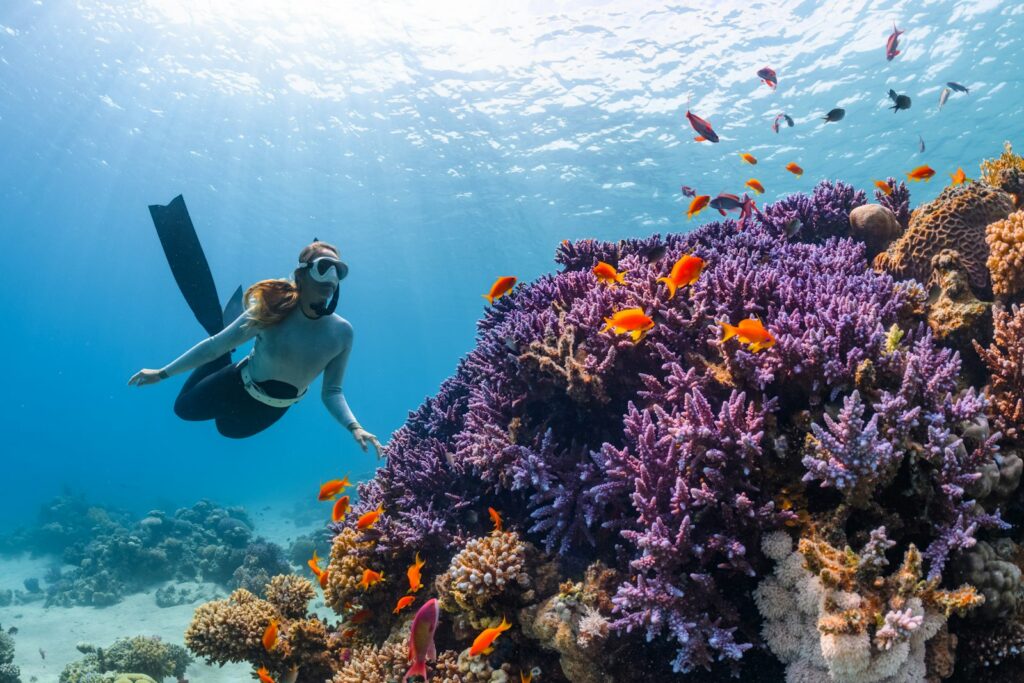
A snorkeling-focused phinisi liveaboard for non-divers in Labuan Bajo is a multi-day charter aboard a traditional Indonesian wooden vessel, designed around surface snorkeling stops rather than scuba diving — giving guests without any certification full, meaningful access to Komodo National Park’s reefs, manta rays, and marine life. The distinction matters more than it might sound: the majority of phinisi liveaboards departing Labuan Bajo are built around divers, with compressors, tanks, briefings, and scheduling that revolve around two or three daily dives. A non-diver on one of those boats is, in practice, a passenger who snorkels alone while the dive group disappears underwater. A genuinely snorkel-centric charter flips the priorities — sites are chosen for surface accessibility, time in the water is allocated to snorkelers, and the crew is briefed to work with people who have fins and masks, not BCDs and regulators.
This guide is for you if you have never dived, have no intention of learning on holiday, or are travelling with children, older relatives, or a mixed group where some members are certified divers and some are not. Komodo National Park contains some of the most biodiverse coral reefs on earth. You do not need a tank strapped to your back to experience them properly.
Why Non-Divers Often Get a Raw Deal on Standard Phinisi Charters
The honest version of this is worth stating plainly. Most operators in Labuan Bajo list snorkeling as a standard inclusion on every charter. Technically this is accurate. What the brochure does not tell you is that many of Komodo’s most celebrated dive sites — Batu Bolong, Castle Rock, Crystal Rock — have surface conditions that are actively difficult for snorkelers. Strong upwellings, exposed positions, and currents that swing from flat to severe with the tide make them genuinely unsuitable for anything other than supervised scuba. Snorkelers at these sites either stay in the tender watching the divers descend, or they enter water that is more challenging than anyone briefed them to expect.
The park’s snorkeling-specific sites are a different story entirely. Shallow, sheltered, rich with coral and fish life, and manageable for anyone with basic water confidence — they are simply not where a dive-centric operator focuses the itinerary. When you book a standard dive charter as a non-diver, you are not necessarily visiting the wrong park. You may just be visiting the wrong stops within it.
A good snorkeling-first phinisi itinerary routes around this problem entirely.
The Best Snorkeling Sites in Komodo National Park
Not all of the park’s reefs are created equal for snorkelers. The sites below are the ones that consistently deliver for surface swimmers — shallow enough to see the bottom clearly, calm enough that a moderate swimmer can hold position, and ecologically interesting enough that an hour in the water feels short.
Kanawa Island (Pulau Kanawa)
Kanawa sits roughly 10 to 15 kilometres offshore from Labuan Bajo, about 45 to 60 minutes by phinisi tender. The house reef begins almost from the beach itself — you can wade in from the shore and within a few fin-kicks you are over shallow coral at 1 to 2 metres depth, with the reef dropping gradually to around 5 to 10 metres. For someone who has never snorkeled a tropical reef before, Kanawa is close to ideal: no current worth mentioning in normal conditions, clear and warm water, and a coral garden dense enough to hold your attention for a full session.
The reef is not pristine — no heavily-trafficked site in this part of the world is — but it remains genuinely colourful, with table corals, brain corals, and the kind of fish density that makes the water feel busy in the best sense. Parrotfish, butterflyfish, wrasse, and the occasional reef shark cruising the drop make reliable appearances. Children who are snorkeling for the first time often have their best moments here, partly because the depth is non-threatening and partly because the fish are close enough to feel within reach.
Some phinisi operators use Kanawa as a final stop on the return to Labuan Bajo, which makes logistical sense but does mean the timing can be rushed. If snorkeling is the priority on your charter, ask explicitly for Kanawa to be scheduled as a full dedicated stop rather than a 20-minute swim on the way back to port.
Pink Beach (Pantai Merah)
Pink Beach on Komodo Island is on every charter itinerary, listed primarily as a photography and swimming stop. What often goes underreported is that the reef running along the beach — accessible from the waterline without a tender — is consistently good for snorkeling and genuinely manageable for beginners.
The pink colouration of the sand comes from Foraminifera, microscopic organisms whose red-pigmented shells mix with white sand to produce the distinctive blush. (The park claims Pink Beach is one of only a handful of true pink-sand beaches in the world — the figure often cited is seven or eight, though no authoritative global inventory exists.) The reef starts shallow and close to shore, making it possible to enter from the beach and drift along the fringing reef at depths of 1 to 4 metres without the need for a tender drop.
Conditions at Pink Beach depend on season and time of day. In the dry season — broadly April through October — the water is calm, the visibility typically 15 metres or better, and the reef is a pleasant, low-stress snorkel. In transitional and wet months, wave action can stir up sand and reduce visibility to single figures. Wind from the south pushes swell against the beach. These are factors your skipper can read and advise on; the site is tidal and weather-sensitive in ways a first-time visitor would not anticipate.
One logistical note: Pink Beach is extremely popular. In peak season (July and August especially), multiple boats anchor simultaneously and the beach fills with guests from every vessel. Early morning visits are calmer and the light for underwater photography is superior. If your charter itinerary can be structured to reach Pink Beach before 9am, the experience improves substantially.
Siaba Besar
Siaba Besar is less commonly name-checked in operator brochures than Manta Point or Pink Beach, but among snorkelers who know the park well it has a reputation as one of the most reliably pleasant shallow-reef stops in Komodo. The site sits on the northwestern side of Siaba Island, sheltered from the prevailing currents that affect the more exposed park sites, with a broad reef flat at 2 to 6 metres and a gentle slope to deeper water.
The turtle population is the headline draw — green turtles feed on the seagrass patches around Siaba Besar with enough regularity that most morning visits produce at least one encounter. These are not staged or provisioned turtles; they are wild animals going about their routine, and encountering them in the water without pursuing or touching them is a reminder of what undisturbed marine habitat looks like. For families with children, Siaba Besar’s combination of accessible depth, calm water, and charismatic wildlife often produces the snorkeling memory of the trip.
The site works best in the morning when light penetration is good and the current is at its most settled. Divers visit Siaba Besar too, but there is genuinely nothing a diver can access here that a competent snorkeler cannot see from the surface, which is not always true of the park’s current-exposed pinnacles.
Kelor Island (Pulau Kelor)
Kelor is often described as the standard first stop on the outbound leg from Labuan Bajo — close to port, quick to visit, and usually combined with the short hike to the island’s viewpoint (roughly 10 to 15 minutes to the top). The snorkeling around Kelor’s base varies in quality depending on exactly where you enter the water: the protected side has reasonable shallow coral, while the current-exposed face is for experienced swimmers only.
For a snorkeling-first itinerary, Kelor’s value is as an easy early warm-up stop — a way to get comfortable with your rental gear and the conditions before reaching sites that require more confidence. Do not plan an entire day around Kelor, but do not skip it if it falls naturally on the route. The hilltop view of Komodo’s harbour and the surrounding islands is worth the climb regardless of how the snorkeling turns out.
Manta Point (Karang Makassar)
Manta Point deserves its own section because the encounter it offers is in a different category from reef-snorkeling, and because the conditions there require a specific kind of preparation that the other sites on this list do not.
Karang Makassar is a cleaning station — a permanent site where reef mantas (Mobula alfredi) return to be groomed by smaller cleaner fish. The mantas are not seasonal visitors; they are resident and return to the same reef plateau, at 5 to 15 metres depth, with enough regularity that an operator who knows the site can plan around it. From the surface, in good conditions, you look down through 10 to 12 metres of clear water and watch animals with wingspans of 3.5 to close to 5 metres circling slowly below you in a kind of unhurried suspension.
It is the most spectacular wildlife encounter in Komodo for a non-diver, and I say that having logged hundreds of dives and more surface swims than I can accurately recall at this site. A manta that rises to within a metre of the surface and turns beneath you is an experience that does not have a precise equivalent elsewhere in the park. But it comes with two honest caveats.
First, the current. Karang Makassar sits in open water and the tidal flow through the Flores Sea affects the site daily. On calm, slack-tide days it is a manageable surface swim for a moderately fit adult. On stronger tidal days, the current runs at 1 to 2 knots and pushes snorkelers sideways faster than most people anticipate. Your guide’s briefing is not a formality; listen to it. Stay close to the tender, signal if you are tiring, and do not attempt to swim against the current to re-position yourself over the cleaning station. Drift with the current, let the guide position the tender to receive you downstream, and float.
Second, the mantas themselves are wild animals doing something specific: they are at the cleaning station to be groomed, not to interact with tourists. Swimming at them, diving toward them, or positioning yourself directly above them will cause them to leave. The guideline maintained by the park is a minimum approach distance of approximately 3 metres — do not break that distance deliberately, do not touch, and do not chase. Groups that follow this consistently almost always get longer and closer encounters on the manta’s own terms than groups that crowd and lunge. This is not philosophy; it is practical animal behaviour.
What Makes a Phinisi Genuinely Snorkel-Focused?
The distinction between a phinisi that “includes snorkeling” and one that is genuinely structured around snorkelers is meaningful, and asking the right questions before you book is how you end up on the right boat.
| Factor | Dive-centric phinisi (“snorkeling included”) | Snorkel-focused phinisi |
|---|---|---|
| Site selection | Prioritises dive sites (Batu Bolong, Castle Rock) with snorkeling as secondary activity | Itinerary built around Pink Beach, Siaba, Kanawa, Manta Point surface access |
| Gear quality | Scuba equipment primary; snorkel gear often basic shared sets | Well-maintained, varied-size masks and fins; flotation vests available |
| Time in water | Non-divers wait on deck or in tender during dive sessions (30–60 min each) | Water time scheduled and allocated equally for snorkelers |
| Guide briefing | Dive briefing dominates; snorkel briefing is brief or absent | Dedicated snorkel briefing: current conditions, site depth, wildlife etiquette |
| Scheduling | Dive timing dictates when the boat moves; snorkelers must fit around it | Departures and site timing optimised for surface conditions and light |
| Family suitability | Variable; children’s needs may conflict with dive schedule | Itinerary can accommodate varied abilities, ages, and energy levels |
The questions to ask an operator directly: Does the itinerary include dive-specific sites like Batu Bolong or Castle Rock, and if so, what do non-divers do while the group is underwater? How much total water time is allocated to snorkelers across the trip? Is there a dedicated guide in the water with snorkelers, or are they expected to manage themselves? What snorkel gear is supplied, and what is the condition of the masks and fins?
An operator who answers these questions specifically and honestly — even when the honest answer involves a tradeoff — is one worth trusting. Vague answers about “everyone having a great time” tell you nothing useful.
Choosing an Itinerary Length as a Non-Diver
The standard charter formats run to 2 days/1 night, 3 days/2 nights, and 4 days/3 nights from Labuan Bajo. For a non-diver, the choice is slightly different from the calculation a diver would make.
- 2D1N — compressed highlights
- Technically feasible for reaching Padar, Rinca or Komodo for the dragon trek, Pink Beach, and one snorkel stop. In practice it is rushed, there is no real weather buffer, and you will sacrifice snorkeling time to keep the schedule moving. Appropriate only if you genuinely cannot take more time, or if you are combining this with a longer land-based stay in Labuan Bajo.
- 3D2N — the practical minimum for snorkelers
- This is the most popular format and, for snorkelers, the right minimum. You can visit Padar at sunrise, Komodo or Rinca for the Komodo dragon trek, Pink Beach, one or two reef stops (Siaba Besar, Kanawa, or Kelor), and Manta Point — without feeling that every stop is being cut short to make the next one. Two nights aboard lets you settle into the boat’s rhythm, which matters if you are prone to any degree of seasickness in the first 24 hours.
- 4D3N — recommended for families and those who want to go slow
- The extra day adds a genuine weather buffer — if Manta Point has difficult conditions on Day 2, you have Day 3 to return. It also allows for longer stays at snorkeling sites and a second pass at any reef that caught your attention. Families with children almost always do better with 4 days; the pace is more human, the children have time to find their water confidence, and there is less pressure on any single stop to deliver the entire trip’s highlights.
Season and Timing for Non-Diving Visitors
The optimal window for snorkeling in Komodo National Park broadly follows the dry season: April through October, with May through early July and September through October representing the best balance of conditions and boat traffic. Here is how the year actually breaks down for someone whose priority is surface water quality rather than dive conditions:
May to early July brings calm seas, the islands still green from the rains, and underwater visibility that regularly exceeds 20 metres. The mantas at Karang Makassar are active through this window. Boat numbers are lower than August and the experience of anchoring in a bay with one or two other phinisi — rather than a dozen — changes the character of the trip entirely.
July and August are peak season. Padar’s hilltop is golden and dry, dragon activity on Rinca and Komodo is high, and visibility in the water is excellent. You will share the park with more boats than at any other time of year. The snorkeling sites are still very good; the overall experience just requires more patience at popular spots.
September and October are the most underrated months. Seas remain calm, crowds thin noticeably after school-holiday season ends, and the manta population is active. Some operators describe October as the single best month on the water. Prices often soften slightly toward the end of this window.
November to March: November remains workable, especially early in the month. From December onward, conditions become progressively more difficult — stronger winds, building swell, and reduced underwater visibility. January and February are genuinely rough months; some operators reduce sailings significantly in February. If your only available window falls in this period, book a larger, heavier phinisi, choose a conservative itinerary that avoids exposed sites, and carry anti-seasickness medication. Set expectations accordingly.
Family Suitability: A Realistic Assessment
Families ask two distinct questions about Komodo phinisi trips: is it safe for children, and will children actually enjoy it? The honest answer to both is: it depends on the children and the operator, and the variables worth asking about are more specific than a general yes or no.
Ages and Water Confidence
Most phinisi operators do not publish minimum age requirements, which leaves parents to make their own assessment. For snorkeling, a child who is confident in open water — comfortable floating without panicking, able to breathe through a snorkel without gagging, and attentive enough to follow a guide’s instructions — can participate meaningfully from around 8 to 10 years old at the calmer sites. Kanawa Island and Siaba Besar, in calm conditions, are genuinely accessible for this age group. Manta Point requires more active swimming and current awareness; younger children and nervous swimmers are often better served watching from the tender, where visibility through the clear water can itself be good.
Children who cannot yet swim, or who are in the 4-to-7 age range, will typically not be snorkeling the open-water sites. They can still have a meaningful time on board — the Komodo dragon treks are for any child who can walk the terrain, the Padar sunrise hike is a shared experience, and the boat itself, with its sun deck, tender, and shifting scenery, is not a boring place for an energetic child. But the water activities will be limited to calm, shallow conditions with direct adult supervision.
What to Ask the Operator
Before booking a family charter, ask specifically: does the boat carry flotation vests in children’s sizes? Is there a crew member or guide dedicated to supervising children in the water separately from the adult group? Can the itinerary be adjusted on the day if a site has unsuitable conditions for children? Operators who answer these questions with practical specifics — not just “of course, we love families” — are the ones worth booking with.
The Komodo dragon treks on Rinca and Komodo Islands deserve their own brief mention for families. Rangers accompany all groups; it is not optional and it is not merely ceremonial. The animals are wild apex predators and they move faster than a casual stroll. Children need to stay within the group, follow ranger instructions immediately, and not run. A ranger who has managed thousands of groups can read a child’s energy level and adjust the route accordingly, but parents need to brief their children before the trek, not during it.
Snorkeling Gear: What Your Phinisi Should Provide and What to Bring Yourself
All phinisi include some form of snorkel equipment. Quality varies considerably between budget and mid-range boats. Here is what to expect, and where bringing your own gear makes a meaningful difference.
| Item | Typically Provided? | Notes |
|---|---|---|
| Mask | Yes, on most boats | Quality varies; if you snorkel regularly, bring your own — a well-fitting mask changes everything in current |
| Fins | Yes | Confirm size range includes yours; open-heel adjustable fins cover most adults; children’s sizes less reliably stocked |
| Snorkel | Yes | A dry-top or semi-dry snorkel is noticeably better in any chop; basic J-tubes are fine in calm conditions |
| Wetsuit / rashguard | Rashguards often; full wetsuits less common on snorkel-focused boats | Central Komodo waters run approximately 24–27°C — comfortable, but a long-sleeve rashguard prevents sunburn during long surface sessions and protects against jellyfish and coral contact |
| Flotation vest | Sometimes | Explicitly ask — essential for nervous swimmers and children; not all boats carry them, and the ones that do may not have children’s sizes |
| Underwater camera | No | Compact housings for smartphones or action cameras work well; a wide-angle lens setting and no flash is the correct approach for reef and manta photography |
On sunscreen: the standard advice for any coral reef environment is to use mineral sunscreen — zinc oxide or titanium dioxide — rather than chemical UV filters. Chemical UV filters, including oxybenzone and octinoxate, have documented toxicity to coral larvae and marine invertebrates, and several popular destinations have banned them outright. Komodo National Park is a Marine Protected Area; behave accordingly. A full-length rashguard or UV shirt, worn while snorkeling, does the job better than any amount of sunscreen and eliminates the problem entirely.
Park Fees and What You Actually Pay
Komodo National Park fees are a persistent source of confusion in phinisi booking, largely because operators quote charter prices without them and the exact fee structure changes periodically. The 2022 proposal to raise fees dramatically to a high annual pass was withdrawn following local protests; the current structure reverted to a lower per-entry model. As of 2024–2026, the practical per-person cost for a standard 3-day/2-night charter works out to approximately IDR 600,000 to IDR 1,200,000 in total park-related fees — covering park entrance, marine activity (snorkeling), ranger accompaniment for land treks, and conservation levies. At current exchange rates, that is roughly USD 35 to 75 per person for the full trip.
These fees are almost universally quoted as excluded from the charter price and collected separately, either by the operator on behalf of the park or paid in cash on arrival at ranger stations. Verify before departure exactly what is included in your charter price and what you will need to carry in cash. The structure can shift — confirm figures with your operator close to your travel date rather than relying on year-old information from any source including this one.
The conservation fee element of the park structure is genuinely meaningful, not a token charge. Komodo National Park funds ranger operations, mooring buoy maintenance (which protects corals from anchor damage), and wildlife monitoring programs from a combination of government allocation and visitor fees. The mantas, turtles, and reefs you are visiting exist in part because this funding supports active management. Paying it without resentment is a reasonable baseline.
Planning Your Charter: What to Ask Before You Book
Once you have identified a budget and a date window, the practical selection process comes down to a handful of targeted questions. The answers, and how an operator delivers them, tell you most of what you need to know.
Ask: Is the boat primarily used for dive charters, and if so, how are non-divers accommodated? Ask for the specific itinerary, not the generic version — the named stops, the approximate times at each, and what the non-diving activities are at each location. Ask about crew-to-guest ratio and whether there is a dedicated water guide for snorkelers. Ask about the minimum age and swimming-ability requirements they recommend. Ask, specifically, what the cancellation and rebooking policy is if weather forces a change to the itinerary — in a park where currents and swell are a real factor, a rigid “no refund, no change” policy on a non-dive-insured booking is a risk worth evaluating.
If you are planning a charter for a family or a group with mixed abilities, the plan your charter page is the right place to start. We can help match your group’s profile — ages, water confidence, specific interests, budget — to vessels and operators whose actual track record matches what they advertise. On WhatsApp, the conversation can cover individual itinerary questions in as much detail as you need before you commit to a booking.
What Non-Divers Actually Experience: A Realistic Picture
The framing around Komodo phinisi trips in most marketing places scuba diving at the centre and treats everything else as supplementary. The reality, for a non-diver on a well-chosen snorkel-focused charter, is quite different.
You will hike to the top of Padar Island before dawn, reaching the viewpoint as the sky turns orange over three distinctly coloured bays — the kind of view that requires no camera to register how improbable it looks. You will walk Rinca or Komodo Island with a ranger a few metres ahead, watching a 2.5-metre Komodo dragon cross the path in front of the group with the casual authority of an animal that has no natural predators. You will drift over a shallow reef at Siaba Besar at 2 metres of depth, watching a green turtle feed on seagrass beneath you with complete indifference to your presence. You will lie face-down at the surface of Karang Makassar, current running gently past your fins, and look down at a reef manta with a 4-metre wingspan circling 8 metres below in clear blue water.
None of those experiences require certification. They require choosing the right boat, planning the right itinerary, and arriving in the right season. That is the work this guide is designed to help you do.
Frequently Asked Questions
Do I need any previous snorkeling experience to join a phinisi liveaboard in Labuan Bajo?
No formal certification or experience is required for snorkeling. What matters is basic water confidence — comfortable floating in open water, able to breathe steadily through a snorkel without panicking, and capable of following a guide’s instructions in current. If you are genuinely a non-swimmer or have significant anxiety about open water, a phinisi charter is probably not the right trip, or should be chosen very carefully for calm-water itineraries only. For most adults with normal beach and pool swimming experience, the sites described in this guide — Kanawa, Siaba Besar, Pink Beach — are well within reach. Manta Point requires more active swimming and is the one site where current conditions can make it unsuitable for nervous swimmers on any given day.
Can children snorkel at Manta Point, or is it only for adults?
Children can snorkel at Manta Point in suitable conditions — calm water with minimal current — provided they are confident swimmers and wear flotation vests. In practice, conditions at Karang Makassar are not always suitable, and the right call for any child who is not a strong swimmer is to watch from the tender. The visibility through the clear water from the tender’s hull can be genuinely good, and many children see their first manta from the boat rather than from the water. For families, Siaba Besar and Kanawa consistently offer more accessible and predictable snorkeling experiences and are better suited to children of a wide age range.
How much does a snorkeling-focused phinisi charter cost for a private group?
Private whole-boat charters in Labuan Bajo cover a wide price range depending on vessel tier, trip length, and season. As a broad orientation: budget-to-mid-range phinisi private charters run roughly USD 1,000 to 3,000 per night for the whole boat (not per person), while luxury vessels typically start above USD 3,000 per night and extend well beyond that for top-tier boats. For a 3-day/2-night private charter, budget accordingly across two nights plus the park fees described above. Open-trip (shared boat) formats — where you book a cabin rather than the whole vessel — are considerably cheaper per person, with rough per-person costs in the USD 100 to 250 per day range depending on boat quality. Park fees are typically separate in either format. Treat all these figures as ranges for orientation; actual quotes will vary by vessel, operator, date, and availability.
Is the Padar Island sunrise hike accessible for non-hikers and older travellers?
The trail to the Padar viewpoint involves approximately 800 steps of varying steepness — the commonly cited figure ranges from 700 to 900 depending on the source and the exact route taken. The hike is manageable for most reasonably fit adults but should not be underestimated; departures for the sunrise hike typically begin in the dark, at 4:30 to 5am, and the path is rocky in sections. Older travellers and those with limited mobility should discuss the hike honestly with their operator before departure and assess whether the viewpoint or a lower vantage point on the trail is the right goal. The views from the mid-trail are genuinely good and there is no obligation to reach the summit.
What is the difference between an open trip and a private charter for a snorkeling-focused group?
An open trip means you book individual cabins on a boat that also carries other passengers you have not met — typically 6 to 12 guests total sharing the vessel. This is the cheaper format per person and can be a good social experience. The tradeoff is that the itinerary is fixed, the pace is set for the group as a whole, and the operator cannot adjust the route or timing specifically for your group’s snorkeling interests. A private charter gives your group full control over the boat, the itinerary, and the pace. For a family with children, or any group with specific accessibility needs or snorkeling preferences, private charter allows the operator to genuinely customise the experience. For solo travellers or small groups of adults who are flexible, a well-chosen open trip on a snorkel-friendly boat can deliver most of what a private charter offers at a fraction of the price.