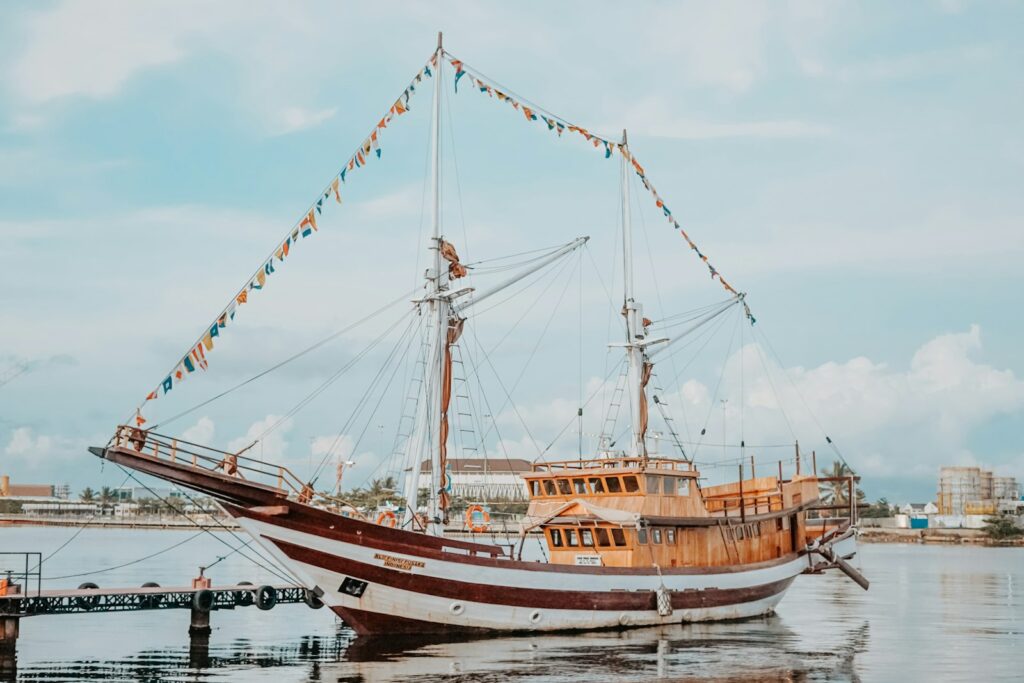
A phinisi (also spelled pinisi) is a traditional Indonesian wooden sailing vessel built by the Bugis, Makassar, and Konjo peoples of South Sulawesi, and today it is the signature craft for exploring Komodo National Park from Labuan Bajo. If you are researching an authentic Indonesian phinisi sailing experience in Labuan Bajo, understanding what this boat actually is — and where it comes from — is the difference between booking any wooden boat and choosing one with real substance behind it.
The word gets used loosely. Charter brokers stamp “phinisi” on everything from immaculate expedition yachts to aging wooden hulls with shared bathrooms. That range is real and worth understanding. But the vessel itself has roots that predate any tourist industry by centuries, and those roots still matter when you step aboard in Labuan Bajo harbor and watch a crew of Konjo sailors work a wooden ship across the Flores Sea.
Origins: The Bugis, Makassar, and Konjo Shipbuilders of South Sulawesi
Phinisi are not simply “traditional Indonesian boats” in a generic sense. They trace to a specific maritime culture concentrated in the southern tip of Sulawesi, among three closely related Austronesian peoples: the Bugis, the Makassar, and the Konjo. The Bugis were historically the dominant trading sailors of maritime Southeast Asia — their outrigger vessels pushed into waters from the Philippines to the coasts of Australia long before European contact, and Bugis navigators were so pervasive in colonial-era shipping that the English word “boogeyman” is sometimes (if disputably) linked to their fearsome seafaring reputation.
The Konjo, a sub-group living in the Bulukumba regency at the southwestern tip of South Sulawesi, became the specialist boatbuilders. Three villages in particular — Tana Beru, Ara, and Lemo-Lemo — emerged as the heartland of phinisi construction. These are not historical curiosities. Today, if you visit Tana Beru, you will still find hulls being assembled on the beach in the same general manner they have been built for generations: enormous keels laid on the sand, planking rising before any interior framing goes in, and master carpenters working without a single blueprint in sight.
The knowledge transfer is oral and familial. A panrita lopi — the Konjo term for a master shipwright — learns through decades of apprenticeship, absorbing the proportions, the structural logic, and the ritual obligations of the craft from his father or grandfather. There are no technical drawings passed between builders. The measurements live in the head and the hands of the craftsman.
UNESCO Recognition: Why 2017 Matters
In 2017, at its 12th session, the UNESCO Intergovernmental Committee formally inscribed “Pinisi, art of boatbuilding in South Sulawesi” on the Representative List of the Intangible Cultural Heritage of Humanity. That inscription is significant for reasons beyond prestige.
UNESCO’s intangible-heritage framework is specifically designed to protect living practices — not artifacts in a museum, but skills actively transmitted through communities. The inscription acknowledged that phinisi boatbuilding is precisely that: a continuous, community-embedded practice in Tana Beru, Ara, and Lemo-Lemo, sustained by a network of master builders, apprentices, ritual specialists, and the broader Konjo community that supplies timber, financing, and ceremonial knowledge.
The inscription also flagged the pressures on that practice. Cheaper fiberglass vessels, demand for larger motorized hulls, and the difficulty of sourcing quality tropical hardwoods all threaten to dilute or displace the traditional craft. When a Labuan Bajo charter operator advertises a “traditional phinisi,” the UNESCO recognition is the global benchmark against which that claim should be measured. A vessel built in Tana Beru by a panrita lopi using ironwood and teak, assembled keel-first without blueprints — that is the thing UNESCO was protecting. A fiberglass hull with a wooden-look exterior is something else entirely.
How a Phinisi Is Built: Keel-First, Without Blueprints
The construction sequence of a traditional phinisi inverts the logic of modern naval architecture in ways that still surprise Western engineers. Where contemporary shipbuilding erects a skeletal frame first and then skins it with hull planking, Konjo builders go the other direction: the keel and bottom strakes go on first, and the structural ribs are inserted afterward, carved to fit the already-established hull shape.
This is called shell-first or plank-first construction, and it places almost the entire structural intelligence of the vessel in the builder’s visual judgment and accumulated experience rather than in written calculations. The panrita lopi reads the curve of the plank, feels the tension in the wood, and makes decisions that a structural engineer would express as differential equations. The results, when done correctly, are extraordinarily strong and seaworthy hulls that have survived the notoriously unpredictable weather of the Indonesian archipelago for centuries.
Timber: Ironwood and Teak
Two tropical hardwoods dominate traditional phinisi construction. Ironwood — known locally as kayu besi or ulin — is used for the structural backbone: keel, frames, and key stress-bearing components. The name is accurate: ironwood is among the densest and most decay-resistant timbers on the planet, with a hardness that blunts ordinary cutting tools. A keel laid in ironwood can outlast several generations of owners. Teak provides the hull planking, decking, and interior joinery — prized for its natural oils, dimensional stability, and the way it weathers gracefully at sea rather than cracking and splintering.
The joinery relies on wooden treenails (wooden pegs) rather than metal fasteners. Iron and steel corrode in tropical saltwater and can split the surrounding wood as they expand; a well-fitted treenail swells with moisture to create a tight, permanent joint that strengthens with time. On an older, well-maintained phinisi, you might inspect the hull and find almost no metal at all in the primary structure.
Ritual at Every Stage
What separates phinisi construction from purely technical boatbuilding is the ritual structure woven through each phase. Tree felling, keel laying, the installation of the first plank, and the final launch are all marked by ceremonies rooted in Konjo-Bugis cosmology — prayers, specific food offerings, and protocols for engaging the spiritual dimensions of the wood and the sea. A boat built without these ceremonies is considered incomplete in a more-than-symbolic sense by many traditional builders.
The UNESCO inscription explicitly recognized this ritual dimension as part of the intangible heritage. The ceremonies are not decorative additions; they are part of the knowledge system, encoding community memory about which trees may be felled, how the spirit of the vessel is to be invoked, and what obligations the new owner accepts.
The Rig: A Gaff-Ketch with Seven or Eight Sails
Ask ten people what kind of rig a phinisi carries and you will get answers ranging from “schooner” to “junk” to a vague wave of the hand. The technically correct answer is a gaff-ketch: two masts, with the shorter mizzen stepped well forward of the stern, both masts carrying standing gaffs from which the sails are drawn out horizontally, somewhat like curtains rather than hoisted on a vertical luff.
Traditional phinisi carry seven to eight sails in total — the exact count varies by vessel size and design, with most sources citing seven as standard and eight on larger rigs. The sail plan includes two main sails on the standing gaffs, foresails forward of the main mast, staysails between the masts, and a bowsprit sail projecting forward from the stem. Under full sail, a phinisi presents a profile that is instantly recognizable: the distinctive forward lean of the bowsprit, the spread of canvas between two masts, the low freeboard and the rakish hull rising from the water.
In practice, most phinisi operating as charter vessels in Labuan Bajo today sail under engine power for the majority of passages — the seas around Komodo National Park involve strong tidal currents, narrow channels, and itinerary pressure that makes purely sail-powered voyaging impractical for guest comfort. But on calm mornings in the lee of Flores, with the engine off and a light southeasterly filling the canvas, a phinisi under sail is something genuinely different from any modern motor yacht.
From Trading Vessel to Charter Boat: How Phinisi Came to Labuan Bajo
For most of their history, phinisi were working vessels: cargo traders, fishing platforms, and inter-island transport. The same hull form that now carries honeymooners to Padar Island once moved copra, spices, timber, and dried fish across the Banda Sea. Many of the older charter phinisi in Labuan Bajo started life as trading or fishing boats and were later converted — cabins added below decks, generators installed, bathrooms retrofitted into what were once cargo holds.
The shift toward charter tourism accelerated through the 1990s and 2000s as international awareness of Komodo National Park grew. Labuan Bajo, the nearest mainland town to the park’s western boundary, became the default departure point. Boat owners and entrepreneurs recognized that travelers wanted to overnight on the water — to be anchored in a quiet bay at sunset rather than racing back to shore — and the phinisi hull, already familiar, already available, proved ideal for conversion. A vessel 20 to 35 meters long, with a shallow enough draft to anchor close to beaches, and the cultural prestige of a UNESCO-recognized craft, was a natural fit.
New-build luxury phinisi followed. Some of the finest vessels now sailing out of Labuan Bajo were commissioned specifically as charter yachts, built in Tana Beru by master craftsmen to the specifications of investors who wanted the authentic phinisi hull and rig but with air-conditioned en-suite cabins, commercial kitchens, and modern navigation systems. The result is a boat that is simultaneously ancient in its structural logic and thoroughly contemporary in its amenities — which is precisely what makes the authentic Indonesian phinisi sailing experience in Labuan Bajo compelling for travelers who could just as easily book a fiberglass catamaran anywhere in the world.
What Authentic Looks Like: A Curation Framework
Given how freely the word “phinisi” is applied in marketing, a few distinctions help when evaluating your options.
- Hull material
- A traditional phinisi hull is solid tropical hardwood — ironwood and teak, as above. Some newer builds use alternative hardwoods due to supply constraints; this is not automatically disqualifying, but worth asking about. Fiberglass hulls styled to look like phinisi are common; they are not traditional phinisi in any structural sense.
- Build location
- Vessels built in Tana Beru, Ara, or Lemo-Lemo by Konjo craftsmen carry the clearest lineage to the UNESCO-recognized tradition. Boats built in Labuan Bajo’s own boatyards or in other regions vary in quality and authenticity.
- Rig
- A gaff-ketch rig with the characteristic standing gaffs and bowsprit is the traditional configuration. Many boats have simplified or motorized rigs; this reduces authenticity but does not necessarily reduce seaworthiness or comfort.
- Construction method
- Keel-first, plank-before-frame construction with treenails and traditional joinery methods distinguishes a properly built phinisi from a boat that merely looks the part. The best charter operators can tell you where and how their vessel was built.
- Age and refit history
- Older converted trading phinisi typically range from 20 to 35 meters. New-build luxury expedition phinisi can reach 40 to 50 meters with purpose-designed cabin layouts. A refit date matters: a well-maintained older hull is often structurally superior to a cheaply built recent vessel.
None of this is about snobbery. It is about knowing what you are paying for. A traveler booking a three-night private charter at $3,000 per night deserves to know whether they are aboard a vessel built by a panrita lopi in Tana Beru or a tourist boat assembled from salvaged timber in a Labuan Bajo shed. The price may be similar; the experience is not.
If you want an independent, vetting-based read on specific vessels before you commit, plan your charter with our concierge — we can steer you toward boats that genuinely warrant the heritage claim, and we are equally candid when they do not.
The Phinisi in Komodo: Why It Fits
Komodo National Park is a UNESCO World Heritage Site, a Marine Protected Area, and one of the most ecologically significant stretches of ocean in Southeast Asia. The currents that make its dive sites world-class — Batu Bolong, Castle Rock, Manta Point at Karang Makassar — are the same currents that demand careful seamanship from any vessel working the park.
The phinisi hull is well-suited to this environment. The shallow draft allows anchoring close to beaches like Pantai Merah (Pink Beach, where Foraminifera give the sand its distinctive color) and off the sandbar at Taka Makassar that nearly disappears at high tide. The broad deck gives comfortable space for watching the flying-fox colony launch from Kalong Island at sunset. The height of the bow provides a stable platform for scanning the water for manta rays at the shallow cleaning station of Manta Point, where reef mantas with wingspans up to around four to five meters circle at five to fifteen meters depth.
And there is the simple fact that a wooden hull feels appropriate in a landscape whose human history is written in wooden vessels. The Bugis traders who worked these waters for centuries before Komodo National Park had a name sailed something like the boat you are now standing on. That continuity is not marketing copy. It is real history, and in a region where so much of what is sold as “authentic” is reassembled for tourists, that realness is worth something.
The Modern Luxury Phinisi: Tradition and Contemporary Comfort
The charter market in Labuan Bajo has pushed phinisi design into territory that would likely astonish a Konjo boatbuilder of two centuries ago. High-end vessels now routinely carry air-conditioned cabins that are, by any standard, proper hotel rooms: queen beds, en-suite bathrooms with hot water, reading lights, storage. Sun decks double as yoga platforms or dining terraces. Dive setups with compressors (and nitrox on better-equipped vessels) serve guests who want to log dives at Castle Rock and Castle Rock’s sister site Crystal Rock on the same day. Tenders — small rigid-hull inflatable dinghies — allow easy transfers to beaches without the boat needing to anchor inshore.
Typical charter phinisi in the luxury and upper-deluxe tier run roughly 20 to 35 meters in length and carry four to seven guest cabins. Larger expedition builds reach 40 to 50 meters with more cabin configurations. None of these figures are fixed across the fleet — every vessel is different, which is part of the point. A traditional phinisi is not produced to a standardized specification; it is built to a conversation between the builder and the owner, within the structural principles of the form.
The question worth asking of any vessel you are considering is whether the contemporary amenities are layered onto a genuinely traditional hull or whether the “phinisi” label is purely cosmetic. Our vetting process tries to answer that question directly — and we are direct when the answer is unflattering to a particular boat.
Sailing from Labuan Bajo: What to Expect
Most charter phinisi depart from Pelabuhan Labuan Bajo, the main harbor on the Flores waterfront. Flights from Bali (Ngurah Rai, DPS) to Komodo Airport (LBJ) run roughly one hour and ten minutes to one hour and twenty-five minutes, with Garuda, Wings Air, Lion Air, Batik Air, and Citilink all serving the route at various times — check close to your dates as schedules shift seasonally.
The core travel window is April through October, with May through June and September through October offering the best balance of calm seas, good underwater visibility (typically twenty to thirty meters in the dry season), and manageable boat traffic. July and August are peak season: visibility is at its best, but the park is at its busiest and prices are at their highest. The wet season from December through March brings rougher seas, reduced visibility, and diminished comfort aboard — many operators reduce sailings in January and February, the worst months.
Park and conservation fees for Komodo National Park are almost always charged separately from charter rates. Expect the combined per-person cost for park entrance, marine fees, ranger fees, and local levies to run roughly 600,000 to 1,200,000 IDR per person for a three- or four-day trip — figures that shift with policy changes, so verify current rates with your operator close to departure. This is a recurring point of confusion in booking; a transparent operator will itemize it clearly rather than burying it in “extras.”
Planning the logistics — flights, pre-/post-charter accommodation, park fee budgeting, and crew gratuity customs — is genuinely easier with someone who knows the harbor and the operators firsthand. We do that work so you do not have to start from scratch. Reach us via WhatsApp or our contact form and we will match you with vessels that fit your group size, dates, and standards, without the sales pressure of an operator’s own booking page.
Frequently Asked Questions
What exactly is the difference between a phinisi and a regular wooden sailboat?
A phinisi is a specific type of traditional Indonesian sailing vessel built by the Bugis, Makassar, and Konjo peoples of South Sulawesi. It is defined by its gaff-ketch rig with standing gaffs and seven to eight sails, its shell-first construction method using ironwood and teak with wooden treenails, and the cultural and ritual knowledge system embedded in its building. A generic wooden sailboat from another tradition is simply a wooden sailboat. The distinction matters because the construction method, the timber selection, and the builder lineage all affect the structural integrity and character of the vessel.
Is phinisi boatbuilding really still practiced the traditional way?
Yes, actively — though under pressure. In Tana Beru, Ara, and Lemo-Lemo in Bulukumba regency, South Sulawesi, Konjo master builders still construct phinisi using keel-first plank-before-frame methods, tropical hardwoods, wooden treenails, and the associated ceremonial practices. This continuity was the basis for the 2017 UNESCO inscription on the Representative List of the Intangible Cultural Heritage of Humanity. The pressures are real — cheaper materials, demand for larger motorized hulls, and hardwood supply issues — but the living tradition persists.
Why do phinisi charters out of Labuan Bajo mostly use engines rather than sails?
Komodo National Park’s waters involve strong tidal currents, narrow passages between islands, and the practical need to keep to an itinerary so guests reach Padar for sunrise or Manta Point during feeding windows. Sailing purely on wind would make those timings unpredictable. Most charter phinisi carry the traditional rig and raise sails when conditions allow — calm open crossings, favorable wind angles — but rely on diesel engines for the bulk of maneuvering. This is a practical adaptation rather than an abandonment of tradition; working phinisi have used auxiliary engines for decades.
How do I know if the phinisi I am booking is genuinely traditional or just a boat that looks the part?
Ask the operator directly: where was the hull built, by whom, in what year, and has the hull material been confirmed as tropical hardwood? Operators who cannot answer those questions are often working with converted hulls of uncertain provenance. Beyond that, look at photos of the keel and lower hull structure, not just the polished interior. An independent curation service like Phinisi Atlas exists precisely to answer these questions before you commit — we physically inspect vessels and document build origins rather than relying on marketing copy.
Does the UNESCO inscription affect which phinisi I should choose for a Labuan Bajo charter?
Not directly — the inscription protects the boatbuilding practice in South Sulawesi rather than certifying individual vessels. But understanding what UNESCO recognized helps you frame the right questions. A vessel built in Tana Beru by a panrita lopi using traditional methods and materials is the living expression of what UNESCO inscribed. A vessel built elsewhere using non-traditional materials and methods, regardless of how it is marketed, does not share that lineage. The inscription gives you a benchmark; due diligence on the specific boat fills in the rest.