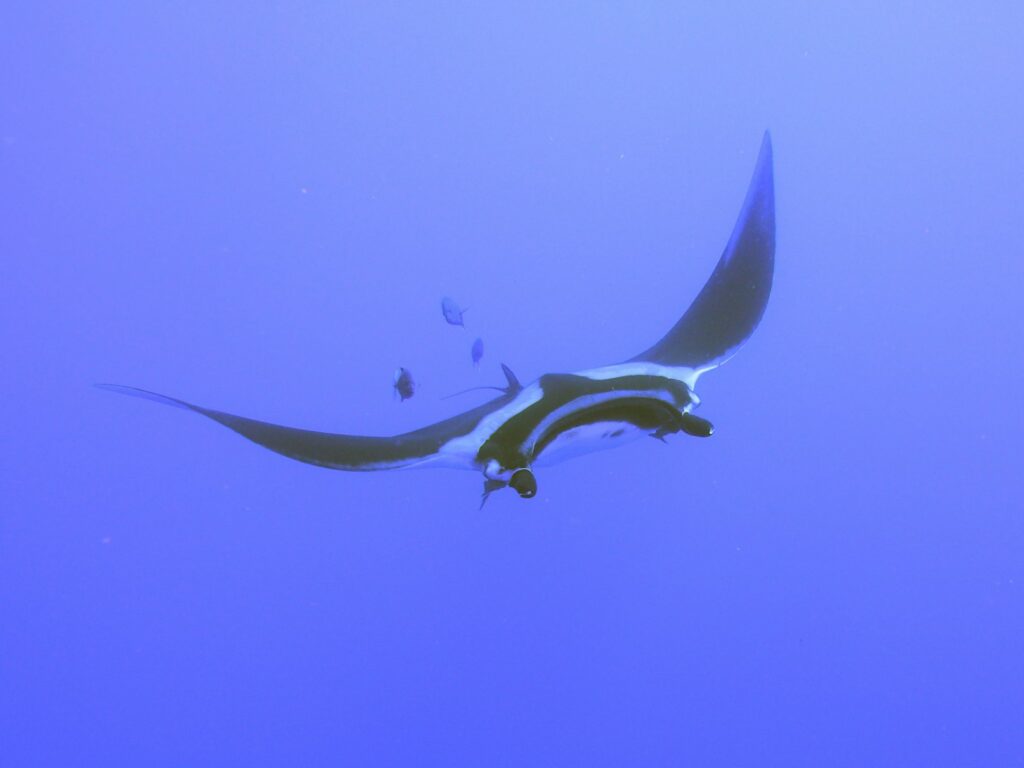
Manta season in Komodo runs year-round — reef manta rays (Mobula alfredi) are resident at sites like Manta Point (Karang Makassar) in every month of the year. For phinisi trips departing Labuan Bajo, the most reliable windows are May through September for sheer encounter frequency, with a secondary peak from October into November as the season transitions and crowd numbers drop. Timing your charter around these windows, and understanding why cool upwellings drive the whole system, makes the difference between circling alone above a cleaning station and watching a dozen animals stack overhead.
Why Mantas Show Up When They Do
Manta rays don’t follow a simple calendar. They follow food and cleaning cues, and in Komodo National Park both of those are tied directly to water temperature and current patterns.
Central and southern Komodo — the area that includes Manta Point on the southwestern edge of Komodo Island — sits in the path of cold upwellings that push up from the deep Sape Strait. When the dry southeast monsoon is blowing hard between June and September, these upwellings intensify. Water temperatures at depth can drop to around 24–26°C, sometimes colder on a strong surge day. That cooler, nutrient-rich water fuels plankton blooms, and the mantas follow the food. Simultaneously, the cleaning stations at Manta Point become more active: the shallower water at 5–15 m keeps the rays accessible to snorkelers and entry-level divers even as the deeper water churns cold below them.
Northern Komodo, by contrast, runs warmer — roughly 27–29°C year-round — and sees fewer resident mantas, though individuals do travel through. If your phinisi itinerary focuses on the northern reefs like Batu Bolong and Castle Rock for current diving, manta encounters there are opportunistic rather than predictable.
The practical upshot: centre your manta plans on southern Komodo, build in two visits to Manta Point if the charter length allows, and book in the window when the upwellings are at their strongest.
Month-by-Month Manta Guide for Phinisi Charters
These assessments reflect typical patterns. Conditions shift year to year and even week to week with wind cycles. They should inform your charter planning, not replace a conversation with your captain the morning of the dive.
| Month | Manta Encounter Likelihood | Water Temp (Central/South Komodo) | Sea Conditions | Verdict for Phinisi |
|---|---|---|---|---|
| January | Low–Moderate | ~26–28°C | Rough; west monsoon at peak; many operators reduce sailings | Avoid unless experienced and flexible |
| February | Low | ~26–28°C | Worst month; heaviest rain, strongest winds | Not recommended for manta focus |
| March | Low–Moderate | ~26–28°C | Improving slowly late month | Transitional; early risers can find light crowds |
| April | Moderate | ~25–27°C | Calm, green islands, excellent visibility | Good all-round charter month; mantas building |
| May | Good | ~24–27°C | Calm, clear; upwellings starting | Strong pick — calm seas, reliable mantas, fewer boats |
| June | Very Good | ~24–26°C | Excellent; dry, steady SE trade winds | Excellent — before peak-season pricing kicks in |
| July | Very Good–Excellent | ~23–26°C | Strong SE winds possible; visibility 20–30 m | Peak season — most reliable but busiest, highest rates |
| August | Excellent | ~23–25°C | Strong currents on exposed sites; cold thermoclines | Best manta month overall; boats and Manta Point crowded |
| September | Very Good | ~24–26°C | Winds easing; comfortable liveaboard conditions | Favourite for experienced divers — strong encounters, thinning crowds |
| October | Good–Very Good | ~25–27°C | Shoulder season sweetspot; calm, clear | Excellent value; mantas still active, crowd pressure drops |
| November | Moderate–Good | ~26–28°C | Variable; first wet-season squalls possible | Decent manta window but plan for weather flexibility |
| December | Low–Moderate | ~26–28°C | West monsoon building; holiday crowds add complexity | Manageable for manta but not the priority window |
The Two Peak Windows in Detail
May to September: The Core Manta Season
This is when everything aligns. The southeast trade winds push consistent swells that drive the cold-water upwellings hardest, plankton concentrations are at their highest in central and southern Komodo, and the resident reef manta population at Manta Point is most reliably present at the cleaning stations. Visibility regularly reaches 20–30 metres across the park’s better sites.
July and August are the statistical peak for encounters, but they’re also the peak for boat traffic. On a busy August morning, Manta Point can have half a dozen phinisi anchored nearby with snorkelers in the water at the same time. The mantas don’t seem to mind much — they’re there to be cleaned, not to socialize with us — but the experience is very different from a quiet September morning when you might have the station to yourself for 40 minutes. The tradeoff is real: more boats means more certainty that someone has already scouted the site that morning, but it also means a noisier, more chaotic encounter.
For divers rather than snorkelers, June and September are the two months I find myself recommending most often. The current windows are predictable enough to plan, the thermoclines are a proper cold shock (bring your 5mm wetsuit — the first time you hit 23°C water in August after snorkeling in 28°C surface water will rearrange your expectations), and the boats are numerous but not overwhelming.
October to November: The Shoulder Sweet Spot
September into October is arguably the best period for a well-planned phinisi manta charter. The southeast monsoon is easing, seas settle to their calmest of the year, and the manta population at Karang Makassar remains active as water temperatures stay in the 24–27°C range before the warm-water wet season builds. Charter rates drop noticeably from the July–August ceiling. A 4-night private charter that commands its highest rates in August might be 15–25% more negotiable in late October.
November is workable but requires flexibility built into your itinerary. The first wet-season squalls can roll in quickly, and a responsible captain will redirect you from an exposed site in the south to a protected northern anchorage when the weather shifts. That’s not a failure of planning — it’s exactly the operational flexibility that a phinisi charter gives you over a land-based resort dive package.
Manta Point: What to Actually Expect
Manta Point — officially Karang Makassar — sits off the southwestern coast of Komodo Island. The name refers to a cleaning station, not a single reef structure. The mantas come to have parasites removed by cleaner wrasse and other small fish; they circle the station slowly, sometimes for hours, at depths between roughly 5 and 15 metres. That makes it genuinely accessible to snorkelers, which is unusual for manta sites in this region.
Wingspans at Karang Makassar regularly reach 3–4.5 metres, occasionally pushing toward 5 metres on the larger individuals. Reef mantas are not migratory in the same way as oceanic mantas; a proportion of the population here is thought to be resident, which is part of why encounters are possible outside the peak season too.
The rules at this site matter. Park conservation guidelines ask that you maintain a distance of at least around 3 metres from the animals, avoid swimming directly above them (it disrupts the cleaning behaviour), and never touch or chase them. Reputable phinisi operators brief guests on this before entering the water. If yours doesn’t, ask. An operator who doesn’t brief on manta etiquette is also probably not maintaining the wider conservation standards that keep this site functioning year after year.
Most 3-night and 4-night phinisi itineraries from Labuan Bajo include one stop at Manta Point. A dedicated dive or snorkel charter can structure two visits — morning and late afternoon, when light conditions and cleaning activity are typically best — on a single day or across two consecutive days.
Pairing the Manta Stop with the Rest of Your Itinerary
A manta-focused phinisi trip is rarely a single-site affair, and it shouldn’t be. The standard 3-night itinerary from Labuan Bajo strings together the park’s main highlights: the sunrise hike up Padar’s roughly 800-step ridge to see the three-bay panorama, a ranger-led Komodo dragon trek at Loh Liang on Komodo Island or Loh Buaya on Rinca, the pink sand of Pantai Merah (caused by Foraminifera shell fragments mixing with white sand), the sandbar at Taka Makassar, and the sunset bat exodus from Kalong Island. Manta Point slots naturally into the late morning or midday on day two or three, when the cleaning station is most reliably active.
A 4-night charter gives you the manta flexibility you actually want. If conditions at Karang Makassar are poor on your scheduled day — a ripping current, a surface chop that reduces visibility — your captain has a spare half-day to return. On a 2-night trip, you get one shot at Manta Point and you take it regardless of conditions. That’s fine in peak season when encounter rates are high. In shoulder months, the extra night genuinely changes the odds.
For dive liveaboards targeting both manta encounters and the current-dive sites in northern Komodo — Batu Bolong, Castle Rock, Crystal Rock — a 5-night charter is the minimum that lets you work both ends of the park properly without rushing.
Ready to plan a manta-timed charter? Plan your charter with our concierge team, or reach us on WhatsApp for a quick conversation about dates — we can usually tell you within minutes whether your target window looks strong based on current booking patterns and captain reports.
A Note on Water Temperature and What to Pack
The same upwellings that concentrate the mantas make southern Komodo genuinely cold by Indonesian standards. In July and August, surface water at Manta Point might read 27°C, but drop below 10 metres and you can hit thermoclines at 22–23°C. A 3mm wetsuit, which is adequate for most Indonesian diving, is uncomfortable here in peak upwelling season. A 5mm full suit is the sensible choice for multiple dives or extended snorkel sessions from June through September. Non-diving guests spending 45 minutes in the water at Manta Point in August will want at least a 3mm shorty.
Dry-season conditions also mean strong current at exposed sites. Manta Point itself is usually manageable — the cleaning station is in a relatively sheltered bay — but nearby reef sites like the Cauldron, Shotgun, and the passages around Rinca can run strong enough to require drift-dive technique. Any diver planning to do more than snorkel at Manta Point should hold at minimum an Advanced Open Water certification and, ideally, a few drift dives in their recent logbook. Ask your charter operator about the dive-guide’s current assessment before committing to a site.
Practical Booking Considerations for a Manta Charter
A few things that tend to catch first-time phinisi bookers off guard, specifically in the context of planning around manta season:
- Book at least three to four months ahead for peak season (July–August)
- The better phinisi fill their July and August slots from March onward. A request in June for an August departure on a mid-range or luxury boat will typically find limited availability at elevated rates.
- Park fees are almost always charged separately
- Your charter rate covers the boat, crew, meals, and guide. Komodo National Park entrance and marine fees — roughly IDR 600,000–1,200,000 per person for a 3- or 4-night trip, paid in cash and arranged by the operator — come on top. Budget for this and confirm what your specific charter includes before signing.
- Shoulder season charters (October–November) offer genuine flexibility
- Private charter rates for a full-boat booking in October can run meaningfully lower than the August peak. If your schedule allows, this window often delivers better value per encounter than the busiest months.
- Shared open-trip phinisi run fixed itineraries
- If you’re joining a shared departure rather than taking a private charter, the itinerary is set. You’ll visit Manta Point on the scheduled day regardless of conditions. Private charters allow the captain to adjust timing, revisit a site, or change the approach based on conditions — a real operational advantage for a weather-dependent encounter like this.
- Certification requirements for diving at Manta Point
- Snorkeling at Manta Point requires no certification. Diving requires at minimum an Open Water qualification. Advanced and drift-diving experience is recommended for any dive sites beyond the cleaning station itself.
Frequently Asked Questions
Are manta rays guaranteed at Manta Point in peak season?
No encounter in the wild is guaranteed. What the peak window between May and September gives you is a much higher probability — on a calm morning in August, experienced captains report encounter rates above 90 percent. Outside this window, encounters still happen regularly; they’re simply less predictable. Any operator who guarantees a manta sighting is overstating what the sea can promise.
Can I snorkel with mantas from a phinisi, or do I need to dive?
Snorkeling is entirely viable at Manta Point. The cleaning station operates at depths between roughly 5 and 15 metres, which means the rays are well within free-diving range and visible from the surface in good visibility conditions. Many guests who don’t dive have some of the most memorable encounters here — the mantas circle slowly and the open-water setting is less enclosed than a reef dive. A calm surface, a decent mask, and patience are the real requirements.
What is the difference between reef mantas and oceanic mantas in Komodo?
Komodo National Park’s resident population is almost entirely reef mantas (Mobula alfredi), distinguished from oceanic mantas (Mobula birostris) by their smaller maximum size (up to around 5 metres wingspan versus up to 7 metres for oceanic), their tendency to form resident rather than migratory populations, and certain coloration details on the underside. For the purposes of a phinisi charter, the distinction is largely academic — reef mantas at Karang Makassar are large, frequent, and close enough to make for genuinely impressive encounters regardless of species.
Does the Komodo National Park closure affect manta diving?
Komodo Island has periodically been the subject of closure proposals that generated significant media attention — notably a plan floated in 2019 and the 2022 fee-hike controversy. As of the time of writing, the park remains open to visitors. Park fees and access rules do change periodically, and it pays to verify the current structure close to your travel date through your charter operator, who will be tracking any updates. The marine areas, including Manta Point, have remained continuously accessible through these regulatory discussions.
Is a 3-night phinisi charter enough for a serious manta experience?
A well-planned 3-night charter can deliver a solid manta encounter, particularly in the May–September peak window. The risk is that you have one scheduled visit to Manta Point with limited room to adapt if conditions are poor on that day. A 4-night charter provides a meaningful buffer — your captain can time the Manta Point approach for the best light and current window, and revisit if the first attempt is disrupted. For divers who specifically want multiple sessions at the cleaning station, or who want to combine mantas with the northern current-dive sites, four nights is the practical minimum. If your primary goal is mantas and you have scheduling flexibility, plan your charter with us and we’ll help you structure the itinerary and timing around the conditions we’re seeing on the water.