How we stay independent: Phinisi Atlas does not own boats or sell a fixed catalogue. When you book a charter we recommend, we may receive a referral fee from the operator at no extra cost to you. This never changes our vetting or the pricing we publish.
A Labuan Bajo phinisi itinerary including Rinca Island for Komodo dragons gives you the best chance of a close encounter on the water’s edge — Loh Buaya, the main ranger station on Rinca, sits just 2.5 hours sailing from Labuan Bajo and fits neatly into a 3-day route without sacrificing Padar, Pink Beach, or Manta Point. The question most travelers wrestle with is whether to spend their single dragon-trekking slot at Rinca Island’s Loh Buaya or at Komodo Island’s Loh Liang — and the answer is not the same for everyone. Both sites sit inside Komodo National Park, both host the same species (Varanus komodoensis), and both require you to walk with an official ranger. But the logistics, the atmosphere, and the practical odds of a satisfying sighting differ in ways that matter when you only have one morning to spend.
The Park, the Population, the Animal
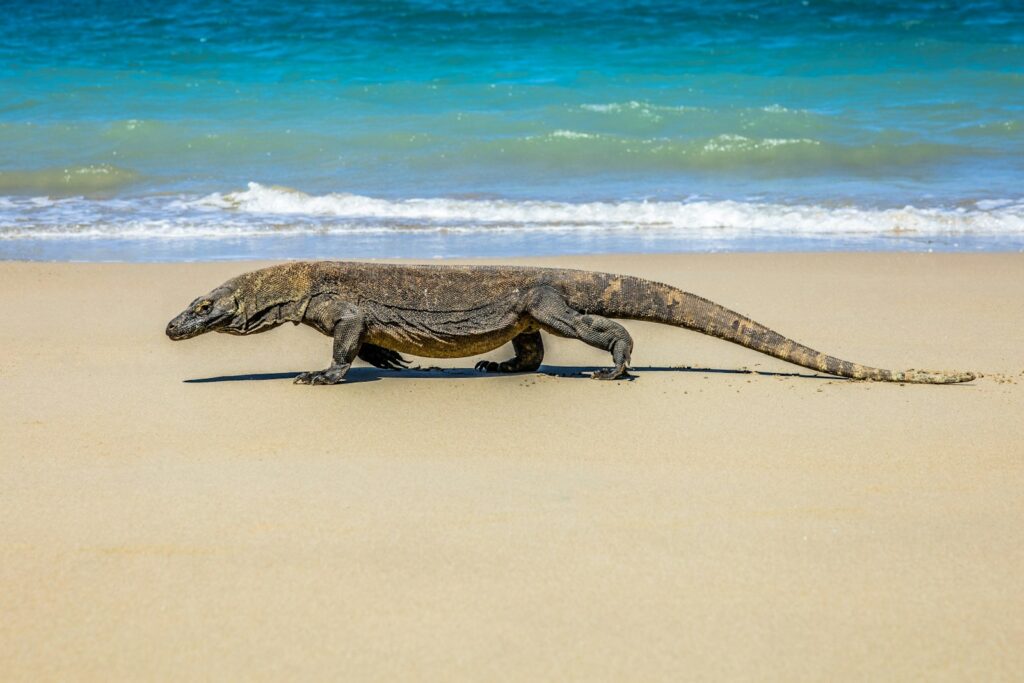
Before getting into site specifics, it helps to calibrate expectations. Komodo National Park holds an estimated 3,000 Komodo dragons spread across Komodo Island, Rinca Island, Gili Motang, and Nusa Kode. Adults reach roughly 3 metres in length and can weigh more than 70 kilograms. These are not zoo animals behind a fence — they move freely through the forest and across the beach, and sightings are genuine, not staged.
Rangers lead every land trek at both stations. There is no unaccompanied walking anywhere in dragon habitat, and park rules strictly prohibit feeding or disturbing the animals. The ranger requirement is not bureaucratic friction; in an environment where a 3-metre reptile can sprint at up to 20 km/h over short distances, an experienced guide who reads animal behaviour is the single most important asset you have on shore.
The park entrance, conservation, and ranger fees are charged in addition to your phinisi charter rate. Expect to budget roughly IDR 600,000–1,200,000 per person for the full 3-day/2-night fee bundle covering entry, marine levy, and ranger costs. Exact figures shift periodically — your operator handles collection and should itemise this clearly on your booking sheet. The widely-reported proposed hike to IDR 3.75 million was shelved after community protests and has not been implemented as of mid-2026.
Loh Buaya: Rinca Island
Location and sailing time
Rinca Island’s main ranger post, Loh Buaya, sits roughly 25–30 kilometres southeast of Labuan Bajo by sea. On a typical phinisi departure — leaving the harbour by 7 or 8 in the morning — you anchor off Loh Buaya in two to three hours. That proximity is the single biggest practical argument for Rinca on a short itinerary. A 3-day/2-night trip that stops at Rinca on Day 1 still has a full second day to reach Padar at pre-dawn, work through Pink Beach, and push west to Manta Point. Include Komodo Island instead and the routing adds significant back-tracking distance, compressing either the dragon time or the reef time.
Ranger-led treks
Loh Buaya offers three marked trek circuits. The short loop covers the immediate station area and the grassy scrub where dragons rest near the kitchen buildings — twenty to forty minutes walking, appropriate for children or anyone with limited mobility. The medium and long circuits cross drier savannah and light monsoon forest and take between one and two hours. The longer options give you a more natural setting and a real sense of the island’s character: the landscape at Rinca is open and slightly less theatrical than Komodo, all dry golden grass in the May-to-October window.
Sighting frequency at Rinca is consistently reported as high. The kitchen and ranger buildings attract dragons because food odours persist, and the station is compact enough that you almost always encounter at least one large adult near the structures. On longer treks you have reasonable odds of seeing animals in actual open terrain, which reads as more “wild” to most visitors than the station-area loiterers. Rangers here are experienced and tend to give context about behaviour, feeding cycles, and the monitoring programme — the quality of the guided experience varies by individual, but Rinca rangers have a solid general reputation among the liveaboard community.
Crowd levels
Rinca gets meaningfully fewer day-trippers than Komodo Island in peak season (July–August). Most day-tour speedboats from Labuan Bajo target Komodo Island for the “famous” name value, which means that during the same busy window, Loh Buaya remains relatively manageable. Morning arrivals before 9 a.m. on a phinisi almost always beat the day-boat crowd. By late morning, the station can fill. On a private charter, you time your arrival to suit conditions — one of the quiet but real advantages of a liveaboard over a day-trip.
The bay itself
Loh Buaya’s anchorage is a sheltered cove fringed with mangrove on the southern edge. Snorkelling directly off the phinisi tender here is modest — this is not a reef-snorkelling destination — but the mangrove fringe supports a visible population of small reef fish and the bay is calm even when wind picks up elsewhere. In the late afternoon, the light on the savannah hillside behind the station turns a warm amber that photographs beautifully. More than a few guests on our vetting trips have said the hour spent back on deck after the trek, watching the island from anchor, was quietly one of the best parts of the trip.
Loh Liang: Komodo Island
Location and sailing time
Komodo Island’s main entry point, Loh Liang, lies roughly 40 kilometres from Labuan Bajo. From Rinca it is another 15–20 kilometres to the south and west. On a 3-day/2-night phinisi route, fitting both Loh Buaya and Loh Liang requires either sacrificing Padar or Manta Point, or running a very long day on the water. On a 4-day/3-night trip the two dragon sites can be combined with the key western highlights without feeling rushed. On three days, you generally choose one. On four days, you can do both.
Ranger-led treks
Loh Liang is the larger and more developed of the two stations. The trek options here are broadly similar in structure — short, medium, and extended circuits — but the terrain at Komodo Island is slightly more varied, with some areas of denser forest where visibility is lower and the sense of actual wilderness is heightened. The Banunggulung and Gunung Api long loops take guides and guests through grassland, seasonal creek beds, and stands of Lontar palms that give the landscape a quality completely distinct from Rinca’s more open savannah.
Dragon population density on Komodo Island is generally considered higher than on Rinca — the island itself is much larger — but that does not automatically translate to better sightings on a short morning trek. The animals range more widely and the forest cover means some treks yield fewer encounters than a station stroll at Rinca. Guides at Komodo Island are highly experienced; the station has been receiving international visitors for decades. The quality of natural-history commentary from a good Loh Liang ranger can be exceptional.
Crowd levels
This is where Komodo Island’s fame becomes a practical factor. Peak season brings substantial speedboat and day-trip volume to Loh Liang. By 10 a.m. in July or August, the main station area can have multiple groups moving through simultaneously. The experience changes. If you are on a phinisi and anchor overnight near the island, a dawn departure to the station before the day boats arrive recovers much of the atmosphere. But that option depends on your captain’s routing and the overnight anchorage being feasible given wind and sea state.
Outside peak season — April through June, or October through November — Loh Liang is quieter and the crowd disadvantage effectively disappears. Shoulder season is consistently the recommendation from experienced operators for visitors who want solitude at either site.
The bay and surrounding highlights
Komodo Island holds a significant geographic advantage for phinisi itineraries: Pink Beach (Pantai Merah) is on the east coast of Komodo Island itself, roughly 8 kilometres from Loh Liang by tender or boat. The pink-red colour comes from the broken shells of foraminifera mixing with white sand — one of a handful of beaches worldwide with this colouration. A Komodo Island morning (dragon trek) followed by a Pink Beach afternoon (snorkelling, swimming) makes a compelling single-island day and is one of the defining sequences in the standard 3-day Komodo route. Rinca does not have an equivalent beach highlight nearby, which is part of why most operators who visit Rinca typically pair it with Kelor Island or Sebayur Kecil on the same or adjacent morning.
Side-by-Side Comparison
| Factor | Loh Buaya (Rinca) | Loh Liang (Komodo) |
|---|---|---|
| Distance from Labuan Bajo | ~25–30 km, 2–3 hrs sailing | ~40 km, 3–4 hrs sailing |
| Dragon sighting reliability | High (station area draws animals reliably) | High, but more variable on longer treks |
| Peak-season crowds | Moderate (fewer day-trip speedboats) | Higher (popular name draws more day trips) |
| Trek variety | Short to medium loops; open savannah | Short to extended loops; forest and grassland |
| Nearby beach highlight | Modest; pair with Kelor/Sebayur | Pink Beach on the same island |
| Fits 3D2N itinerary | Yes, easily — closer to Labuan Bajo | Yes, but tighter scheduling required |
| Fits 4D3N itinerary | Yes, with more buffer for marine stops | Yes, comfortably |
| Scenic character | Open savannah, mangrove bay, quiet | More varied terrain, forest atmosphere |
| Ranger fee structure | Same park fee framework; ranger fees per group | |
Which Fits Your Phinisi Route?
On a 3-day / 2-night itinerary
Rinca is the pragmatic choice for most 3-day phinisi routes. Leaving Labuan Bajo at dawn on Day 1, you reach Loh Buaya before the day boats, complete a medium trek, and still have the afternoon for Padar at sunrise the following morning. The classic 3-day sequence runs: Kelor Island snorkel stop → Loh Buaya (Rinca dragons) → Kalong Island sunset bat flight → Padar pre-dawn hike → Pink Beach snorkel → Komodo/Taka Makassar → Manta Point. That route covers the park’s core highlights without any stop feeling cut short. If you substitute Rinca for Komodo Island in this template, you sacrifice either Manta Point or Pink Beach to make the extra distance work. For most guests on a tight three days, that trade-off does not pay off.
On a 4-day / 3-night itinerary
Four days changes the calculus entirely. The buffer day allows you to visit both Loh Buaya and Loh Liang without compressing the marine programme. A 4-day route typically inserts Komodo Island (dragons plus Pink Beach) as a dedicated Day 2 sequence, while Rinca falls on Day 1 or Day 3 depending on wind and anchorage strategy. This is the itinerary we recommend to guests who feel strongly about seeing both sites — and there are good reasons to. The two islands have genuinely different characters. Doing both in a single trip gives a far more complete picture of the park than either alone.
Dry season versus wet season considerations
Dragon activity and visibility are both better in the dry season (May–October). In the wet months, particularly January and February, vegetation is denser, some trekking paths can be slippery, and sea conditions complicate the additional sailing distance to Komodo Island. If you are travelling in shoulder season (April, November), Rinca is still the easier logistical choice, and the crowd advantage is less critical — both sites are quieter. If you are locked into peak season (July–August), the crowd delta at Rinca versus Komodo Island is at its most pronounced, and the early-morning timing advantage of Rinca is most valuable.
Thinking through your specific dates and priorities before booking is exactly the kind of detail worth discussing with a concierge who knows the park. Plan your charter with our team — a quick WhatsApp conversation about timing and route goals usually gets you a sharper itinerary than any templated package can offer.
What the Trek Is Actually Like
Both sites follow a similar structure. Your tender drops you at the wooden jetty; the ranger station is a short walk from the pier. You sign in, your guide collects the group, and the ranger briefs everyone on distance from animals (a minimum of several metres), no sudden movements, and no food or strong scents that could attract attention. Then you walk.
The medium trek at either station takes roughly 45 minutes to 90 minutes at an unhurried pace. You will likely see dragons at the station area — adults resting near buildings, occasionally young animals in the trees. On longer loops you move into open terrain where encounters are less predictable and correspondingly more memorable. Rangers carry a forked wooden staff; this is the standard crowd-management tool if an animal moves toward the group, and experienced rangers use it with calm efficiency.
Photography: the light at both stations is best in the first two hours after sunrise. Midday light in the dry season is harsh and flattens the texture of the skin. A 70–200mm zoom lens gives you useful working distance; most guests with smartphones do fine but miss the textural close-ups that require optical reach. If you want those images, bring a telephoto or ask if anyone in your group can lend one.
Footwear matters more than most people expect. The terrain at both sites includes loose volcanic gravel, exposed tree roots, and in the wet months, clay that smears across smooth-soled sandals. Closed-toe shoes or trail sandals with grip are the minimum. Flip-flops are routinely regretted.
Children and Dragon Treks
Rangers at both Loh Buaya and Loh Liang accommodate children on the short circuit. The key variables are the child’s ability to stay quiet and follow instructions, and your own comfort level with the inherent unpredictability of wildlife encounters. Rangers assess groups at the gate and will guide younger or less-mobile visitors on the safest path. Very young children (under 5 or 6) are generally kept to the immediate station area where animals are more habituated to human presence and ranger management is tightest. This is a candid point worth raising with your operator before departure — good operators brief families specifically rather than applying a generic safety speech.
Planning a Phinisi Itinerary Around Dragon Sightings
The logistical reality is that Komodo National Park is large enough that sequencing matters. A phinisi gives you flexibility that a day-trip speedboat simply cannot replicate — you anchor overnight where you choose, time your arrivals, and adapt to weather without a fixed turnaround. That flexibility is most valuable on dragon mornings, where arriving at 7 a.m. rather than 10 a.m. can be the difference between a quiet, unhurried encounter with a 2.5-metre adult in open grass and a crowded shuffle through the station behind three other groups.
On most 3-day charters we have reviewed, Rinca delivers the better overall package for dragon sightings within a tight schedule: it is closer, it has a consistently high encounter rate at the station, crowds are lower in peak season, and it slots into Day 1 without disrupting the Padar–Pink Beach–Manta Point core sequence that defines the Komodo phinisi experience. Komodo Island delivers a more varied landscape and the Pink Beach pairing, and it is worth the extra day if you can afford it.
Neither site disappoints, provided you go in with realistic expectations. A Komodo dragon sighting is never guaranteed — this is wildlife — but consistent feedback from guests across dozens of inspected charters makes clear that early-morning arrivals at either station almost never come away empty-handed.
Want help building the right sequence for your dates, group size, and priorities? Plan your charter with our concierge team, or reach us directly on WhatsApp for a no-pressure conversation about what works for your trip.
Frequently Asked Questions
Can you see Komodo dragons at both Rinca and Komodo Island on a single phinisi trip?
Yes, on a 4-day/3-night itinerary. A 3-day/2-night trip can technically fit both, but it compresses the marine programme significantly — most guests on three days choose one site. Rinca (Loh Buaya) is the more common choice on 3-day routes because it is closer to Labuan Bajo and easier to slot into Day 1 without sacrificing Padar or Manta Point.
Which site has better odds of seeing Komodo dragons — Rinca or Komodo Island?
Both sites have high encounter rates for morning arrivals. Rinca’s Loh Buaya is particularly reliable because the compact ranger station area draws adult animals consistently. Komodo Island’s Loh Liang has a larger animal population overall, but they range across a bigger island, so encounters on longer treks can be more variable. For a short morning trek, Rinca edges ahead on reliability.
Is Rinca Island less crowded than Komodo Island for dragon treks?
In peak season (July–August), yes — meaningfully so. Most day-trip speedboats from Labuan Bajo route to Komodo Island, partly for the famous name and partly because it combines with Pink Beach. Rinca attracts fewer day-trippers, which means morning arrivals on a phinisi are more likely to have the station largely to themselves. Outside peak season, the difference shrinks and both sites are manageable.
Do phinisi itineraries always include a ranger-led dragon trek, or is it optional?
Any land visit to Komodo or Rinca Island for dragon viewing requires an official ranger escort — it is a park rule, not optional. The ranger fee is included in the broader park fee structure that your operator collects and pays. Most reputable phinisi charters bundle the park fees into the trip logistics, but confirm this during booking: some advertised prices exclude park entry, trekking, and ranger fees, which can add up to IDR 600,000–1,200,000 per person on a 3-day trip.
What is the best time of day to do a Komodo dragon trek from a phinisi?
Early morning, ideally arriving at the ranger station by 7 to 8 a.m. At that hour, animals are active and moving before the midday heat drives them to shade. Light for photography is also better in the first two hours after sunrise. One of the core advantages of a phinisi liveaboard over a day trip is the ability to anchor close to either Loh Buaya or Loh Liang overnight and reach the station before the day-boat crowd arrives from Labuan Bajo.