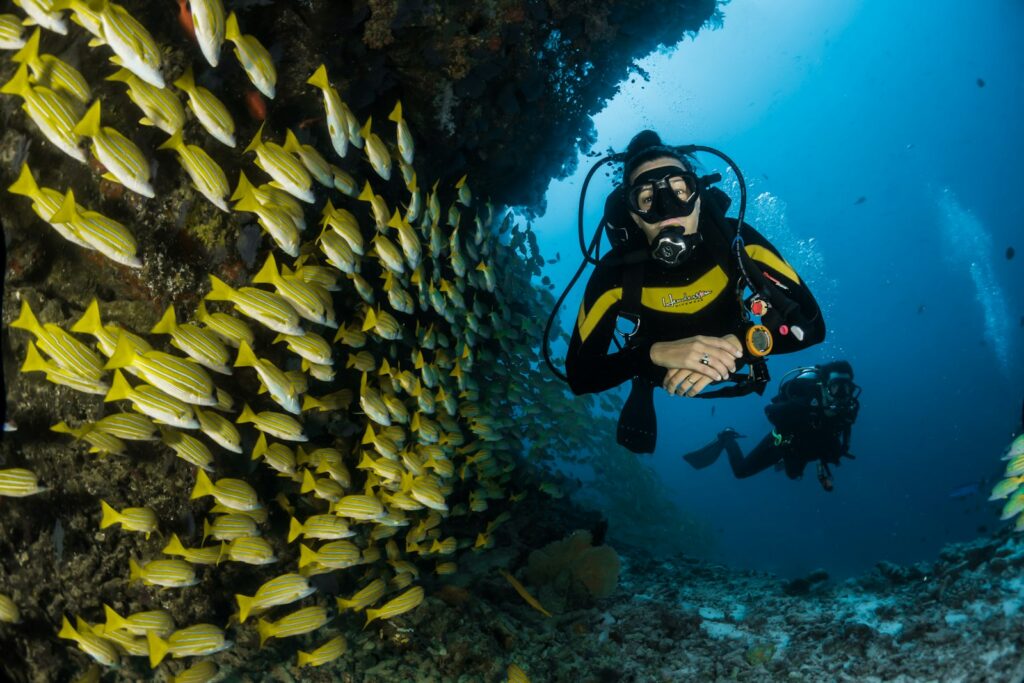
Yes, currents on Komodo phinisi dive trips from Labuan Bajo are strong — and at certain sites, on certain tides, they are among the most powerful you will find anywhere in tropical diving. That is not a deterrent; it is the engine behind everything remarkable about these reefs. The strong tidal flow that pours through the straits between Komodo, Rinca, and the surrounding islands drives cold, nutrient-rich upwellings from the deep. Those upwellings feed the plankton that feed the reef fish that feed the reef. Without the current, the fish life you came to see would largely not be there.
Understanding how these currents work, which sites they hit hardest, and how your skill level intersects with site selection is the difference between a dive trip you talk about for years and one you spend white-knuckling a rock.
Why Komodo Currents Are So Strong
Komodo National Park sits in a narrow band of islands between the Flores Sea to the north and the Indian Ocean to the south. Twice daily, a tidal cycle pushes an enormous volume of water through the straits. Because the passages are shallow and constricted — some bottleneck points drop from reef-top at five metres to walls that descend past sixty — the water accelerates sharply. Think of squeezing a hose with your thumb. The water does not slow down; it speeds up.
At peak tidal exchange, surface currents at exposed sites like Castle Rock can run at two to four knots. At depth, along the walls of Batu Bolong, the flow can be faster still, deflecting off the seamount’s curved flanks in unpredictable directions. This is not unusual ocean current — it is channelled, compressed tidal energy. On a good day, it carries you over the reef like a slow-motion flight, with sharks holding station and schools of fish hovering in suspension. On a bad tide, it can pin you against a rock or drag you into open water before your guide has time to react.
Water temperature adds another layer. Central and southern Komodo receives cold upwellings — you will regularly hit thermoclines dropping to 24°C or lower in the dry season. Northern sites near Tatawa Besar run warmer, around 27–29°C. The cold patches are where the planktonic bloom concentrates, which is exactly why the reef mantas at Manta Point — known locally as Karang Makassar — arrive at the cleaning station in the first place. Manta rays (Mobula alfredi) cruise in from depth, hover at five to fifteen metres in the gentle shallows, and let cleaner wrasse do their work. The current feeds the system; the system feeds the experience.
The Specific Sites and What They Demand
Not all Komodo sites are equal in current exposure. A good phinisi operator will time the dive schedule around tidal windows, but conditions can shift fast. Knowing what each major site involves lets you calibrate your own readiness — and have an informed conversation with your divemaster before you kit up.
Castle Rock
Castle Rock is a submerged seamount in the north of the park — no surface feature, just a pinnacle rising from depth to about five metres below the waterline at high tide. It is the most current-exposed site in the park by reputation, and that reputation is earned. At the wrong tidal moment, the current here runs hard from multiple directions as water piles around the seamount and deflects. The draw is extraordinary: schooling hammerhead sharks are a real possibility, dense aggregations of trevally and snappers, and Napoleon wrasse cruising past at arm’s length. But this site requires solid Advanced Open Water at minimum, real current-diving experience, and a divemaster who has dived it that day, on that tide. Surface swells can complicate entries and exits. Castle Rock on a slack-tide window is accessible to a competent Advanced diver. Castle Rock mid-current is a site for the genuinely experienced.
Crystal Rock
Crystal Rock sits close to Castle Rock in the north and delivers similar fish life — reef sharks, large dogtooth tuna, a permanent school of barracuda that spirals like a living tornado. Current exposure is comparable to Castle Rock, though the site’s topography offers a few more ledges and overhangs where you can duck out of the flow and watch the action in relative comfort. The same experience threshold applies: this is not a site for divers fresh from their Open Water certification.
Batu Bolong
Batu Bolong — literally “hollow rock” — is arguably Komodo’s most photogenic site. A lone rock breaks the surface; below it, a vertical wall drops into blue water on one side while the inshore face forms a sheltered slope. The trick with Batu Bolong is that the current wraps around the rock from the exposed side, and if you drift past the sheltered corner you quickly find yourself in open water. It is frequently included on phinisi itineraries for advanced divers, and for competent Open Water divers on the right tide with a guide who knows when to turn back. The coral cover on the protected wall is exceptional — the kind of coverage that makes underwater photographers fall silent. Schools of fusiliers so thick they block the light. White-tip reef sharks resting in the sand channel at the base.
Manta Point (Karang Makassar)
Manta Point is a different animal. The site is a shallow plateau — five to twenty metres — where reef mantas gather at a cleaning station. Current here is generally moderate, less violent than the northern seamounts, and the manta encounter is often accessible to Open Water divers. The challenge is behavioural rather than technical: staying calm, keeping a horizontal profile, not chasing or hovering directly above the mantas. The park code asks divers to maintain at least three metres’ distance and to avoid cutting across the mantas’ path to the cleaning station. Fin quietly, breathe slowly, let them come to you. The current at Manta Point does pick up on certain tidal phases — your divemaster will be watching it, and a good guide will call the dive before conditions change rather than after.
The Cauldron (Shotgun)
This is the site that generates the most diver stories — and a few diver nightmares. The Cauldron, sometimes called Shotgun on operator itineraries, is a bowl-shaped depression where water enters through a narrow gap and exits through a channel, creating a powerful river-like current at the right state of tide. Entry is against the flow; you swim into the bowl and wait for the current to reverse, then shoot through the channel in a rush. It is deliberately thrilling. It is also one of the clearest examples of a site that requires an experienced guide who has done the dive that day. Time the entry wrong, or misjudge the tidal phase, and it stops being thrilling. This site is for experienced divers only — not certification-level gatekeeping but genuine judgment that comes from having managed current before.
Tatawa Besar and Siaba Besar
These two sites in the central and northern park are generally more forgiving and are often included on diving phinisi itineraries for mixed-skill groups. Tatawa Besar has a wide, sloping reef with moderate current and good coral cover. Siaba Besar is known for green sea turtles resting on the reef — the site’s calmer conditions make it appropriate for Open Water divers and make it a natural first dive of a trip while the group finds its footing.
Down-Currents: The Risk Nobody Talks About Enough
Surface and horizontal currents are visible and, with experience, manageable. Down-currents are different. At exposed seamounts and points — Castle Rock, Batu Bolong, certain conditions at Crystal Rock — the current deflecting off a vertical wall or the edge of a plateau can develop a strong downward component. You start descending faster than your buoyancy compensator can compensate. You add air, but you keep going down. By the time you recognise what is happening, you may already be well below your planned depth.
The response is counterintuitive. Do not fight the down-current by finning upward — at two to three knots downward, you cannot win that battle and you will exhaust yourself trying. Instead, swim horizontally out of the current column. The down-current usually occupies a discrete water mass; moving laterally a few metres often brings you back into neutral or rising water. Established drift-diving practice is also your protection: controlling your buoyancy throughout the dive rather than setting it and forgetting it, staying off the wall face where deflection is strongest, and maintaining visual contact with your guide.
Every phinisi divemaster worth their position will brief down-current protocol before you enter the water at exposed sites. If you board a phinisi and the pre-dive briefing does not mention current management, that is a signal about the quality of guidance on offer.
Certification and Experience: What You Actually Need
- Open Water (OWD)
- Sufficient for calmer sites — Manta Point on a good day, Tatawa Besar, Siaba Besar, Kanawa reef. Not sufficient for Castle Rock, Crystal Rock, Batu Bolong on exposed tidal phases, or the Cauldron. An OWD with minimal post-cert dives should be honest with their divemaster about their actual experience, not just their card.
- Advanced Open Water (AOWD)
- Opens access to most sites on the right conditions. The AOWD peak-performance-buoyancy and deep dives are directly applicable here. But certification is a floor, not a ceiling — an AOWD with one hundred logged dives in calm warm water is a different diver than an AOWD who has spent time in current elsewhere.
- Rescue Diver / Divemaster and above
- Castle Rock, Crystal Rock, and the Cauldron in full current are most comfortably dived at this level. Not because the certification itself transforms you, but because you have accumulated the repetitions to read current changes before they become problems, and to make calm decisions underwater when conditions shift.
- Logged dives as a practical guide
- Operators vary in their guidance. A rough working standard used by experienced guides: 50+ logged dives before attempting the exposed northern seamounts, with some of those dives in moving water. This is informal and site-specific — ask the divemaster on your specific phinisi, not a generic online forum.
One thing that matters as much as certification: honesty. Komodo’s divemasters are guiding groups across a range of experience levels, often in a second or third language. If you have anxiety about current, tell your guide before the dive, not after you have gone over the edge. A good guide will position you on the calmer side of the site, keep you in reach, and call the dive early if conditions change. That conversation happens at the surface, in calm water, with your BC inflated — not twenty metres down with the current accelerating.
How Phinisi Operators Manage the Current Question
A well-run diving phinisi out of Labuan Bajo will do several things that direct the current exposure you experience.
First, tidal timing. Your divemaster should plan each dive around the tidal window, targeting slack water or the ebb phase at exposed sites. This is not a guarantee — tides at Komodo are semi-diurnal, meaning two cycles per day, and local topography creates variations from the published tables. But an operator who says “we go when the guests are ready” rather than “we go when the tide is right” is not running a serious dive operation.
Second, site selection for the group. A good phinisi guide reads the group after the first dive and adjusts the subsequent site list accordingly. If two guests are struggling with buoyancy, the next dive will not be Castle Rock. This is what genuine site expertise looks like — knowing the full roster of sites, not just the headline names.
Third, descent strategy. At sites like Batu Bolong, the standard approach is a negative-entry descent — you deflate on the surface and kick down quickly, using the wall’s shelter to control the descent before the current grabs you. Your guide will demonstrate or explain this before entry. If they do not, ask.
Fourth, the surface marker buoy. At every drift dive, a delayed surface marker buoy should be deployed on ascent — a bright tube that tells the phinisi’s tender where to collect you. Current carries groups laterally; a competent tender driver follows the bubbles and the SMB. Without it, a drift dive becomes a recovery exercise. Check that your guide carries an SMB and that the tender is in the water and watching before you enter.
If you are in the planning stage and want to discuss how to match site selection to your group’s experience levels — or which trips include genuine current-briefing protocols — you are welcome to plan your charter with our concierge. We vet diving phinisi on the quality of their dive guidance, not just the thread count in the cabins.
Drift Technique: Working With the Current
Drift diving is a skill most divers develop over time through specific experience. A few principles that apply directly to Komodo:
Buoyancy is everything. In current, buoyancy errors amplify. A diver who is slightly negative keeps crashing into the reef; one who is slightly positive gets pulled toward the surface. Neutral buoyancy — genuinely neutral, not within a half-metre of neutral — is what allows you to hold position effortlessly in flow and react to current changes without burning air or disturbing the reef.
Keep fins still when possible. In a current that is carrying you at one to two knots, unnecessary kicking is wasted energy and disturbs particulates. Learn to steer with small fin adjustments and let the current do the moving. You will be calmer, you will last longer, and the fish will not scatter.
Stay with the group. Current separates divers. The distance between you and your guide should be smaller in strong current than in calm water, not larger. If you notice yourself drifting away from the group — laterally, vertically — correct it immediately. The further you drift, the more effort it costs to recover, and the harder it becomes for the guide to manage everyone simultaneously.
Watch the reef. The reef surface is the most reliable current gauge you have. At slack water, particles and plankton drift gently. As the current builds, soft corals and gorgonian fans lean uniformly in one direction. Feather stars close their arms. Fish drop lower to the reef. These are your real-time tide indicators, available to you at depth when your gauge is showing a number but not telling you what the current is doing right now.
Know when to surface. A Komodo drift dive in strong current covers distance quickly. If conditions change abruptly — an unexpected channel accelerates the flow, or a down-current develops — the correct decision is often to surface and re-enter from the tender at a calmer part of the site, not to battle current until you are low on air and far from the boat. This is not failure; this is reading the situation correctly. Good guides make this call without drama.
Seasons and Current Intensity
Current is present year-round at Komodo — the tidal exchange does not take a break. But the dry season (approximately April through October, with July through September being peak) delivers the best combination: calmer sea surfaces, best underwater visibility at around twenty to thirty metres at top sites, cold upwellings at maximum strength, and therefore maximum plankton and fish aggregations. This is when the manta encounters at Karang Makassar are most reliable and when the schooling action at the northern seamounts peaks.
April through June offers calmer conditions and fewer boats — a genuine advantage for dive trips, since less boat traffic means easier navigation for tenders and less noise interference on the reef. October and November offer a similar window as the peak-season crowds thin.
During the wet season (roughly December through March, with January and February the worst), surface conditions deteriorate — waves and chop make entries and exits harder and comfort on the phinisi itself less reliable. Visibility drops. Many operators reduce dive schedules or shift emphasis to protected sites. Some suspend diving operations in February. This is not the time to attempt your first Komodo dive trip.
What to Ask Your Phinisi Operator Before You Book
The quality of dive guidance varies significantly across the phinisi fleet operating out of Labuan Bajo. A few questions that separate a serious dive operation from one where diving is an afterthought:
- Does the divemaster check tidal tables and adjust the day’s dive sites accordingly, or is the itinerary fixed?
- How many dives per day are planned, and what is the maximum depth at each site?
- Is Nitrox (enriched air) available? At what mix, and is there an additional charge?
- What is the minimum certification requirement for northern seamount sites like Castle Rock and Crystal Rock?
- Does the guide carry a delayed surface marker buoy, and is a dedicated tender in the water during dives?
- What is the protocol if a diver surfaces away from the group in current?
- How many divers per guide? Two or three is professional. Six to eight is management, not guiding.
A divemaster who answers these questions fluently, without hesitation, has dived these sites many times and thought about safety as a practice rather than a checklist. The answers themselves matter less than whether the person giving them knows the material cold.
FAQs: Currents on Komodo Phinisi Dive Trips
Do I need to be an Advanced Open Water diver to dive at Komodo?
Not for every site — Open Water certification is sufficient for calmer sites like Manta Point on moderate conditions, Tatawa Besar, and Siaba Besar. For the northern seamounts — Castle Rock, Crystal Rock, and the Cauldron — Advanced Open Water with real current-diving experience is the practical minimum. Certification cards are not the whole picture; the number and variety of your logged dives matters equally. Be honest with your divemaster about your actual experience, and they will match you to the right sites.
Are down-currents dangerous, and how do I know if I am caught in one?
Down-currents at Komodo are real and can be rapid. The main indicator is uncontrolled descent that continues despite adding air to your buoyancy compensator. If you find yourself sinking faster than you can compensate, resist the instinct to fight it vertically — swim horizontally out of the current column instead, which usually takes only a few fin strokes. Pre-dive briefings at exposed sites should cover this protocol. If they do not, ask your divemaster directly before entering the water.
What is the best time of year for diving the strong-current sites like Castle Rock?
July through September offers the peak combination of calm sea surfaces, maximum underwater visibility (often twenty to thirty metres), cold upwellings that drive plankton and fish aggregations, and reliable tidal windows. April through June and October through November are excellent shoulders — fewer boats, near-comparable conditions. Avoid January and February; sea conditions deteriorate and many operators reduce dive schedules entirely during those months.
Is Manta Point suitable for less experienced divers?
On the right conditions, yes. Manta Point — Karang Makassar — is a shallow cleaning station site at five to twenty metres with generally moderate current, and it is accessible to Open Water divers who are comfortable with their buoyancy. The challenge is behavioural: stay calm, maintain at least three metres from the mantas, avoid chasing, keep horizontal in the water column. Your guide will position the group correctly. On certain tidal phases, current picks up — your divemaster will call the dive early if conditions shift before you are comfortable doing so yourself.
How many dives per day can I expect on a diving phinisi liveaboard from Labuan Bajo?
Most diving phinisi operate two to four dives per day, depending on tidal windows and the group’s energy levels. Three dives per day is common on a well-run liveaboard — morning, midday or early afternoon, and a late afternoon dive, sometimes with a night dive as an option at anchor. The number matters less than whether the schedule is genuinely built around the tides. A fixed three-dives-per-day itinerary that ignores tidal phases is less valuable than a flexible two-to-three-dive day timed to the site conditions.
Planning a diving phinisi trip and want to match the right vessel and guide quality to your group’s experience level? Reach out to plan your charter — we are happy to advise over WhatsApp or email, and we can point you toward operators whose dive programmes are genuinely current-aware rather than just dive-trip branded.