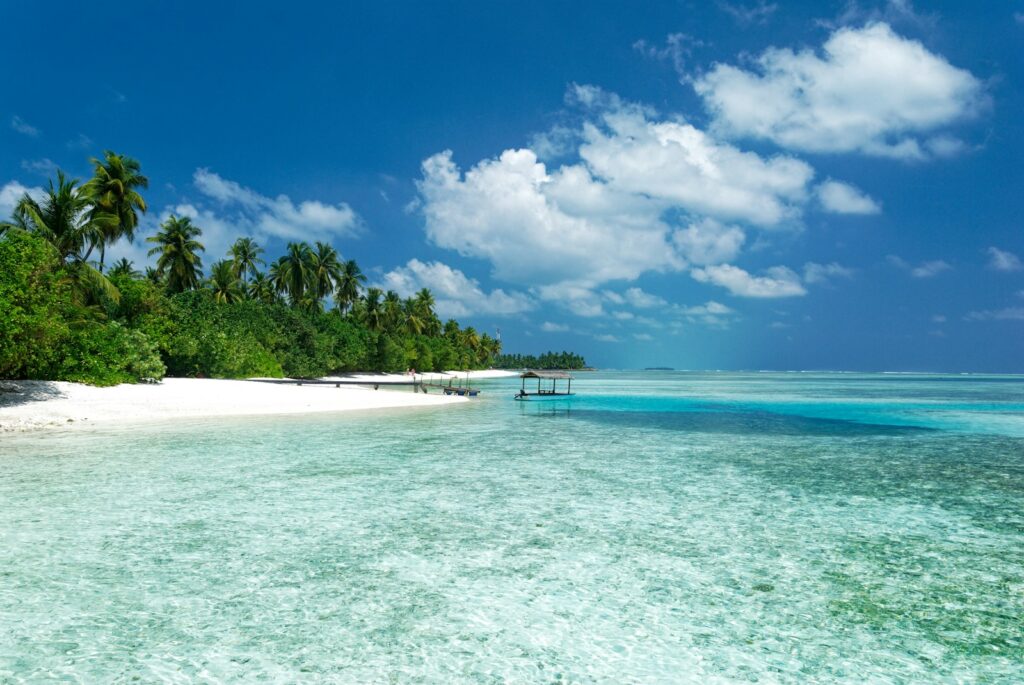
Kanawa Island snorkeling from a Labuan Bajo phinisi boat means pulling anchor roughly 10–15 km offshore and dropping into a shallow fringing house reef that starts at barely 1–2 metres off the beach and grades down to around 5–10 metres before giving way to deeper water. The transfer from Labuan Bajo harbour takes 45–60 minutes by tender or the phinisi itself — close enough to tuck in as a first or last stop on a 3D2N itinerary, far enough that the reef is quieter than the busy sites inside the national park core.
Where Kanawa Sits in a Komodo Itinerary
Pulau Kanawa is not inside the core patrol zone of Komodo National Park the way Padar or Rinca are, which changes the logistics in a couple of practical ways. Park entrance fees are typically tied to the main island clusters, so your phinisi crew will advise you on exactly which fees apply to a Kanawa stop — it is worth clarifying this at the itinerary-planning stage rather than discovering a surcharge on the last morning. The island itself is small, privately managed, and has basic infrastructure including sun loungers and a simple café.
On a standard 3D2N phinisi route, Kanawa usually appears on Day 1 (heading west from Labuan Bajo as a warm-up reef before the full park push) or on the final morning of Day 3 before returning to harbour. On a 4D3N itinerary, it fits more comfortably mid-route — an easy, unhurried half-day between the intensity of a Komodo dragon trek and the drift currents at Manta Point. Either way, the typical day structure holds: snorkel stop before lunch aboard, then on to the afternoon’s main attraction.
The Reef Itself: What You Are Actually Looking At
Depth and Entry
The fringing reef wraps around the island’s shoreline like a collar. You wade or swim from the beach and are over living coral almost immediately. In the shallowest sections — 1 to 2 metres — even nervous first-timers and children who can swim will manage if seas are calm. The visibility here depends heavily on tide and time of day; early morning, before snorkel traffic kicks up the sand, is reliably the clearest. By mid-afternoon on a busy day, particulate can reduce horizontal visibility to under 5 metres in the shallows.
The drop-off toward 5–10 metres is gradual rather than dramatic. This makes Kanawa genuinely family-friendly in a way that sites like Batu Bolong or Castle Rock are not — those sites demand current management experience that even a competent recreational diver has to respect. At Kanawa you are not fighting thermoclines or unpredictable upwellings. The trade-off is that you are also not going to see the schooling barracuda towers or massive napoleon wrasse that come with the stronger-current sites deeper in the park.
Marine Life You Can Reasonably Expect
Komodo National Park’s waters support extraordinary biodiversity across its 1,817 square kilometres of marine habitat, and Kanawa shares the same bioregion. On a typical morning snorkel here you can expect hard coral table formations and branching staghorns in the shallower sections, interspersed with patches of soft coral where the light breaks through. Resident reef fish are the dominant story: parrotfish grinding on coral, sergeant majors patrolling their egg patches, wrasse of various sizes, the occasional moray eel tucked under a ledge. Turtles are seen with some regularity — green turtles in particular — though they are not guaranteed on any single visit.
What you are less likely to encounter here compared to the park’s northern dive sites: manta rays (for those, Manta Point / Karang Makassar is the dedicated stop, where reef mantas with wingspans of up to 4.5–5 metres use the cleaning station at 5–15 metres depth), Komodo’s famous channel currents with their associated pelagic life, and the macro critters that reward slow, trained eyes at sites like Tatawa Kecil. Kanawa is a reef health story, not an adrenaline story. That is its honest appeal.
Reef Condition and Conservation
Komodo National Park holds UNESCO World Heritage status as both a terrestrial and marine protected area. The reef conservation rules that apply in the park core — no touching corals, no collecting shells or specimens, use of mooring buoys rather than anchor drops on live reef — apply at well-run phinisi operators across the region. When booking, it is worth asking your operator directly whether the boat uses buoys or drops anchor. A crew that anchors on coral at a less-monitored site like Kanawa is one that will do the same at Manta Point. The question is a useful proxy for how seriously the operator takes marine stewardship overall.
Best Time to Visit Kanawa for Snorkeling
The dry season running roughly April through October gives you the best underwater conditions across the entire Komodo region. Visibility in this window can reach 20–30 metres on good days, seas are calmer, and the logistics of running a phinisi itinerary become more predictable. Within that window, May to June and October are the sweet spots: good water clarity, fewer boats than the July–September peak, and a landscape that is still partially green from the tail end of the wet season.
July and August bring the most traffic. Kanawa’s relative distance from Labuan Bajo means it stays quieter than Pink Beach or the Padar viewpoint — but relative quiet is still relative in high season. If you are on a private phinisi charter and the itinerary is flexible, asking your captain to time the Kanawa stop for early morning (before day-trip boats from Labuan Bajo arrive) makes a measurable difference to your experience of the reef.
The wet season months of December through March introduce a different calculation. January and February see the roughest seas in the region, with stronger winds and reduced visibility. Many operators scale back sailings during this period, and a 45–60 minute crossing that is comfortable in May can become genuinely unpleasant — or unsafe — in February swell. If your travel dates fall in the wet season, discuss Kanawa specifically with your captain: the exposure of the crossing and the island’s orientation mean it is more sensitive to northwest swell than some of the more sheltered sites inside the park bays.
- Transfer time from Labuan Bajo
- ~45–60 minutes by phinisi or tender
- Distance from harbour
- ~10–15 km offshore
- Reef depth range
- 1–2 m (beach entry) to ~5–10 m (reef edge)
- Best season
- April–October (peak visibility May–Sep; sweet spot May–Jun, Oct)
- Worst period
- January–February (heavy rain, rough seas, low visibility)
- Manta rays here?
- Unlikely — for mantas, the dedicated stop is Manta Point / Karang Makassar
- Skill level
- Beginner-friendly in calm conditions; children who can swim managed with supervision
- Park fee status
- Confirm with your operator — Kanawa is outside the main park core; fee structure may differ
Kanawa on a Private Phinisi vs a Shared Open Trip
On a private phinisi charter, Kanawa’s timing is entirely negotiable. If the morning light is perfect and you want two hours rather than forty-five minutes, the captain adjusts. On a shared open-trip boat, the schedule is fixed — you get your designated slot and move with the group. Neither format is categorically superior, but the flexibility argument is most acute at a stop like Kanawa, where the quality of your reef experience is meaningfully affected by whether you arrive before or after the day boats from town.
Private whole-boat charters across the luxury end of the market run from roughly USD 1,000 to USD 5,000 or more per night depending on the vessel’s quality and amenities — and that range is wide by design, because a 20-metre budget phinisi and a 35-metre luxury vessel with en-suite cabins, a professional dive guide, and a compressor for Nitrox fills occupy entirely different brackets even though both use the word ‘private.’ Shared open-trip phinisi run approximately USD 100–250 per person per day. The Komodo park fees — currently in the rough range of IDR 600,000–1,200,000 per person for a 3D2N trip across all the park, ranger, and conservation components — are usually charged on top of the boat rate regardless of which format you book. Verify the current exact figures with your operator before departure, as these are adjusted periodically by park authorities.
If a Kanawa stop matters to you specifically, mention it when you are reviewing the proposed itinerary rather than assuming it is included. Some operators skip Kanawa in favour of Sebayur Kecil or Siaba, which are within the park and offer comparable reef conditions. Neither is objectively better — they are different reefs at different distances, and the right answer depends on your group’s priorities and how much time you want to spend in transit versus in the water.
Ready to plan your charter? Talk to our concierge — we can match your group size, travel dates, and budget to operators we have vetted firsthand, and we are available on WhatsApp if you prefer to plan in real time.
Practical Notes for the Day
Gear and Sun Exposure
Good phinisi operators provide basic snorkel sets, but the fit of rental masks is always a lottery. If snorkeling is a priority for your trip rather than an incidental activity, bringing your own mask is the single most impactful equipment decision you can make. A mask that seals well on your face means the difference between two hours of uninterrupted reef time and twenty minutes of fogging and leaking.
The sun at Kanawa is equatorial and the shallow water creates a lens effect — reflected UV from the surface hits the backs of your legs, your shoulders, and the back of your neck even through light cloud. A reef-safe sunscreen and a rashguard or lycra suit are not optional courtesies here; they are practical kit. Many operators now specifically request or provide reef-safe options, as standard chemical sunscreens are documented contributors to coral bleaching, and in a marine protected area the request is reasonable.
Eating and the Island
Kanawa has basic facilities including a café, so it is technically possible to take a meal ashore — but most phinisi guests eat aboard, and the food quality on a well-provisioned charter boat will generally exceed what a small island café can offer. The better use of shore time is the snorkeling itself, and a post-reef lunch at anchor in Kanawa’s bay is a genuine pleasure. Most phinisi guests remember the meal they had at anchor, sea flat, canopy rigged, better than any restaurant stop along the route.
Photography in the Shallows
Kanawa’s 1–2 m entry zone is well-suited to wide-angle reef photography rather than macro work — the ambient light at that depth is generous, coral formations are photogenic, and the fish activity is consistent. If you are shooting with a phone in a housing or a basic underwater camera, this is a forgiving environment. The higher ambient light means you can often skip strobe and still get usable colour. Deeper toward 8–10 m the scene gets richer and the colour palette shifts — worth a few minutes of free-diving down if you are comfortable doing so, but not a site that rewards extended breath-hold work the way a wall dive would.
How Kanawa Fits the Broader Route
To put Kanawa in honest context: it is not the signature dive site that Batu Bolong or Castle Rock are. It is not where you see Komodo dragons, and it is not the iconic tri-bay panorama from Padar’s ridgeline. What it does well is provide a calm, accessible, genuinely beautiful reef stop at a distance from Labuan Bajo that fits naturally as a bookend to a multi-day itinerary — a relaxed entry into the archipelago on Day 1, or a final hour of clear water before the phinisi points its bow back toward harbour.
For non-divers or guests who are not seeking the strong-current sites, it is often the highlight precisely because it is comprehensible at snorkel depth. You do not need to be certified or briefed on current management strategies. You need a mask, a fin set, and reasonable sea conditions — all of which a competent operator will provide or confirm before the anchor goes down.
The honest recommendation: if your itinerary includes Kanawa, embrace it for what it is. If it does not and you specifically want it, ask early. And if your priority is manta rays, dragon treks, and the full Komodo spectacle, treat Kanawa as the aperitif rather than the main course — it earns that role without apology.
Planning a phinisi route that includes Kanawa or other stops across the archipelago? Reach out to our concierge team for independent advice on operators, itineraries, and what the current sea conditions are looking like for your travel window. We are also on WhatsApp for straightforward questions that do not need a full email thread.
Frequently Asked Questions
How far is Kanawa Island from Labuan Bajo by phinisi?
Kanawa Island sits approximately 10–15 km offshore from Labuan Bajo harbour. By phinisi or tender, the transfer takes around 45–60 minutes depending on sea conditions and vessel speed. It is close enough to work as a Day 1 warm-up stop or a final morning detour before returning to port on the last day of a 3D2N or 4D3N charter.
Is Kanawa Island snorkeling suitable for beginners or children?
Yes, in calm conditions. The fringing house reef starts at 1–2 metres off the beach, which is genuinely shallow — children who are comfortable in the sea and can swim independently will manage with adult supervision. The absence of strong channel currents (which are a real factor at sites like Manta Point or Batu Bolong) makes Kanawa one of the more forgiving reef snorkeling stops in the Komodo region. Always verify sea conditions with your captain on the morning of the stop.
Will I see manta rays at Kanawa Island?
Manta ray sightings at Kanawa are not what the reef is known for. The dedicated manta stop in the Komodo region is Manta Point (Karang Makassar), where reef mantas use a shallow cleaning station at 5–15 metres and sightings are consistent during the dry season, especially May through September. If manta encounters are a priority for your trip, confirm that Manta Point is on your itinerary — it is a distinct stop from Kanawa.
Do I need to pay a park entry fee to snorkel at Kanawa Island?
Kanawa Island sits outside the main Komodo National Park patrol zone that covers Komodo, Rinca, Padar, and the core marine sites. Whether a park fee applies to a Kanawa stop depends on your operator’s permit structure and how the day’s route is filed. The practical answer is to ask your operator directly before the trip — a transparent operator will give you a clear breakdown of which fees are included and which are charged separately. Park and conservation fee structures in the Komodo region are periodically revised, so verify close to your travel date rather than relying on figures from a year or more ago.
What is the best time of day to snorkel the Kanawa reef?
Early morning — ideally before 09:00 — gives you the best combination of visibility, light angle, and fish activity. The shallow sections are clearest before snorkel traffic stirs up fine sediment, and the morning sun at a low angle produces good colour rendering in the 1–5 metre zone without the harsh overhead midday light that flattens underwater photography. If your phinisi is anchored near Kanawa overnight, a pre-breakfast snorkel is worth the early alarm.