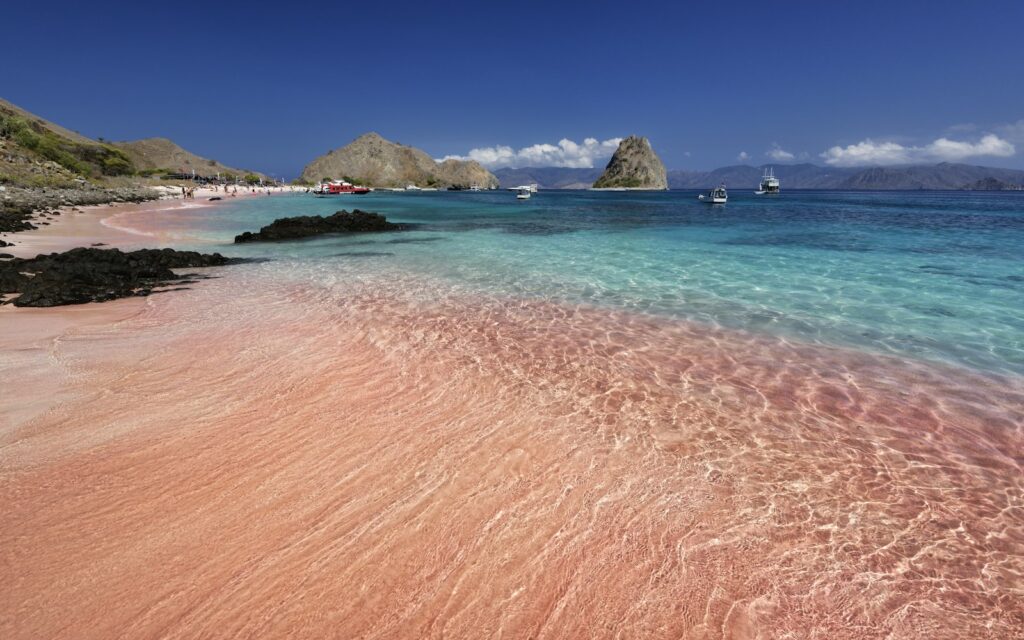
Pink Beach (Pantai Merah) on Komodo Island gets its color from the crushed red shells of microscopic Foraminifera — single-celled organisms whose iron-rich calcium carbonate housings tint the white coral sand a distinctive rose. The result is one of only around seven or eight pink-sand beaches known to exist worldwide, and it is reachable only by boat — which is precisely why a labuan bajo phinisi pink beach snorkeling and photo stop has become the centerpiece of almost every Komodo National Park itinerary worth planning.
There is nothing vague about the color. Stand at the waterline on a clear morning and the sand shifts from pale salmon near the high-tide mark to a deeper brick-rose where the wet sand catches the light. It changes again at depth: the reef below the entry point is dense enough that even snorkelers peering down through 3–5 m of water can see coral tables and the occasional reef shark gliding past. Pink Beach is not difficult. It is also not empty in peak season. How you arrive — and when — matters a great deal.
What Makes the Sand Pink: The Science Behind Pantai Merah
Foraminifera (forams, informally) are marine protists that build intricate shells, called tests, from calcium carbonate. Several species incorporate iron into their shell structure, producing that characteristic red-orange pigmentation. When they die, the tests accumulate on the seafloor, fragment under wave action and fish predation, and mix gradually with the surrounding white carbonate sand produced by coral and mollusks. At Pink Beach, the ratio is high enough to be unmistakable even from a phinisi deck at anchor.
The beach sits on the southwestern coast of Komodo Island inside Komodo National Park — a UNESCO World Heritage Site and Marine Protected Area covering roughly 1,817 km² of land and sea. The color is most saturated where the sand is fine and where the shoreline geometry slows wave energy, concentrating the foram material rather than dispersing it. You will notice the hue varies along the 300-metre strip: the southern end tends to be the richest pink, the northern end a softer peach. This is worth knowing for photography.
The foram explanation is scientifically settled, but the beach is still frequently misidentified in travel writing as being colored by coral. Coral fragments are white-grey. The pink comes entirely from the foram shells. Worth getting this right if you are explaining it to fellow guests at dinner aboard.
Getting There: Why Phinisi Is the Correct Vessel
Speedboat day trips from Labuan Bajo do reach Pink Beach, typically as a rushed 90-minute stop within a tight circuit. A phinisi — the traditional twin-masted wooden vessel of the Bugis and Konjo peoples of South Sulawesi — approaches this differently. You arrive at anchor in the early morning or mid-morning after the speedboats have already cleared out, or you stay into the golden hour after they have left. The phinisi also anchors far enough offshore to avoid reef damage: operators using mooring buoys (park rules require no anchoring on coral) leave the entry corridor clean.
On a 3D2N private charter, Pink Beach typically falls on the morning of Day 2 or early afternoon, after the Padar Island sunrise hike. On a 4D3N trip, the pace slows enough to allow two full hours rather than forty-five minutes. That extra time changes the experience substantially — long enough to snorkel both the left and right reef arms, dry out on the beach, take unhurried photos, and still have energy for the Taka Makassar sandbar or Manta Point in the afternoon.
Phinisi vessels range from open-trip budget boats (sharing with strangers, basic meals, simple cabins) to private luxury charters where the beach stop can be timed and extended to your preference. For photography in particular, private charter gives you something no shared boat can: the ability to ask the captain to hold the mooring until the light is right. That is not a small thing when the difference between flat midday light and the low-angle morning glow is the difference between a good image and a great one.
Best Timing for Snorkeling and Photography
Time of Day
Early morning — roughly 07:30 to 09:30 — gives the best snorkeling visibility and the warmest photographic light on the beach itself. The sun angle from the east illuminates the sand face-on rather than bleaching it out from overhead. Water clarity at Komodo during the dry season runs to 20–30 m on good days, and the sandy bottom at Pink Beach is shallow enough (1–4 m in the entry zone) that you can see every detail from the surface without diving.
Midday (11:00–13:00) is when most day-trip boats cluster here. If you are on a private phinisi charter, instructing your captain to arrive before 09:00 or after 14:00 almost entirely avoids the crowd. The late-afternoon window — 14:30 to 16:00 — gives a softer, more directional light that most photographers prefer for wide shots of the beach.
Season
The dry season, roughly April through October, is when Pink Beach is at its best for both snorkeling and photography. May through early July offers green hillsides framing the cove (the vegetation is still lush after the wet season), clear water, and a thinner crowd than August–September peak. July, August, and early September bring the highest visitor numbers but also the strongest underwater visibility — 25–30 m is realistic on a calm day. October is a personal favorite: visibility remains excellent, the boats thin out, and the late-season light is particularly warm.
January and February are the roughest months. Seas in the Flores Sea can be choppy enough to make the phinisi passage uncomfortable, and reduced visibility — sometimes below 10 m — takes the edge off the underwater experience. Most reputable operators suspend or heavily reduce sailings in February specifically. If your dates fall in the wet season, the November–December window is a reasonable compromise: occasional rain but generally manageable seas.
Snorkeling Pink Beach: Entry, Reef Layout, and What to Expect
The Entry Point and Reef Arms
The beach has a natural sandy entry lane in the center, flanked by reef on both sides. Wade in slowly — the bottom is sandy and flat for the first 10–15 m, then transitions to scattered coral heads before the reef proper begins at roughly 3–5 m depth. The left reef arm (when facing the sea) tends to be more intact and more frequently snorkeled. The right arm is slightly deeper and often less crowded even when the beach itself is busy.
Current at Pink Beach is generally mild compared to the notorious channels at Castle Rock or Shotgun — this is a sheltered cove. That said, tidal conditions change the picture. On an outgoing tide the water pulls gently offshore, which is noticeable once you get beyond the first reef line. Stay within about 50 m of the beach unless you are a confident swimmer and the conditions are clearly calm. The phinisi’s tender (the small motorized dinghy carried on board) should be standing by when guests are in the water — on a well-run charter it always is.
Marine Life
The reef at Pink Beach is not Komodo’s most dramatic dive site — Castle Rock and Crystal Rock are in a different category — but it punches well for snorkeling. Resident species include green and hawksbill turtles (common), reef sharks (blacktip, frequently seen resting on sandy patches), Napoleon wrasse, parrotfish in several species, and the usual Indo-Pacific reef fish community: surgeonfish, angelfish, moorish idol, and dense schools of fusiliers near the reef edge. Occasional sightings of bumphead parrotfish in small groups, particularly in the early morning before boat traffic builds.
Nudibranch and macro life are present but harder to find without diving. For snorkelers, the big draws are the turtles and the visual scale of the reef tables — some of the Acropora table corals here are genuinely large, wide enough that swimming across them takes a few seconds. The coral health is reasonable; bleaching events have affected parts of the park, but the Pink Beach site has maintained relatively good coverage.
Certification and Equipment
No certification is required for snorkeling. A mask, fins, and a snorkel are all you need, and every legitimate phinisi operator provides these as standard. If you have your own equipment, bring it — rental gear varies in quality and fit, and a poor-fitting mask will spoil a session more reliably than any current. A rashguard or wetsuit (3 mm short) is recommended; water temperature in central and southern Komodo runs roughly 24–27°C due to cold upwellings that drive plankton productivity. Northern Komodo and the shallower reef at Pink Beach tends toward the warmer end of that range — around 26–28°C in the dry season — but a rashguard still keeps you comfortable for an hour in the water and provides sun protection.
Photo Spots: Getting the Pink Beach Shot
The beach photograph that circulates endlessly online is taken from a slight elevation at either end of the cove, looking back along the beach with the phinisi at anchor in the blue water behind. The northern headland gives you the classic angle with the vessel and open ocean framing the pink sand foreground. The southern end offers a tighter composition with the hillside vegetation above.
On-Beach Angles
The most reliable technique for capturing the pink color is to photograph the wet sand at the waterline at a low angle — nearly parallel to the ground — in morning or late-afternoon light. The saturation doubles compared to a straight-down overhead phone shot. Polarizing filters (physical or in editing) reduce glare significantly and deepen the blue-green water contrast against the sand.
Drone
Drone photography at Komodo National Park requires a permit, which your phinisi operator should arrange as part of the charter paperwork. Do not fly without it — rangers are present at Pink Beach and enforcement has tightened in recent seasons. Assuming your permit is in order, the aerial view is the definitive Pink Beach image: the full sweep of the rose-pink beach curved against vivid blue water, with the phinisi at anchor and the dry hills of Komodo Island as a backdrop. The best aerial light is 07:30–09:00 or 15:30–17:00. Direct noon light from above washes out the color.
Underwater
For underwater photography, the sandy bottom with scattered coral heads in 2–4 m of depth is well-suited to a wide-angle lens or an action camera on a float. Position yourself looking up-reef with the surface light behind you for the classic turtle silhouette shot when one obliges.
Park Fees and Practical Notes
Pink Beach sits within Komodo National Park, and all visitors pay entrance fees. The fee structure has been revised multiple times and should be confirmed close to travel — a proposed hike to roughly IDR 3.75 million per person was protested heavily by the local tourism industry and effectively shelved, and the current structure reverts to a lower per-person per-day charge. Practically, for a 3D2N or 4D3N phinisi trip, budgeting roughly IDR 600,000 to IDR 1,200,000 per person for park and ranger fees combined is a reasonable working estimate. Park fees are almost always charged separately from the phinisi charter rate — this is one of the most common surprises for travelers who see a charter price and assume it is all-inclusive. Ask your operator explicitly before booking.
- Beach location
- Southwestern coast of Komodo Island, Komodo National Park, East Nusa Tenggara, Indonesia
- Sand color source
- Red-pigmented Foraminifera shells mixed with white coral sand
- Rarity
- One of approximately 7–8 pink-sand beaches worldwide (estimate)
- Snorkel depth range (entry zone)
- 1–5 m; reef proper begins at ~3–5 m
- Water temperature (dry season)
- ~26–28°C at surface (central Komodo upwellings can cool to ~24–27°C)
- Typical phinisi visit duration
- 45–90 min (shared open-trip); 2–3 hrs (private charter, flexible)
- Best season for visibility
- May–October (peak visibility July–September: 20–30 m)
- Best season for photography (light + fewer boats)
- May–early July and October
- Park fees (approximate, 2026)
- ~IDR 600,000–1,200,000 pp for a 3D2N trip; confirm with operator — usually excluded from charter price
- Drone permit
- Required; arrange via your phinisi operator before departure
How Pink Beach Fits Into a Phinisi Itinerary
On the standard 3D2N route from Labuan Bajo, Pink Beach almost always appears on Day 2 morning, after the pre-dawn Padar Island sunrise hike and a return to the boat for breakfast. The sequence — Padar at first light, Pink Beach mid-morning — is genuinely well-designed: you arrive with a natural energy high from the hike, the snorkeling cools you down, and you have a long afternoon ahead for Taka Makassar sandbar or Manta Point at Karang Makassar. On a 4D3N charter, the itinerary can breathe: some operators save Pink Beach for Day 3 when boat traffic is marginally lighter, or pair it with a short morning reef snorkel nearby before arriving.
If you are planning a private charter specifically around photography — drone and underwater — a 4D3N structure gives you the flexibility to schedule Pink Beach around ideal light conditions rather than accepting whatever the day hands you. It also gives you a weather buffer. Komodo’s conditions can shift within a morning; having an extra day means a suboptimal Day 2 can be recovered on Day 3 without compressing the rest of the itinerary.
If you want to plan your charter around photography conditions, drone permits, or specific timing at Pink Beach, our concierge handles the logistics — including coordinating the permit with your operator before departure. WhatsApp planning works well for itinerary questions once you have a shortlist of boats.
Conservation Notes for Snorkelers and Phinisi Guests
The reef at Pink Beach has survived this long partly because the mooring buoy system prevents anchor damage. Do not anchor on coral — your captain should not do this, and if they do, it is a reasonable flag about how the rest of the trip will be managed. On the reef, the rules are the same as everywhere in the park: no touching corals or marine life, no standing on the reef, no collecting shells. The pink sand itself is protected — taking handfuls home (a genuinely common impulse) removes the foram material that makes the beach what it is. Leave it.
Reef-safe sunscreen is worth using here and throughout the park. Standard chemical sunscreens — particularly those containing oxybenzone and octinoxate — have documented coral-toxicity effects. Physical sunscreens (zinc oxide, titanium dioxide) are available in Labuan Bajo, or bring your own. At this latitude and in this light, you need it regardless of reef considerations.
Frequently Asked Questions
Is Pink Beach worth visiting if I have already snorkeled Manta Point or Batu Bolong?
Yes, for different reasons. Manta Point and Batu Bolong are strong dive and snorkel sites for marine life intensity — schooling fish, pelagic action, strong current. Pink Beach is a shallower, calmer reef with good turtle and blacktip shark sightings, set against an unusual beach that is photogenic in its own right. They serve different purposes in an itinerary. Most travelers who do both do not feel the Pink Beach stop was redundant.
How pink is the sand really — does it look pink in photos or only in person?
It is genuinely pink, not a photo filter or marketing exaggeration. The saturation varies with light conditions: low-angle morning or late-afternoon sun brings out the rose tones strongly; flat midday light makes it appear more peach or salmon. Wet sand at the waterline shows the color most vividly. In photographs, a polarizing effect (physical or in post) and avoiding direct overhead noon light gives the most accurate representation of what it looks like to stand there.
Can non-swimmers or nervous snorkelers participate at Pink Beach?
Yes. The entry is a shallow sandy bottom for the first 10–15 m, with no surge or significant current in the sheltered cove on most days. The depth is wading height for most adults until you clear the beach. A life jacket is available from your phinisi crew and is not unusual to use — comfortable phinisi operators have no issue with guests floating with a jacket rather than fins. Non-swimmers can still experience the shallow entry and photograph from the beach while others snorkel.
Are there facilities at Pink Beach — toilets, shade, refreshments?
Minimal. There is a small ranger post and limited shade from vegetation at the northern end of the beach. No permanent food or refreshment vendors operate at the site. Your phinisi will have all food, water, and any post-snorkel needs. Plan to bring everything you need from the boat for a beach stop — sunscreen, water, snacks, towels — rather than expecting anything ashore.
How do I make sure my phinisi arrives at Pink Beach before the day-trip crowd?
Book a private charter and explicitly discuss timing with your operator before departure. A private phinisi has the flexibility to schedule the Pink Beach stop for early morning — departing a nearby overnight anchorage at first light and arriving by 07:30 to 08:00 before the Labuan Bajo speedboats clear the one-hour crossing. On shared open-trip boats, timing is fixed by the group itinerary and cannot be customized this way. This timing difference is one of the most cited reasons experienced Komodo travelers prefer private charter for photography-driven itineraries.