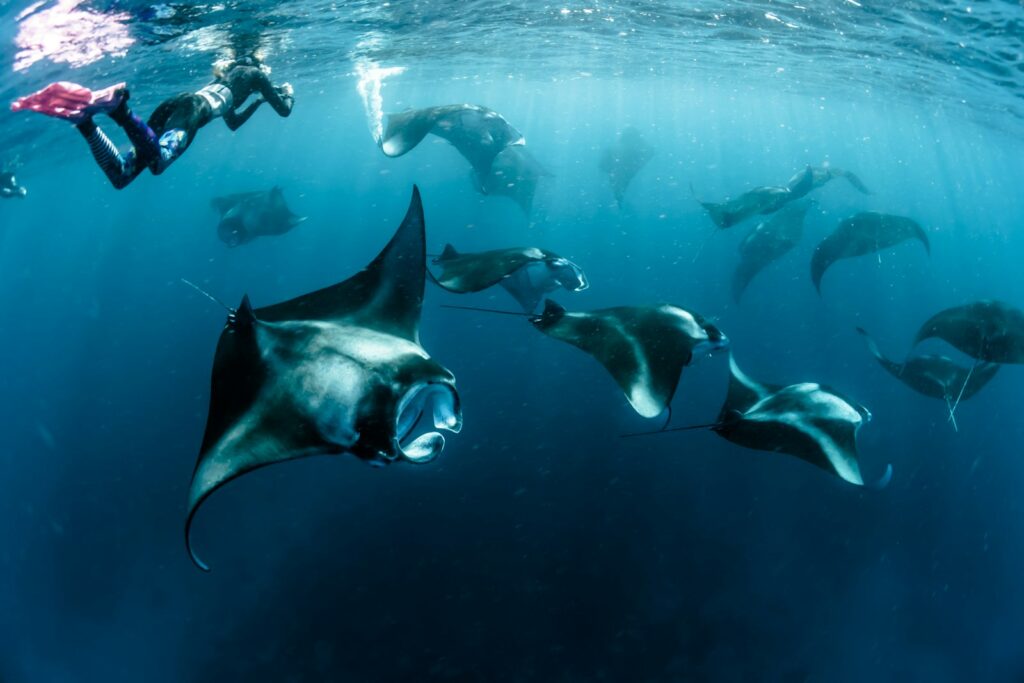
The phinisi route from Labuan Bajo to Manta Point — locally called Karang Makassar — is the single most-requested stop on any Komodo charter itinerary, and for good reason: it delivers reliable, close-range encounters with wild reef mantas (Mobula alfredi) in water shallow enough for snorkelers to fully participate. The site sits inside Komodo National Park, roughly a half-day sail east of Labuan Bajo harbor, and it functions as a permanent cleaning station rather than a seasonal aggregation — which is why your skipper can plot a course there with genuine confidence rather than a hope and a prayer.
That said, “reliable” does not mean “guaranteed,” and anyone promising you mantas on demand is selling you something. What I can tell you, after more dives and surface swims at this site than I care to count, is that understanding how the site works — the depths, the currents, the etiquette — will dramatically raise the quality of your encounter when the mantas do appear. This guide covers everything you need to plan the stop properly from your phinisi.
Karang Makassar: What the Site Actually Is
Karang Makassar translates roughly as “Makassar Reef.” It is not a dramatic wall or a pinnacle — it is a wide, gently sloping reef plateau that sits at 5 to 15 metres depth, shallow enough that surface snorkelers hovering at 1–2 metres of water can look straight down and watch mantas circling below them. The cleaning stations are the key feature: cleaner wrasse and other small reef fish pick parasites and dead skin off the mantas’ undersides and gill plates, and the mantas circle slowly in place to let them work. This behaviour keeps the animals at the same depth, in the same general area, often for extended periods.
The mantas here are reef mantas, Mobula alfredi — the smaller of the two manta species (the other being the oceanic manta, Mobula birostris). “Smaller” is relative. Reef mantas at Karang Makassar regularly reach 3.5 to 4.5 metres wingspan, with individuals measured near the upper limit of the species at close to 5 metres. Watching a 4-metre disc of cartilage and muscle slow-roll beneath you while its cephalic fins curl forward like outstretched arms is an experience that doesn’t dull with repetition.
How Cleaning Stations Work
A cleaning station is essentially a service point that mantas return to because the reward — parasite removal — is reliable. The mantas approach, often facing into a slight current, and hover while the cleaner fish do their work. They are not feeding at this site; they are not chasing baitfish. They are there to be groomed, and they are focused on exactly that. This is what makes snorkeling viable: a manta engaged at a cleaning station is moving slowly, predictably, and often repeatedly over the same patch of reef. You do not need to chase it. You need to position yourself in its path and stay still.
That last sentence is the most important advice in this entire guide. Mantas spook. Not dramatically — they do not flee in terror — but if a snorkeler dives at them, swims aggressively toward them, or positions directly above them and blocks the light, the manta will simply drift away and may not return for the duration of your group’s time in the water. A calm, patient group at the surface, moving slowly and letting the mantas come to them, will almost always get better and longer encounters than an excited group that charges in.
The Phinisi Route from Labuan Bajo
Most 3-day/2-night charters from Labuan Bajo include Manta Point as a standard stop, typically on the second or final day of the itinerary. A typical sequence runs: Kelor Island → Komodo or Rinca for dragon trekking → Pink Beach → overnight anchorage → Padar sunrise → Manta Point → Taka Makassar sandbar → return toward Labuan Bajo via Kanawa. The exact order shifts with weather, tides, and how many other boats are already anchored at each site, but Manta Point almost always falls in the mid-trip window.
From Labuan Bajo harbour, the sailing distance to Karang Makassar is roughly 40–50 nautical miles, depending on the route taken through the islands. On a modern phinisi making 6–8 knots under engine, that is a 5–8 hour passage — which is why most itineraries do not sail directly there from port. Instead, the boat anchors near Komodo or Rinca Island the first night and covers the remaining distance to Manta Point the following morning, arriving when conditions are typically calmer and the light is better for spotting mantas from the surface.
What the Sail Actually Looks Like
The passage through the national park is the reason people hire a phinisi in the first place. You move through a landscape of dry volcanic islands — grey-green slopes of lontar palms and savannah grass dropping straight into water that shifts from teal over sand to ink-blue in the channels. The currents in the Flores Sea are strong and the tidal differential is significant, which is why a good captain times the passage to avoid the worst of the opposing flow. Ask your skipper the night before: when are we leaving for Manta Point, and why that time? The answer tells you a great deal about how well they know the waters.
If you want to include Manta Point in a 2-day/1-night charter, it is technically possible but tight — you will be moving faster, spending less time at each stop, and the itinerary leaves little buffer if winds or currents are not cooperating. The 3-day/2-night format is the minimum I’d recommend for a relaxed visit, and 4 days gives you a meaningful weather buffer: if conditions at Manta Point are rough on Day 2, you have Day 3 to retry. That flexibility matters more than people realise when they are booking months in advance.
Best Months to Visit Manta Point
Reef mantas are resident year-round at Karang Makassar — they are not a migratory species that passes through on a schedule. But encounter rates and visibility are not uniform across the year.
- May to October (peak window)
- The dry season brings calmer seas, lower swell, and the best underwater visibility — typically 20 to 30 metres on a good day. Cooler upwellings from the south push plankton-rich water through the central park, which is precisely what draws mantas to feed and aggregate. August and September are statistically the busiest months, both for manta activity and for the number of boats on the site. Expect company.
- November and April (shoulder season)
- These transitional months often offer the best combination of decent conditions and fewer boats. October through November in particular has a strong reputation among local dive guides as a quality window — seas are still manageable, visibility remains reasonable, and the peak-season crowds have thinned. If you have flexibility, shoulder season is worth targeting.
- December to March (wet season)
- January and February are genuinely difficult months in Komodo. Seas are often rough, visibility drops to 5–10 metres or less, and the crossing from Labuan Bajo can be uncomfortable on any vessel smaller than a coastal ferry. Some operators suspend sailings entirely in February. Manta sightings still occur — the cleaning station does not close — but planning a trip around Manta Point in these months is a gamble that weather conditions will cooperate. If you must travel in this window, book a larger, more stable phinisi and carry seasickness medication.
Snorkeling at Manta Point: What to Expect
Your phinisi will anchor or moor at a distance from the cleaning station, and the crew will deploy the tender (the small skiff most phinisi carry) to ferry snorkelers to the drop-in point. Do not ask to jump directly from the phinisi into the manta zone — the approach and exit by tender is standard practice that reduces disruption to the site.
The brief from your guide will cover the essentials. Pay attention to it even if you have snorkeled before. Conditions at Karang Makassar are not always benign.
Currents
Komodo National Park is famous — among divers, occasionally notorious — for its currents. The tidal surge through the channels between islands is among the strongest in the Indonesian archipelago. Manta Point sits in a more sheltered position than some of the park’s extreme dive sites (Crystal Rock, Castle Rock), but currents are present and can run at 1–2 knots even on relatively calm days. A 2-knot current pushes a snorkeler sideways faster than most people realise, and it can separate a group quickly if everyone does not stay aware of their position.
Practical advice: keep the tender in sight, stay close to your guide, and if you feel yourself tiring against the current, signal the tender immediately rather than fighting to hold position. The best snorkelers at this site are not the strongest swimmers — they are the ones who read the current, position themselves to drift over the cleaning station rather than fight back to it, and let the water do the work.
Visibility and Depth
On a good day in peak season, visibility at Karang Makassar is exceptional — 20 metres and sometimes more. The mantas are visible from the surface well before they pass directly beneath you, which gives you time to position rather than scramble. On less favourable days, particularly in transitional months, visibility can drop to 10–12 metres. The mantas are still there; you just see them later and have less time to adjust your position.
The cleaning station sits primarily at 5 to 15 metres. Snorkelers at the surface are 1–2 metres deep at most. This means you are often looking down at mantas moving 8–12 metres below you — perfectly visible in good conditions, but a reminder that free-diving skills matter if you want a closer look. That said, mantas frequently ascend to within a metre or two of the surface when currents push them up, and a patient snorkeler who stays still will often get a pass-by that no amount of diving down would have produced.
The Etiquette Rules — and Why They Matter
Komodo National Park has established marine wildlife interaction guidelines, and Karang Makassar is one of the sites most actively managed by rangers. The core manta rule is a minimum approach distance of approximately 3 metres — do not swim directly at a manta, do not position yourself directly above one, and do not attempt to touch, grab, or ride one. Park guidelines and international manta conservation codes vary between 3 and 5 metres as the stated minimum; treat 3 metres as the absolute floor, not the target.
These rules are not bureaucratic obstacles. The mucus layer on a manta’s skin protects it from infection, and a single hand touching the wing or disc can disrupt that layer in a localised area. More practically: a manta that has been chased or touched at a cleaning station will leave and may avoid the site for hours or days afterward. You are not just affecting your own experience — you are affecting every snorkeler who arrives after you, and you are potentially conditioning an animal that returns to this cleaning station to associate human presence with stress rather than tolerance.
The most effective approach, consistently, is to drop into the water, hover at the surface, and let the mantas come to you. A relaxed group of snorkelers who look non-threatening from a manta’s perspective will often get animals passing within a metre of them — voluntarily, on the manta’s terms. That is a fundamentally different experience from chasing and is why the operators who enforce these rules firmly tend to deliver better encounters, not worse ones.
Flash Photography and Drone Use
Underwater flash or strobe photography at cleaning stations is generally discouraged and in some contexts prohibited — sudden bright flashes can startle mantas and disrupt cleaning behaviour. Natural-light photography with a wide-angle lens and good ambient light is the correct approach. Ask your guide before diving with strobes.
Drone use within Komodo National Park requires a permit and is subject to specific conditions. Flying a drone over snorkelers in the water creates additional risk to people and wildlife alike. If you plan to photograph the site from above, confirm the permit status with your phinisi operator before departure, not on the day.
Practical Gear for Manta Point Snorkeling
Most phinisi supply basic snorkeling equipment — mask, fins, snorkel — but quality varies significantly between boats. If you have your own mask and you snorkel frequently, bring it. A well-fitted mask that does not leak is worth more in current-affected conditions than any amount of premium rental gear.
| Item | Notes for Manta Point |
|---|---|
| Wetsuit or rashguard | Central Komodo waters run approximately 24–27°C — warm, but a 3mm shorty is comfortable for long surface sessions and provides sun and jellyfish protection |
| Fins | Full-foot or open-heel; closed-heel gives better power in current; avoid long freedive blades unless you are experienced — they can be hazardous in close proximity to others |
| Mask | Bring your own if possible; a low-volume freedive mask improves downward visibility; anti-fog treatment the night before |
| Snorkel | Dry-top or semi-dry preferred in chop; purge valves are convenient in current |
| Flotation vest | Optional but useful for less confident swimmers — keeps you neutrally buoyant at the surface without effort, allowing you to focus on the mantas |
| Underwater camera | A compact housing and wide-angle lens; mantas photograph best at close range with ambient light; no flash |
| Sun protection | Reef-safe mineral sunscreen (zinc/titanium only — chemical UV filters are known coral toxins); long-sleeve rashguard does the job better anyway |
Is Manta Point Right for Non-Swimmers and Children?
This question comes up often on family charters. The honest answer: it depends on the conditions on the day and the individual child or nervous adult.
In calm conditions with minimal current, Manta Point is a gentle site. The water is warm, the depths are not threatening, and the cleaning station is not far from where the tender drops snorkelers. A confident child of ten or eleven who is comfortable in open water and wearing a flotation vest can absolutely have a meaningful experience here.
In stronger current, the same site requires active swimming and spatial awareness. Non-swimmers and young children should remain in the tender and watch from there — they will often still see mantas passing beneath the hull, and the view from the boat in good visibility can be genuinely good. It is far preferable to a frightening experience in water a child is not ready for.
Ask your phinisi guide to assess conditions honestly before anyone enters the water. A responsible operator will give you a straight answer, not the one they think you want to hear.
Combining Manta Point with Other Sites on Your Route
Karang Makassar does not exist in isolation — it sits within a broader itinerary that, on a well-planned 3 or 4-day phinisi charter, also includes Padar Island, Pink Beach, Komodo or Rinca for Komodo dragon trekking, Taka Makassar sandbar, and often Kanawa Island for a final shallow-reef snorkel before returning to Labuan Bajo. Each of these sites requires a different mode of attention: the dragon trek is physical, the Padar sunrise hike is predawn and aerobic, the Pink Beach stop is relaxed and photogenic.
Manta Point works best when it is not rushed. A 45-minute snorkel session gives time for the mantas to settle to your group’s presence, for conditions to reveal themselves, and for the less confident swimmers in your party to find their rhythm before the animals arrive. Operators who budget 20 minutes and move on are prioritising throughput over experience. When you are planning your charter with our concierge, ask specifically how much time is allocated at each site and whether the itinerary can flex that allocation if conditions are right. On WhatsApp, we can walk through different itinerary structures in detail before you commit to dates or a vessel.
Conservation Status and Why It Matters to Your Charter Choice
Reef mantas (Mobula alfredi) are listed as Vulnerable on the IUCN Red List. They are slow-reproducing — a female produces at most one pup every two to three years — and historically targeted by gill-raker fisheries across the Indo-Pacific. Indonesia declared mantas a protected species in 2014, and Komodo National Park, as both a UNESCO World Heritage Site and a Marine Protected Area, adds an additional layer of regulatory protection.
That protection is only as effective as the behaviour of the people in the water. The cleaning station at Karang Makassar has survived decades of tourism pressure because a critical mass of operators — and the rangers who oversee the site — have enforced the rules consistently. High-quality phinisi operators contribute to this through briefings, through refusing to allow guests into the water without them, and through choosing moorings that do not damage the reef structure that sustains the cleaning station in the first place. It is one concrete reason why the operator you book matters beyond amenities and pricing.
Frequently Asked Questions
Do I need to be a certified diver to see the mantas at Manta Point?
No. Karang Makassar is one of the best manta experiences in Komodo specifically because it is fully accessible to snorkelers — no certification required. The cleaning station sits at 5 to 15 metres depth, and mantas frequently ascend close to the surface. Divers get a different angle and can hold position more precisely in current, but many of the most memorable encounters at this site happen at the surface. Snorkeling ability and confidence in open water with some current is what matters, not a certification card.
How long does it take to sail from Labuan Bajo to Manta Point?
Direct sailing time from Labuan Bajo harbour is roughly 5 to 8 hours at a phinisi’s typical cruising speed, depending on the route and conditions. In practice, almost no itinerary sails direct — the boat makes stops en route (Kelor Island, Rinca) and typically anchors overnight before continuing to Manta Point the next morning. From the usual overnight anchorage near Komodo or Rinca Island, the remaining sail is 1 to 2 hours. Your skipper times the arrival to coincide with calmer morning conditions and, ideally, slack or gently running tide.
What is the difference between Manta Point and the other snorkel stops on the phinisi route?
Pink Beach is a wide, shallow fringing reef — ideal for casual snorkeling, photography, and anyone who wants a relaxed introduction to the park’s marine life. Kanawa Island has a gentle house reef that drops gradually from ankle-deep water, very forgiving for families and beginners. Manta Point (Karang Makassar) is specifically managed as a marine megafauna site — the pull is the manta rays themselves, the conditions can involve real current, and the experience is more active and less predictable. If your group contains strong snorkelers who want a wildlife encounter, Manta Point is the priority stop. If the group skews toward children or beginners, Pink Beach and Kanawa are more consistently accessible.
Can I snorkel at Manta Point in January or February?
Technically yes — mantas are resident year-round. Practically, January and February are the roughest months in Komodo, with heavy rain, strong winds, and reduced visibility that can drop to 5 metres or less. The crossing from Labuan Bajo is uncomfortable and some operators limit or suspend sailings entirely. If you travel in these months, choose a larger and more stable phinisi, accept that visibility may be poor, and treat any manta encounter as a bonus rather than a near-certainty. The dry season window from May through October is strongly preferred.
What should I do if I see another snorkeler chasing or touching a manta?
Signal your guide immediately — this is exactly the situation guides are briefed to manage. Do not confront the other snorkeler yourself while you are both in the water; that rarely ends well and can create more disturbance. Your guide or a ranger on site can address it directly. On your charter, the pre-water briefing is the right moment to raise this expectation: ask your operator explicitly how they handle guests from other boats who do not follow the guidelines. A good operator will have a clear, calm protocol. One that shrugs it off is telling you something about their standards more broadly.