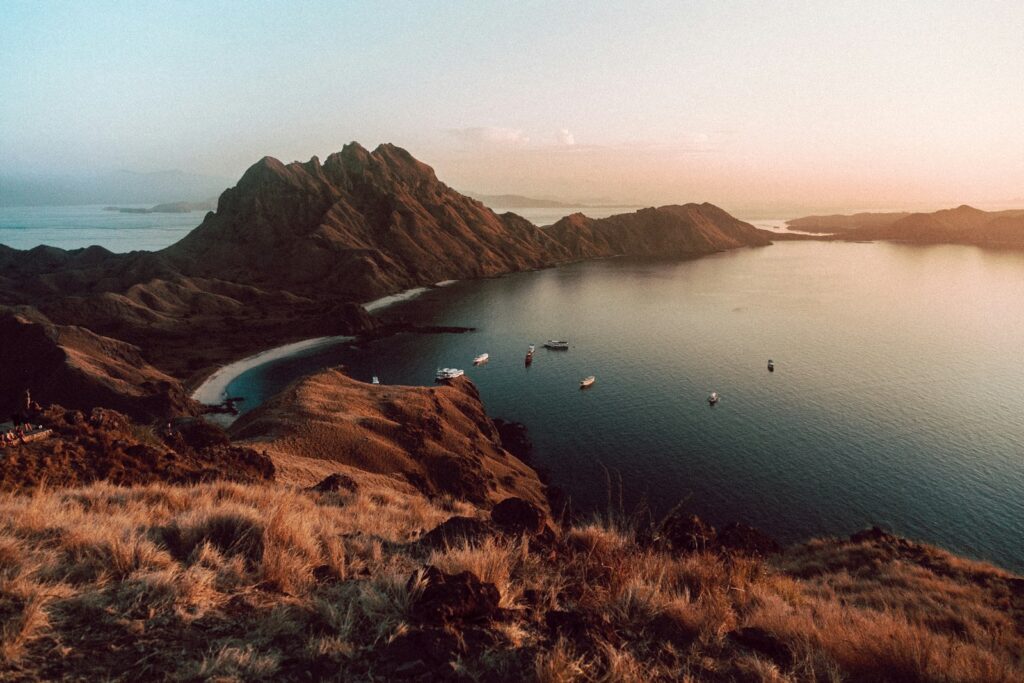
A Labuan Bajo phinisi route avoiding the crowds at Komodo is one that sequences stops around the day-trip boat schedule, uses the park’s quieter months strategically, and anchors at sites most speed-boat operators never bother to include. The logic is simple: Komodo National Park draws well over 100,000 visitors a year, most of them funneled through Pelabuhan Labuan Bajo on identical day-trip speedboats that hit the same four spots between 9 a.m. and 3 p.m. A phinisi liveaboard lets you break that clock entirely — sleeping inside the park, arriving at Padar before sunrise, and slipping away to reef sites the crowds haven’t reached yet.
What follows is a practical guide, not a sales pitch. These are the timing windows, route sequences, and site choices that actually work — informed by years of watching traffic patterns in this park and talking frankly with captains who know where the other boats go.
Why Komodo Gets Crowded, and Why a Phinisi Changes That
Most visitors to Komodo National Park do not stay overnight. They arrive in Labuan Bajo on morning flights from Bali — a short hop of roughly 1 hour 10 minutes — and board speedboats that depart the harbor by 8 or 9 a.m. By mid-morning, those boats are stacking up at Padar Island. By midday, Pink Beach is lined with vessels three deep. By 2 p.m., they are heading back.
A phinisi operates outside this window by design. You board the afternoon or evening before departure, sail to an anchorage inside the park, and wake up already there. That single fact — sleeping inside the park rather than commuting from the harbor — is the mechanical reason why a well-planned liveaboard itinerary is quieter. The window you want at Padar is 5:30 to 8:30 a.m. A speedboat from Labuan Bajo cannot be there at 5:30 a.m. Your phinisi can.
None of this is automatic, though. A phinisi that departs at 9 a.m. on Day 1, makes straight for Padar, and follows the standard day-trip sequence will arrive at the same time as the day-trip boats. The tactics below are about making deliberate choices, not just booking a liveaboard and hoping for the best.
Timing Padar Island: The Single Biggest Lever
Padar is the most photographed viewpoint in the park — the panorama of three distinctly colored bays (black sand, white sand, and a pocket of pink) is what most people have in mind when they book a Komodo trip. It is also the biggest crowd flashpoint. Here is how to handle it.
The Pre-Dawn Ascent
The summit hike involves roughly 800 stairs and takes most reasonably fit people about 30 to 45 minutes at a comfortable pace. The goal is to reach the top viewpoint before the sky turns fully light — ideally positioned 10 to 15 minutes before sunrise. Practically, that means leaving the beach by 5:00 to 5:15 a.m., which means anchoring near Padar the night before.
Your captain should know the good overnight anchoring spots on the island’s sheltered eastern side. Confirm this before you book: ask specifically whether the itinerary includes sleeping near Padar rather than sailing from a distant anchorage on the morning itself. Some operators cut corners here and schedule a long pre-dawn motor instead.
By the time the first speedboats arrive at Padar — rarely before 9 a.m. even on busy days — you should be back on the phinisi having breakfast.
Late Afternoon as a Backup
If your itinerary does not allow a Padar overnight, the late afternoon window — roughly 3:30 to 5:30 p.m. — is the second-best option. The day-trippers are gone. The light is warm and directional. The descent back to the beach is in comfortable temperatures. Some travelers prefer this light for photography. The tradeoff: you may be on the hill in the residual heat of the afternoon, and the boat cannot easily anchor for a full sunset if you also want to reach Kalong Island for the bat exodus.
Choose based on your priorities. Photographers who want the softer, more golden light often prefer the late slot. Travelers who want both the Padar view and the Kalong bat flight on the same evening will need to decide which matters more — the logistics rarely allow both at full quality.
Reading the Day-Trip Clock: Site-by-Site
Every major site in the park has a predictable crowd curve driven by the harbor-departure pattern. Understanding it lets you sequence your route intelligently.
| Site | Crowd Peak | Quiet Window | Notes |
|---|---|---|---|
| Padar Island (summit) | 9:00 a.m. – 1:00 p.m. | Before 8:30 a.m. / after 3:30 p.m. | Pre-dawn ascent requires overnight anchoring nearby |
| Pink Beach / Pantai Merah | 10:00 a.m. – 2:30 p.m. | Before 9:30 a.m. / after 3:00 p.m. | Snorkel the reef early; beach itself stays crowded longest |
| Komodo Island (Loh Liang) | 9:30 a.m. – 1:30 p.m. | Before 9:00 a.m. / mid-afternoon | Rangers required; book entry ticket through your operator |
| Rinca Island (Loh Buaya) | 10:00 a.m. – 1:00 p.m. | Before 9:30 a.m. / after 2:30 p.m. | Often less crowded than Komodo; dragons near ranger station |
| Manta Point / Karang Makassar | 9:30 a.m. – 12:00 p.m. | Before 9:00 a.m. / after 1:00 p.m. | Mantas less affected by boat numbers, more by in-water behavior |
| Taka Makassar sandbar | 11:00 a.m. – 1:30 p.m. | Early morning / late afternoon | Sandar exposed at low tide only — check tides, not just boat timing |
| Kelor Island | 9:00 a.m. – 11:00 a.m. | Afternoon (most day-trips skip it then) | Short 10–15 min climb; often a first stop for harbor-departing boats |
| Kalong Island (bat flight) | Sunset hour only | Only viable at sunset; arrive 30 min early | Crowd level varies; overnight boats can position earlier |
The pattern is consistent: day-trip boats stack up at the most iconic photo stops between 9:30 a.m. and 2 p.m. A phinisi that sequences its day to hit those sites outside those hours — sleeping at Padar, snorkeling Pink Beach at 8:30 a.m., reaching Komodo’s Loh Liang by 9:00 before the queue forms — will experience a fundamentally different park.
Off-Peak Months: When the Park Breathes
The broad dry season runs from April through October. Within that window, the crowd experience varies considerably.
The Quietest Windows in the Dry Season
Late April to mid-June is the best combination of conditions and manageable numbers. The islands are still green from the tail end of the wet season — the landscape looks lush rather than the golden-brown of peak dry season. Seas are calm. Dive visibility is building toward its seasonal peak. The July–August surge has not yet arrived. Prices for private charters are typically in the lower half of their seasonal range. The one consideration: periodic afternoon showers are still possible, which some travelers find affects photography conditions.
October into early November is the other sweet spot that experienced travelers underuse. The peak-season crowds have cleared. Visibility is still excellent — often 20 to 30 meters at the better reef sites. Water temperatures are stable. The dragons on Komodo and Rinca are active and visible. Prices start to ease from the July–August peak. If your schedule allows any flexibility on travel dates, this window is worth targeting specifically.
July and August: High Season Without the Stress
Peak season is not avoidable for many travelers, and it does not have to be miserable. The crowd-timing tactics in the section above matter more in July and August than at any other time of year. A pre-dawn Padar ascent during peak season is still a near-solitary experience. A Padar visit at 10:30 a.m. in August is not.
One practical note for July–August: book your phinisi charter significantly in advance. Private boats on preferred departure dates in peak season fill three to five months out on quality vessels. Last-minute availability in August typically means the boats that were not chosen first.
What to Avoid
January and February are the roughest months. Heavy rain, strong wind, and choppy seas are the norm. Many operators reduce or suspend sailings, particularly for boats that sail the southern and central sections of the park where swells build. If you must travel during the wet season, mid-March onward begins the transition to calmer conditions, and late March can be usable, though variable.
The Christmas and New Year period — roughly December 22 through January 5 — brings a pronounced surge. It overlaps with the onset of the wet season, so you face both crowds and deteriorating conditions simultaneously. Committed travelers do it and manage fine with good boats and flexible routing. It is simply the least favorable combination on the calendar.
Alternative Anchorages and Overlooked Sites
Beyond timing, the other major tool for reducing crowd exposure is simply going where the day-trip boats do not. Most speedboat itineraries are built around five to six set stops that their operators have used for years. A private phinisi on a custom route can step meaningfully outside that circuit.
Kanawa Island
Kanawa sits roughly 10 to 15 kilometers from Labuan Bajo harbor — close enough to reach in 45 to 60 minutes, far enough that most day-trip operators skip it unless it is specifically requested. The fringing house reef starts almost from the beach, dropping through a series of shallow coral terraces from 1 to 2 meters at the shoreline to 5 to 10 meters at the base. It is a genuinely pleasant snorkel for mixed-ability groups who want productive marine life without strong current. On a 4-night itinerary, an early-morning Kanawa stop as a warm-up on Day 1 — before heading deeper into the park — positions the boat well and avoids the midday harbor traffic.
Sebayur Kecil and the Northern Reefs
The northern section of the park — above the main tourism corridor — sees a fraction of the traffic that Padar and Pink Beach attract. Sites like Sebayur Kecil and the reef systems around Tatawa offer genuine underwater quality with far fewer boats competing for the same mooring. These are typically on 4D3N and longer itineraries rather than the compressed 3D2N format. If you are on the fence between three nights and four, the access to quieter reef territory is one of the strongest arguments for the extra day.
Taka Makassar at Dusk
Taka Makassar is the crescent sandbar that barely survives high tide — it can be walked end-to-end in a few minutes when the tide is right. Most boats visit at midday when it is overrun. An early-evening stop, timed to low tide on the return leg from the southern sites, is a different experience entirely. The bar clears. The light drops low and amber. A small inflatable or the ship’s tender brings you out to stand on a strip of white sand with open water in every direction. It is one of the genuinely photogenic moments the park offers and it costs nothing beyond timing awareness.
Kalong Island — Arrive Early
The bat exodus from Kalong Island happens at sunset, which is obvious to every boat in the park. What separates a phinisi from a speedboat at Kalong is the ability to arrive 40 to 60 minutes early, anchor quietly, and watch the first bats begin to stir in the trees before the main flight. The colony is estimated in the thousands to tens of thousands of flying foxes. The show lasts from roughly 20 minutes before sunset to 30 minutes after. Day-trip boats rush in at the last minute and leave the instant it ends. Staying the night — anchored in the bay or nearby — means the full transition from afternoon light to dusk without engine noise from departing speedboats.
Ready to design an itinerary around these windows? Plan your charter with our concierge team — we work through WhatsApp and can usually have a draft route in front of you within 24 hours.
Sequencing the Route: A Practical Framework
The following framework applies to a 3-night private phinisi charter. The specific sites can be adjusted based on your group’s interests — diving, trekking, photography — but the underlying sequencing logic holds across most configurations.
Day 0 (Afternoon Departure)
Board in Labuan Bajo harbor in the early afternoon — ideally by 2 p.m. Sail immediately toward the park rather than waiting for a formal Day 1 start. Stop at Kelor Island on the way: it is a 30-minute sail from the harbor, the hilltop viewpoint takes 10 to 15 minutes, and by visiting it in the afternoon you skip the morning rush that forms when day-trip boats use it as their first stop. Continue to a Padar-adjacent anchorage, arriving before dinner. Overnight at Padar.
Day 1: Padar Pre-Dawn, Then Rinca
Wake at 5 a.m. Hike Padar in darkness, reaching the top by first light. Return to the boat for breakfast by 8 a.m. Now sail south to Rinca Island (Loh Buaya). Arriving by 9 to 9:30 a.m. means you are ahead of or concurrent with the slowest speedboats, and Rinca typically sees fewer boats than Komodo Island regardless. Trekking with official rangers through the semi-arid habitat, with dragons often visible near the ranger station kitchens, takes 1 to 2 hours depending on the trail. Back aboard by noon, then an afternoon sail toward Manta Point or a reef site to the north. Overnight anchorage away from the main Pink Beach corridor.
Day 2: Pink Beach Early, Manta Point, Taka Makassar
Reach Pink Beach by 8:30 a.m. for an early snorkel on the reef before the midday boats arrive. The foraminifera-rich pink sand is photogenic in morning light. Depart by 10 a.m. and head to Manta Point. The resident reef mantas — Mobula alfredi, with wingspans approaching 4 to 5 meters — use the cleaning station at roughly 5 to 15 meters depth. Snorkelers and divers share the site; the protocol is to enter quietly, maintain distance of around 3 meters, and let the mantas approach rather than chasing them. Afternoon: cross to Taka Makassar timed to low tide. Late afternoon: Komodo Island (Loh Liang) for the dragon trek if not done on Day 1. Sail toward Kalong for the sunset bat flight. Overnight in the area.
Day 3: Kanawa or Northern Reef, Return
A final morning snorkel at Kanawa or one of the northern reef sites before the return sail to Labuan Bajo. Morning departures from the anchorage mean arriving in the harbor by midday, leaving time for a hotel check-in and afternoon flight connection to Bali.
Park Fees and What to Expect
Komodo National Park charges several layered fees. The exact structure is revised periodically and the figures here are approximate — verify current amounts with your operator before departure, as these are set by park authorities and change without much notice.
As a rough budgeting guide for a 3-night liveaboard trip, expect roughly IDR 600,000 to 1,200,000 per person in total park-related fees — covering the park entrance (higher for foreign visitors, historically around IDR 150,000 to 225,000 per day), marine and conservation levies, and the mandatory ranger fee for all land treks. Rangers are required for every visit to Komodo and Rinca islands; you cannot walk in dragon habitat unaccompanied. These fees are almost always charged separately from the boat charter price, collected in cash and managed by your captain or guide. If an operator quotes a fully all-inclusive price that bundles fees, ask for the breakdown — legitimate operators are transparent about this.
The 2022 proposal to raise entrance fees to a high annual-pass level caused protests in Labuan Bajo and was effectively shelved. The park has not implemented that structure as of the most recent reporting available to us. Verify before you travel.
Honest Tradeoffs: What Crowd-Avoidance Costs
Tactics have consequences. Pre-dawn hikes mean early nights. Visiting Pink Beach before 9:30 a.m. means the light is flatter and cooler, better for snorkeling than for the warm-toned photography that midday and afternoon light produces. Choosing the shoulder months in April–June means a small chance of afternoon rain. Moving to quieter northern sites means longer sailing distances, which is fine on a relaxed 4-night itinerary and more of a squeeze on 2 nights.
None of these tradeoffs are deal-breakers. But they are real, and a good charter concierge will walk you through them honestly based on your group’s specific priorities rather than just telling you that everything is possible. If photography is the priority, the crowd-timing approach and the lighting approach may point in slightly different directions. If the dragon trek matters most, Rinca tends to deliver a comparable experience with less competition for ranger time than Komodo Island.
One other note: private charter costs reflect the flexibility you are buying. Private phinisi in the luxury tier run roughly $1,000 to $5,000 or more per night for the whole boat, typically accommodating four to twelve guests. Ultra-luxury expedition yachts go higher still, on quote-only terms. The crowd-avoidance and timing advantages discussed here apply at most price points — what you are negotiating with budget is not crowd-avoidance capability but the comfort, crew quality, and amenities surrounding the experience.
Want help matching these tactics to a boat that fits your group size and dates? Plan your charter with Phinisi Atlas — reach us via WhatsApp for a faster response, and we will come back with specific vessel recommendations within the day.
Frequently Asked Questions
What is the best month for a Labuan Bajo phinisi route avoiding the crowds at Komodo?
Late April through mid-June and October through early November are the two quietest windows within the dry season. Conditions are good, seas are calm, and the volume of day-trip speedboats operating in the park is noticeably lower than during the July–August peak. If peak-season travel is unavoidable, the timing tactics — pre-dawn Padar, early morning Pink Beach — matter most in those months.
Can I really be alone at Padar for the sunrise?
Near-alone, yes. Even in peak season, a phinisi that anchors at Padar overnight and begins the ascent before 5:15 a.m. will typically share the summit with only a handful of other liveaboard guests who had the same idea. The speedboat wave does not arrive until well after 9 a.m. By contrast, visiting Padar at 10 a.m. in August means joining dozens of other groups on the stairs and summit at the same time.
Is Rinca or Komodo Island better for avoiding crowds on the dragon trek?
Rinca (Loh Buaya) generally sees fewer day-trip boats than Komodo’s main station at Loh Liang, partly because it is closer to Labuan Bajo harbor and operators who want to maximize time at the southern sites skip it. Dragon encounters at Rinca are comparable in quality — the animals congregate near the ranger station — and the terrain is slightly more open, which some people prefer. Arriving at either island before 9:30 a.m. reduces queue time for rangers regardless of which you choose.
Do phinisi boats actually anchor inside the park overnight, or do they return to Labuan Bajo?
Legitimate liveaboard phinisi on multi-night itineraries sleep inside the park. They hold the necessary permits and use designated mooring buoys or established anchoring areas rather than dropping anchor on coral. This overnight positioning is exactly what enables the pre-dawn timing advantages described in this guide. Budget day-charter boats and some open-trip operators do return to Labuan Bajo harbor each night; if you are comparing quotes, confirm overnight anchorage inside the park is part of the itinerary.
What is Taka Makassar, and is it worth stopping at?
Taka Makassar is a small crescent-shaped sandbar that emerges fully only at low tide and can disappear at high water. It is walkable end-to-end in minutes. It is worth stopping at specifically because the late-afternoon and early-evening visit — when most boats have cleared — is genuinely photogenic and surprisingly uncrowded compared to the midday peak. Check the tide schedule with your captain before building it into the itinerary; visiting at high tide means there may be little sandbar left to stand on.