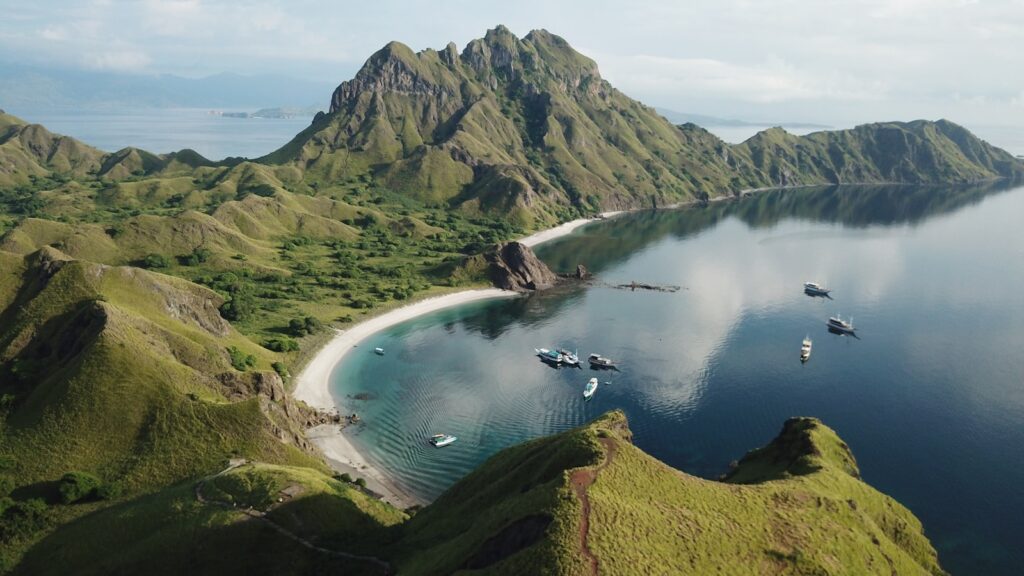
A Labuan Bajo phinisi sunrise hike up Padar Island is, in practical terms, exactly this: you anchor offshore on your liveaboard the evening before, wake at around 04:30, take a tender to the beach, and climb roughly 700 to 900 steps (the widely quoted figure is about 800) to a ridge viewpoint that, once the light arrives, shows you three distinctly colored bays in a single panoramic frame. The snorkeling route you add afterward, usually at Pink Beach or one of the reef stops on the way back north, turns a single dramatic morning into the most complete day most phinisi itineraries offer. This guide covers everything you need to make that morning count.
Why Padar Belongs on Every Phinisi Itinerary
Padar Island sits within Komodo National Park, a UNESCO World Heritage Site and Marine Protected Area. It has no permanent human settlement and no Komodo dragons; the island is too dry and too small to sustain a viable population. What it does have is a ridgeline that cuts between four bays, three of which carry visibly different sand colors: one black-volcanic, one white, one a dusky pink caused by the same Foraminifera-shell chemistry that makes Pink Beach famous. At sunrise, with the phinisi anchored below and the first light catching the water at different angles, the contrast between those three bays is as stark as it looks in photographs.
That view is also genuinely informational for a diver or marine naturalist. The volcanic black-sand bay sits in a channel exposed to serious down-current; the white bay faces a gentler angle that makes it a reasonable afternoon anchorage in calm conditions; the pink-tinged bay on the southern side is shallow and warm. This is why you often see reef manta rays (Mobula alfredi) circling not far off on mornings with slack current. Standing on that ridge, you’re reading the geography of the park.
The Step Count: What 800 Steps Actually Means
Published figures for the Padar climb range from 700 to 900 steps, depending on the trailhead you leave from and how steps are counted on the steeper loose sections. Most operators cite approximately 800. The route is not technical (no ropes or scrambling), but the grade is consistent and there are stretches near the top where the path narrows to a ridge and the exposure is real, especially in pre-dawn dark.
- Total ascent (approximate)
- ~800 steps, graded as moderate by Indonesian national park standards
- Elevation
- Not a formally published figure; the viewpoint is on a low ridge, not a high mountain. Most fit adults reach the top in 30 to 50 minutes at a steady pace.
- Terrain
- Compacted earth and rock; some loose stone near the summit; minimal shade
- Lighting
- You will be climbing in the dark with a headlamp; the path is well-worn and easy to follow, but don’t attempt it without a torch
- Ranger requirement
- An official park ranger must accompany the group. Your phinisi crew coordinates this; it is not optional.
- Return time
- Descent takes roughly half the ascent time; most groups are back at the tender by 07:30–08:00 to allow breakfast aboard before the next stop
The main physical consideration is footwear. Flip-flops are a poor choice on loose rock in the dark; closed-toe shoes with grip are recommended. The other consideration is heat: even at 05:30 the humidity in Komodo is notable, and on days without a ridge breeze the climb runs warm. Carry water.
Pre-Dawn Timing from Your Phinisi Anchorage
Getting the sunrise right from Padar requires backward-planning from the summit. Sunrise in Komodo runs roughly 05:50–06:30 depending on the month; May and June sit around 06:10–06:20, August closer to 06:00. You want to be on the viewpoint ridge at least 15 to 20 minutes before civil sunrise, which means leaving the anchorage by tender at 04:30 to 05:00 at the latest to allow beach landing time plus the climb.
The evening before, your skipper will discuss anchorage position with the crew. Padar has a sheltered bay on the western side that is the standard overnight stop in calm conditions; from this anchorage the beach landing and trail access are straightforward. In stronger swell or high season when multiple phinisi share the bay, your boat may anchor slightly farther out, which affects tender time but not the trail itself.
One thing worth knowing: Padar gets busy at sunrise during peak season, particularly July and August. A queue of 80 to 120 hikers from multiple liveaboards on the same trail at the same pre-dawn hour is a reality on peak-season Saturdays. Your captain will generally know whether competitors have filed for the same anchorage and can sometimes time departure slightly earlier or later to reach the viewpoint before or after the tightest congestion. Private charters have considerably more flexibility than shared open trips here, which is a practical advantage worth weighing when you choose your charter format.
The Three-Colored View: What You’re Actually Seeing
At the summit, the viewpoint faces roughly north-northeast. The three bays fan out below:
- The black-sand bay (closest to the main channel): dark volcanic sand, deeper water, typically with some chop from the channel current
- The white-sand bay (southern center): classic carbonate sand, calmer aspect, the most common anchorage for the overnight
- The pink-tinted bay (far south): the faint rose coloring comes from broken Foraminifera shells mixed into the white sand, the same mechanism as Pink Beach on Komodo Island, just less concentrated
The colors are most distinct in the low-angle light of sunrise, particularly in the dry season (May through October) when the sky is clear and the angle of light changes minute by minute. In overcast or wet-season conditions the contrast drops significantly, which is another reason April through October is the consistent recommendation for this hike.
Photography: Making the Conditions Work
The Padar ridgeline is one of the most photographed viewpoints in Indonesia, which means anyone with a smartphone has seen the shot. Making your frame distinct requires arriving early enough to catch the pre-sunrise color gradient (deep blues transitioning through orange) before the sky flattens into daylight. The 15 minutes before the sun clears the horizon tend to produce the most usable images.
Practical notes for the climb:
- Drones require a permit inside Komodo National Park; confirm this with your operator before you fly. The rules are enforced and the fines are real.
- A wide lens works better than telephoto at the summit, as the bay spread is horizontal and broad.
- The wind on the ridge is unpredictable; a lens cloth is worth carrying.
- If you are shooting with a phone, the panorama function captures the geometry more honestly than a single frame.
- The descent light, about 30–40 minutes after sunrise, gives clean golden-hour illumination on the bay you’re walking down toward, which is often more interesting for portraits and detail shots than the summit panorama itself.
Ready to plan the charter that makes this morning happen? Plan your charter with our concierge. We’re also reachable by WhatsApp for questions about specific itineraries and anchorage logistics before you commit.
Pairing the Hike with a Morning Snorkel Route
The standard phinisi schedule after Padar is breakfast aboard followed by a morning snorkel stop, typically one of a few options depending on direction of travel:
| Snorkel Stop | What You Find | Depth Range | Best For |
|---|---|---|---|
| Pink Beach (Pantai Merah, Komodo Island) | Fringing reef, hard coral gardens, reef fish; the beach itself for photos | 1–8 m from shore | All levels; families; photography |
| Taka Makassar sandbar | Crescent sandbar (disappears at high tide), clear turquoise shallows, some reef fish around the edges | Ankle to waist shallow; reef edges 3–6 m | Swimming; non-swimmers; photography |
| Manta Point (Karang Makassar) | Reef manta rays (Mobula alfredi), up to ~5 m wingspan; cleaning station at 5–15 m | 5–15 m (snorkel from surface) | Confident snorkelers; divers |
| Kanawa Island reef | Shallow fringing house reef, 1–2 m off the beach dropping to 5–10 m; good coral coverage | 1–10 m | Beginners; relaxed half-day |
The decision between these depends on your direction of travel, the state of the tide, and what else is on the itinerary. Manta Point is current-dependent: mantas feed in upwelling and cleaning-station conditions, and your guide will know on the morning whether conditions favor a stop. On a well-run 3D2N itinerary, Padar sunrise followed by Pink Beach snorkel and a dragon-trek on Komodo or Rinca in the afternoon is the single most information-dense day you can have in the park.
What to Carry for the Padar Morning
Your crew will brief you the evening before, but the short list:
- Headlamp or strong phone torch (essential, not optional)
- Closed-toe shoes with grip (trail runners or hiking shoes; sandals are genuinely inadequate on loose rock in the dark)
- Water: at least 500 ml per person, more in July–September when pre-dawn humidity runs high
- A light layer if you run cold, because the ridge at 05:00 can surprise you with wind even in the dry season
- Sun protection for the descent and beach time afterward, as the post-sunrise walk back is fully exposed
- Snorkel fins and mask for the water stop after breakfast (most phinisi provide gear; confirm when booking)
Fees and Practicalities Inside Komodo National Park
Padar Island falls inside Komodo National Park, and all visits carry park fees. The fee structure has been revised multiple times and is subject to change; verify the current breakdown with your operator close to travel. As a budgeting reference, recent per-person charges for a multi-day liveaboard have run in the range of approximately IDR 600,000 to 1,200,000 for the combined park entrance, marine use, and ranger/trekking components across a 3D2N trip. These fees are almost always excluded from advertised phinisi rates and paid separately, typically in cash arranged through your operator.
Rangers are mandatory for all land treks in the national park, including the Padar hike. Your phinisi crew coordinates ranger assignment in advance; no independent trekking is permitted. This is a genuine safety protocol: the terrain is unfamiliar, trail marking is minimal in the dark, and conditions can change with the wind.
Planning the Overnight: Which Phinisi Itinerary Includes Padar Sunrise
The Padar sunrise hike requires an overnight anchorage. It cannot be done as a day trip from Labuan Bajo because the sailing time from the harbor plus the pre-dawn start don’t line up logistically. This means it sits naturally inside a 3D2N or 4D3N phinisi itinerary, where the first night anchorage positions you for the second morning’s hike. Most quality operators on 3D2N routes include Padar as a standard stop; on 2D1N compressed itineraries, it sometimes appears but requires the crew to push timing aggressively.
Private charters have the clearest advantage here: you set the anchorage, you set the wake-up time, and your crew isn’t coordinating 12 other guests on different fitness levels. On a shared open-trip phinisi, the group wake-up tends to be later and the compromises more visible. The Padar sunrise is, for many travelers, the moment they remember longest from the whole trip. That’s worth weighing when you choose your charter format.
For help matching the right itinerary to your dates, group size, and what else you want to see, plan your charter with our team. We can advise on which anchorages give you the cleanest timing for Padar without sacrificing the afternoon snorkel and the Kalong sunset bats on the same day.
Frequently Asked Questions
How many steps is the Padar Island hike?
Published figures range from approximately 700 to 900 steps; the most commonly cited figure is around 800. The trail is not technically difficult but gains elevation consistently on a loose rocky path, and you will be climbing in the dark with a headlamp. Most fit adults reach the viewpoint in 30 to 50 minutes at a steady pace. Closed-toe shoes with grip are genuinely important: flip-flops are not adequate on this terrain at 04:30 in the morning.
What time should we leave the phinisi for the Padar sunrise?
Departure from the anchorage by tender should happen between 04:30 and 05:00 to allow for beach landing, the climb, and 15 to 20 minutes of settling time on the ridge before the sun clears the horizon. Sunrise in Komodo runs roughly 05:50 to 06:30 depending on the month and time of year. Your captain will calibrate the exact departure time based on the distance from the anchorage to the trailhead and the likely pace of your group.
Can I do the Padar sunrise hike on a day trip from Labuan Bajo?
No. The logistics don’t work: sailing time from Labuan Bajo harbor to Padar is roughly 2 to 3 hours in normal conditions, which means leaving before midnight to reach the beach in time for a 05:00 hike start. The sunrise hike requires an overnight anchorage on a liveaboard phinisi, positioning you within tender distance of the beach the night before. It is a defining reason to book a 3D2N or 4D3N itinerary rather than a day-trip speedboat tour.
What snorkel stop pairs best with the Padar sunrise hike?
After breakfast following the descent, most 3D2N itineraries head to Pink Beach (Pantai Merah) on Komodo Island for a mid-morning snorkel. It’s accessible to all levels, the coral coverage is good in calm conditions, and the pink sand is photogenic. If your itinerary has the flexibility, Manta Point (Karang Makassar) is a strong alternative if conditions favor manta activity: reef mantas are resident year-round here, with stronger presence from May through September. Your guide will know on the morning whether a manta stop is worth the detour.
Is the Padar hike suitable for beginners or older travelers?
The trail is classified as moderate: not a technical climb, but not a casual beach walk either. The elevation gain is consistent and there is no shade. Travelers who are reasonably fit and comfortable walking uphill on uneven ground in the dark generally manage it without issue. For those with knee or mobility concerns, the descent can be harder than the ascent on loose rock. It is worth discussing with your crew the evening before; some operators can arrange a ranger for a shorter alternative viewpoint that provides a partial bay view with less elevation gain.