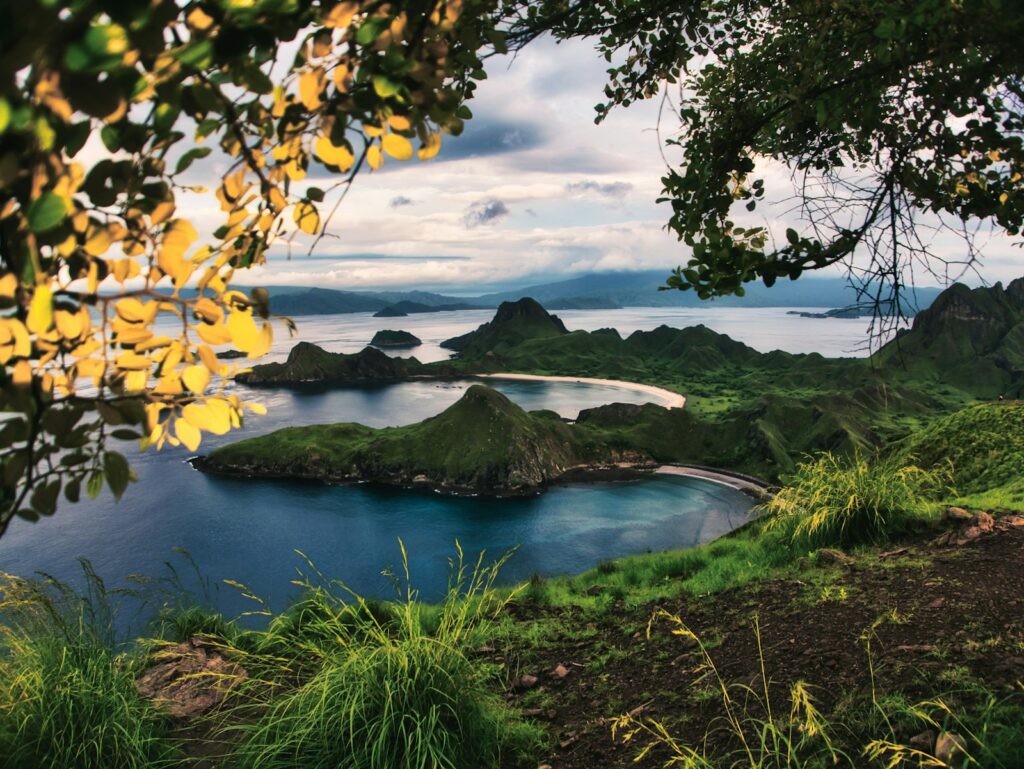
A Labuan Bajo phinisi trip in January or February is possible, but it is not straightforwardly safe for every traveler or every itinerary. January and February are the peak of the northwest monsoon — the roughest two months in the Komodo National Park sailing calendar — bringing heavy rain, strong winds, choppy to rough sea conditions in the open channels, and significantly reduced underwater visibility. Many reputable operators reduce their sailing schedules substantially during these months, and some suspend routes to exposed southern sites like Manta Point and the Pink Beach anchorage on Komodo Island entirely, particularly in February.
That is the honest answer. It is not the answer that fills charter boats in January, which is exactly why we are giving it to you plainly.
We have been in these waters long enough to have anchored at Manta Point in a February squall and watched the cleaning station sit empty while the surface heaved. We have also worked with clients who had only a January window, chose the right operator, accepted an adjusted route, and came home with a genuinely good trip. The difference was not luck. It was having accurate expectations, the right boat, and an operator who was honest about what the month could and could not deliver. This piece is meant to give you that same clarity before you book.
What January and February Actually Look Like at Sea
Komodo National Park sits in a narrow corridor between the Java Sea and the Indian Ocean, and in the northwest monsoon season the winds funnel through it with more force than the calendar-friendly summaries suggest. The meteorological picture is worth understanding because it explains why some trips in these months work and others do not.
From roughly December through March, northwest monsoon winds reverse the pattern that makes the dry season so reliable. Instead of the southeast trades that push cool, clear upwelling water through the park’s channels, you get northwesterly winds driving swells in from the Indian Ocean and the Flores Sea simultaneously. The channels between islands that you sail to reach Padar, Komodo Island’s western shore, and the southern reefs become genuinely rough corridors. Seas of 1.5 to 2.5 metres are common in open water during January’s worst periods. Not catastrophic by oceanic standards — but on a 25-metre wooden phinisi, that is enough motion to make a significant portion of passengers miserable before breakfast.
Rain compounds everything. Afternoon squalls arrive with little warning, visibility on deck drops, drone flights become impossible, and the hillsides of Padar — which look so dramatic in photography — are often obscured by cloud. The sunrise hike to the ~800-step summit viewpoint, which is the most anticipated moment of most itineraries, frequently delivers grey mist rather than the golden panorama that fills Instagram. That is not a disaster. But it is worth knowing.
Underwater, the northwest monsoon’s sediment stirring reduces visibility at most sites to single-digit or low-double-digit metres. Dive sites that regularly reach 20 to 30 metres clarity in July and August commonly drop to 5 to 12 metres in January and February. The reef life does not disappear, but the open-water drama — schooling pelagics, hammerheads appearing from the blue at Castle Rock — is substantially less likely to materialise when visibility is restricted to the length of a dining table.
What Operators Actually Do in January and February
This is information that very few booking platforms make transparent, so let us be specific about what the market actually looks like in these months.
Reputable charter operators — the ones with experienced captains who know these waters rather than agencies optimising for year-round booking revenue — take measurably different approaches to January and February. The patterns we have observed break into roughly three categories.
Operators Who Reduce but Continue Sailing
Some operators run reduced schedules, concentrating trips on the period between major weather systems. They modify itineraries to avoid the most exposed routes: less time in Komodo’s southern channels, more time in the northern park or close to the Labuan Bajo coastline where Kelor Island, Kanawa Island, and the protected bays provide shelter. A four-day trip that would normally reach Manta Point, Pink Beach, Rinca for dragons, Padar sunrise, and Taka Makassar sandbar might, in January, deliver Padar, Komodo Island for dragons, and Kelor and Kanawa for snorkeling — a meaningfully shorter highlights list but a still-decent experience on the right boat with the right captain reading the weather daily.
Operators Who Suspend Entirely
A number of premium private charter operators simply do not sail January and February. They close the season after late December and reopen in March or April. This is not timidity — it is honest product management. These operators have a reputation built on delivering specific experiences, and those experiences are not reliably deliverable in the monsoon peak. If you contact such an operator in November asking about a February slot, a good one will tell you this directly rather than taking your deposit and managing expectations after the fact.
Open-Trip Boats and Budget Operations
Open-trip shared phinisi — the per-person-priced boats that group together solo travelers and small parties — are more likely to keep sailing year-round because their business model depends on regular departures. The issue is not that they sail, it is that the flexibility to modify the route based on daily conditions is much more limited when you have eight strangers with different tolerance levels and a fixed itinerary they booked six weeks ago. Weather-driven itinerary changes on an open-trip boat are logistically and commercially complicated in ways they simply are not on a private whole-boat charter where the captain can consult directly with the guests each morning.
If you are considering a budget open-trip phinisi in January or February, factor this into your decision: the boat will likely sail, but the route may be significantly curtailed, and the mechanism for communicating that curtailment — and any associated compensation — is often opaque at booking time.
Specific Sites: What You Can and Cannot Reliably Expect
Not all of Komodo National Park is equally exposed to the northwest monsoon. Understanding which sites are protected and which are vulnerable helps you calibrate what a January or February trip might realistically include.
- Padar Island sunrise hike
- The anchorage on Padar’s eastern side is somewhat sheltered from northwest swells, so reaching the island is often possible. The ~800-step summit hike itself is unaffected by swell — it is a land walk. What changes is the sky: cloud cover and morning mist are common in the monsoon season, and the famous three-bay panorama is frequently obscured. The hike is still worthwhile as a physical experience, but budget for the possibility that the view does not cooperate.
- Pink Beach (Pantai Merah, Komodo Island)
- Komodo Island’s west coast bears significant northwest-swell exposure. The Pink Beach anchorage can be rough and sometimes untenable for comfortable overnight stays in January and February. Snorkeling here in 1.5-metre swell is unpleasant and potentially unsafe for non-strong swimmers. Many operators simply remove Pink Beach from January–February itineraries. Its distinctively coloured sand — the red-pigmented Foraminifera shells mixed with white coral — is not going anywhere. The beach will be there in May.
- Manta Point (Karang Makassar)
- The route to Manta Point involves crossing open water on Komodo Island’s southern side — exactly the exposure zone that makes January and February the roughest transit in the park. The crossing is possible in settled windows but is the first thing a prudent captain will cancel when conditions deteriorate. Even when you do reach Manta Point, the cleaning-station activity that makes it remarkable depends partly on the upwelling conditions that the monsoon disrupts. Manta rays are present year-round as residents, but the dense cleaning-station aggregations that the peak months produce are a dry-season phenomenon. A single encounter is realistic; the 10-to-20-individual sessions common in May through September are not.
- Komodo and Rinca Islands (dragon treks)
- The ranger-led treks at Loh Liang on Komodo Island and Loh Buaya on Rinca are less directly affected by sea conditions — once you reach the ranger station, the walk itself is inland. Komodo Island’s anchorage has better protection than the southern sites, and Rinca is generally accessible from the north even in monsoon conditions. Dragon sightings are less reliable in the wet season because denser vegetation disperses individuals away from the water sources near ranger stations where they concentrate in the dry season. But both islands remain operational, and the roughly 3,000 Komodo dragons across the park do not hibernate. Sightings happen; they just require more patience.
- Kelor Island and Kanawa Island
- These are the monsoon-season workhorses. Kelor sits close enough to Labuan Bajo that the transit is manageable in most January and February conditions. The short ~10-to-15-minute hill walk to the viewpoint is unaffected by weather, and the snorkeling in the island’s channel — while less spectacular than the open-park sites — functions year-round. Kanawa Island, roughly 45 to 60 minutes from Labuan Bajo by tender, has a protected fringing reef starting almost from the beach; it is shallow (1 to 2 metres near shore, dropping to 5 to 10 metres) and relatively current-free. A January trip routed around Kelor and Kanawa plus a Komodo or Rinca dragon trek can be legitimately satisfying. It is not the complete Komodo experience, but it is honest about what it is.
- Taka Makassar sandbar
- This crescent of white sand is in the park’s interior and is often accessible even in monsoon conditions when sea state cooperates. The transit route matters. With a captain who chooses sheltered passages rather than open-channel crossings, Taka Makassar can be a reasonable stop. It is tidal — entirely exposed at low tide, nearly submerged at high — so your arrival time matters more than the season.
- Kalong Island (Bat Island)
- The sunset flying-fox exodus is genuinely weather-resistant. Rain does not suppress the colony’s departure, though it changes the visual character of the event. The anchorage near Kalong is sheltered enough that this stop is typically achievable year-round.
Who Should Avoid January and February
We are going to be direct about this, because the conventional charter-booking posture is to find a way to say yes to every inquiry. That is not curation. It is sales.
You should seriously reconsider or reschedule a January or February Labuan Bajo phinisi trip if any of the following apply.
First-Time Visitors to the Park
If this is your only or primary opportunity to experience Komodo National Park, the monsoon peak is not the window to choose. Padar at dawn under clear sky, snorkeling above the pink sand of Pantai Merah, the manta cleaning station in full swing, Castle Rock on a day with 20-metre visibility — these are the experiences that justify the journey. In January and February, two or three of these are likely to be unavailable, significantly degraded, or entirely weather-dependent. A first visit deserves the park at a closer approach to its best. April through October is when that best is achievable.
Anyone Prone to Seasickness
This is not a minor caveat. Phinisi vessels — traditional two-masted wooden schooners with displacement hulls — move with the sea rather than cutting through it. They are not stabilised motor yachts. In calm water they are extraordinarily comfortable and peaceful. In 1.5- to 2-metre monsoon swell, they roll. Not dangerously, in most cases, but persistently. People who are mildly susceptible to motion sickness in cars or on ferries are frequently incapacitated for the first day or more of a monsoon-season phinisi trip. If you know you are susceptible, January and February are the months that will confirm your worst fears about boat travel.
Travelers with Tight or Non-Negotiable Itineraries
Private whole-boat charters give you daily route flexibility. Open-trip shared phinisi often do not. If you have booked four days with specific stops in mind — Padar sunrise, Manta Point, Pink Beach, Komodo dragons — and weather prevents two of those stops, your options on a shared boat are limited. Wet-season sailing rewards flexibility. It punishes rigidity.
Families Traveling with Young Children
Rough sea conditions, disrupted sleep from the boat’s motion, and itineraries that shrink due to weather are hard on adults. They are harder on children. If the Komodo dragon trek and Padar hike are the anchors of a family trip, January and February carry a genuine risk of those anchors not holding. For a family on a private charter with a highly experienced captain and genuinely flexible expectations, a carefully planned February trip can work. For a family on a shared boat with fixed departures and a child who has never slept on a moving vessel, it is a significant risk to take knowingly.
Who Might Still Consider January or February
There are travelers for whom these months make real sense, and we would do them a disservice by suggesting otherwise.
Experienced sailors and divers who have already seen the park in peak season and want a different, quieter perspective will find January and February genuinely interesting. The park’s northern diving sites — Crystal Rock and Castle Rock in the north Komodo area — benefit from warmer water (roughly 27 to 29°C year-round) that is less affected by the southern upwelling reduction. A dive-focused private charter concentrating on the northern zone can deliver respectable diving even in the wet season, though visibility will be below peak levels. The absence of the July–August flotilla is a genuine pleasure.
Budget-conscious travelers who have done the maths and accepted reduced highlights for a lower price point can use January and February strategically. Shared open-trip prices in low season are at their floor. The dragons are still there. Kelor and Kanawa still snorkel. If your priority is spending time on a traditional Indonesian phinisi in beautiful waters and the specific site list is secondary, the monsoon shoulder can deliver real value — provided you book with an operator who is honest with you about the adjusted itinerary rather than one who promises the full route and delivers a shortened version without warning.
Photographers seeking specific atmospheric conditions sometimes choose January deliberately. Rain-soaked hillsides, dramatic cloud formations over Padar’s ridgeline, mist in the channels at dawn — these are legitimate aesthetic choices, and nobody else will be there to compete for the shot. Whether the cloud breaks enough for the three-bay panorama is a matter of timing and luck, but the moody version of Komodo has its own character.
If any of this describes you and you are seriously considering a January or February charter, plan your charter with our concierge and we will tell you specifically which operators are still sailing, which boats are genuinely suitable for monsoon conditions, and which routes are realistic. We handle these conversations via WhatsApp as well — sometimes a five-minute back-and-forth clarifies more than a two-hour research session.
Questions to Ask Any Operator Before Booking in Low Season
The most protective thing you can do before booking a January or February phinisi trip is ask the right questions. Most charter operations will answer honestly if you ask directly; the issue is that most travelers do not ask.
Ask the operator: Which sites on the standard itinerary do you actually skip or abbreviate in January and February? Ask for specifics — Manta Point, Pink Beach, Padar — not a general answer about weather flexibility. Ask how the captain makes the daily routing decision, and who you speak to if the itinerary changes. Ask whether they have a partial-refund or credit policy if weather forces a significant curtailment. Ask when they last ran this route in January or early February and what the conditions were.
An operator who answers these questions with candour — including the unflattering parts — is an operator worth booking with. One who deflects to general reassurance about “international safety standards” and “flexible itineraries” without specifics is telling you something important about how they handle problems after your deposit has cleared.
Safety vs. Comfort: A Necessary Distinction
The question in the title of this piece is whether January or February phinisi sailing is safe. The honest answer requires separating two things that often get conflated: physical safety and experiential quality.
Physical safety on a well-maintained, properly crewed phinisi operated by an experienced captain is not fundamentally compromised by January or February conditions in Komodo National Park. The park is not the open ocean. The channels are not the Drake Passage. An experienced captain reads the weather, knows the sheltered routes, and will anchor rather than push through a deteriorating sea state. The fires and sinkings that have occasionally marked this charter industry’s safety record have generally been the product of overloaded boats, deferred maintenance, and under-experienced crew — not the monsoon season specifically. Choose your operator carefully and the physical risk is manageable.
Experiential quality is a different matter. The reasonable expectation of seeing Manta Point, swimming at Pink Beach, summiting Padar under a clear sky, and reaching Komodo’s dragon treks in genuinely accessible conditions — the full Komodo itinerary as it is sold and as most travelers imagine it — is not reliably achievable in January and February. That is not a safety issue. It is a product-quality issue, and it is the more relevant concern for most travelers making this decision.
When people ask whether it is safe to sail a Labuan Bajo phinisi in January or February, what they are usually really asking is whether the trip is worth doing. On balance, for most first-time visitors and for anyone whose vision of the trip is anchored to the highlights, the answer is: not this particular month. Come back in April.
The February Specific: Why It Is the Hardest Month
January gets more attention because it follows the Christmas season, but February is arguably the more difficult month to plan around. By February, the northwest monsoon has been established for six to eight weeks. Operators who reduced their schedules in January have sometimes had to suspend routes entirely. The weather-window game — finding the gaps between systems — becomes more volatile rather than less. March begins the gradual transition back toward drier conditions, but February sits at the bottom of the trough.
From a practical planning standpoint, February also has the fewest boats operating, which means the options you find available are a subset of the year-round fleet. The vessels that continue sailing in February tend to be either very experienced operations with captains who know the park intimately, or budget operations whose year-round model requires them to keep sailing regardless. The middle tier of competent-but-cautious operators is largely absent. If you are planning a February trip, this dynamic matters: the available field is more polarised between excellent and questionable than it is in any other month.
What a Good Low-Season Itinerary Actually Looks Like
For a traveler who has weighed all of this and is committed to January or February, the itinerary worth building looks different from the standard 3D2N and 4D3N routes. A realistic and satisfying wet-season route focuses on protected sites and treats the exposed highlights as aspirational rather than guaranteed.
| Day | Realistic wet-season stop | Standard dry-season equivalent |
|---|---|---|
| Day 1 afternoon | Kelor Island: viewpoint hike + snorkel | Same (Kelor is accessible year-round) |
| Day 1 sunset | Kalong Island: flying-fox exodus | Same |
| Day 2 early | Padar Island: summit hike (cloud-dependent panorama) | Clear-sky three-bay panorama |
| Day 2 mid-morning | Komodo or Rinca: ranger-led dragon trek | Same (condition-independent) |
| Day 2 afternoon | Taka Makassar sandbar (route dependent) | Same, typically more accessible |
| Day 3 morning | Kanawa Island: snorkel on house reef | Pink Beach (likely unavailable in Jan–Feb) |
| Day 3 afternoon | Return to Labuan Bajo | Same, sometimes with Manta Point stop |
This is a condensed summary of what a 3D2N wet-season route might hold when a good captain manages conditions well. Manta Point is absent. Pink Beach is absent. The underwater spectaculars of Crystal Rock and Batu Bolong are absent. What remains is still a remarkable trip by most benchmarks — Komodo dragons, a traditional phinisi voyage, Padar’s ridge, Kalong’s sunset bats, and the park’s quietest anchorages. It is just not the full Komodo experience that the dry season reliably delivers.
Park Fees and Operational Logistics in Low Season
One practical note: Komodo National Park remains fully operational in January and February. The park does not close. Ranger-led treks at Loh Liang and Loh Buaya continue. The fee structure — which currently runs to approximately IDR 600,000 to 1,200,000 per person for a 3D2N trip covering park entrance, marine fees, and ranger charges — applies year-round, and operators handle the collection. There is no low-season discount on park fees.
Labuan Bajo itself is accessible year-round by air. Flights from Bali (Ngurah Rai, DPS) to Komodo Airport (LBJ) take roughly 1 hour 10 minutes to 1 hour 25 minutes; Garuda Indonesia, Wings Air, Lion Air, Batik Air, and Citilink all operate routes that continue through the wet season. The town waterfront — Pelabuhan Labuan Bajo — remains the standard departure point for phinisi charters regardless of season. January and February bring more rain to the town itself, but the logistical infrastructure functions normally.
Frequently Asked Questions
Is it actually dangerous to sail a phinisi in January or February?
Physical danger on a well-maintained phinisi with an experienced captain is not the primary concern in January or February — these waters are not the open ocean, and a good captain shelters rather than pushing through a deteriorating sea state. The more accurate concern is that sea conditions materially degrade the experience: rough channels, reduced visibility, disrupted plans, and significant motion on the boat. For travelers prone to seasickness or those expecting the full Komodo highlights itinerary, the conditions create a real risk that the trip will not deliver what you imagined. That is a different risk from physical danger, but it is the risk most travelers should weight in their decision.
Do operators suspend sailings in January and February?
Yes — many reputable operators reduce their sailing schedules significantly in January and February, and some suspend routes to exposed southern Komodo sites entirely, particularly in February. Premium private charter operators often close the season after late December and do not reopen until March or April. Open-trip shared boats are more likely to maintain year-round departures but may significantly curtail itineraries without always making this clear at booking time. Always ask an operator specifically which sites they skip or modify in the monsoon season before you commit a deposit.
What is the visibility like for snorkeling and diving in January and February?
Underwater visibility drops significantly in the northwest monsoon season. Sites that reach 20 to 30 metres in July and August commonly deliver 5 to 12 metres in January and February. Suspended sediment from monsoon rains and the absence of the cold-water upwelling that creates dry-season clarity are both factors. The reef life is still present — fish, turtles, and modest coral cover year-round — but the open-water spectaculars like large pelagic encounters and wide-angle reef photography are much harder to achieve.
Can I see manta rays at Manta Point in January or February?
Reef manta rays are resident in Komodo National Park year-round and individual encounters are possible at Manta Point (Karang Makassar) in January and February. However, the dense cleaning-station aggregations — groups of 10 to 20 mantas circling the shallow station at 5 to 15 metres depth — are primarily a dry-season phenomenon, strongest from May through September. In the wet season, aggregation density is lower, encounters are less predictable, and the transit to Manta Point involves rough open-water crossings that some captains will cancel in poor conditions. A January manta encounter is a bonus possibility, not a plannable expectation.
If I have to travel in January or February, what should I prioritise booking?
Prioritise a private whole-boat charter over a shared open-trip boat — the routing flexibility to shelter from bad conditions and adjust daily plans is significantly greater when the captain is managing your group alone rather than a mixed booking of strangers with varying tolerances and expectations. Choose an operator who is transparent about wet-season routing (ask explicitly which standard highlights they skip in January or February and get a direct answer). Focus itinerary expectations on Komodo or Rinca for dragons, Kelor and Kanawa for sheltered snorkeling, Kalong for the sunset bat exodus, and Padar as an aspirational stop — with genuine acceptance that the panorama may be cloud-covered. Reach out to our concierge and we will match you to operators who are honest about what February actually delivers, not just what it is supposed to deliver on paper.