Labuan Bajo phinisi last minute deals in shoulder season are a real phenomenon, not a marketing fiction. In April through June and again in October and November, private charter operators regularly drop rates by 15 to 30 percent compared to the July–August peak, and boats that would have been fully committed four months in advance sometimes become available on two to three weeks’ notice. The reason is straightforward: the core demand that drives peak-season prices does not reach its ceiling in the shoulder months, which means negotiating room opens up and last-minute slots appear.
We have been crewing and guiding phinisi trips through Komodo National Park for years. Our crew grew up in Flores, and the harbour in Labuan Bajo is as familiar to them as a backyard. We have watched the shoulder season work well for travelers who understood what they were getting into — and poorly for those who arrived with peak-season expectations and shoulder-season timing. This piece is an attempt to give you the honest version of that tradeoff, with enough specifics to make a real decision.
What Shoulder Season Actually Means in Labuan Bajo
The Komodo calendar breaks into three distinct zones: peak season (July–August, plus late December), shoulder season (April–June and October–November), and wet season (roughly January through mid-March). Shoulder season is not a euphemism for bad conditions. It is dry-season sailing with lower commercial pressure. The southeast trade winds are either establishing themselves or winding down, seas are calm to moderate, and the park’s main sites — Padar, Pink Beach, Manta Point, Komodo, Rinca, Taka Makassar — are all accessible and productive.
What shoulder season lacks is the absolute peak of underwater visibility that July and August deliver at exposed north-park sites like Crystal Rock and Batu Bolong. In shoulder months, visibility at those dive sites typically runs 15 to 22 metres rather than 22 to 30 metres. For most travelers on a 3D2N or 4D3N leisure trip who are snorkeling rather than technical diving, that gap is barely perceptible. For a dedicated dive liveaboard with a week of hard sites on the schedule, it matters more.
Beyond visibility, the experience is arguably better in shoulder months for travelers who care about the atmosphere of the trip rather than the checklist of optimal conditions. Padar at sunrise with four other boats in the anchorage feels entirely different from Padar at sunrise with twenty. Pink Beach on a Wednesday in May does not require a queue for the best stretch of sand.
The Two Shoulder Windows: April–June vs October–November
The two shoulder periods have different characters, and they suit different travelers.
April, May, and June — The Green Window
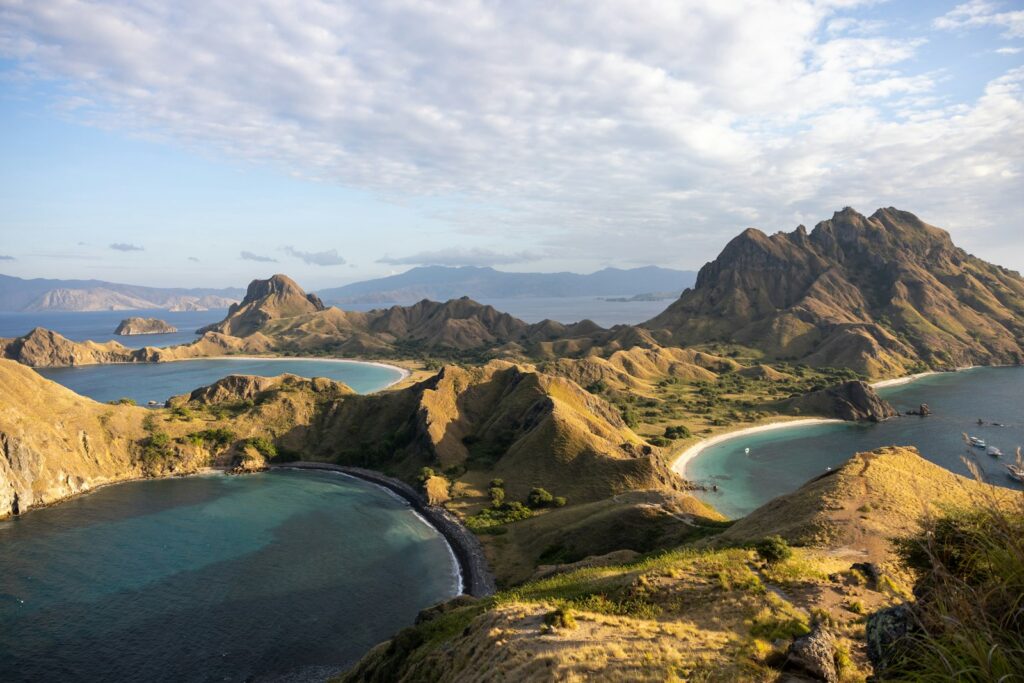
April marks the transition out of the wet season. By mid-April, conditions in the park are reliably dry-season quality: calm anchorages, clear enough water, predictable weather patterns. The hillsides on Padar and across the island group are still richly green from the wet-season rains — deeply saturated olive tones on the ridgelines, not the golden-brown tones that July photography produces. Both aesthetics are legitimate; they are just different. If you have only seen the dry-season photographs that dominate travel imagery of Padar, the green version can be a surprise. A pleasant one.
May is genuinely one of our favourite months for guiding. The manta aggregation at Manta Point (Karang Makassar) is building toward its primary peak — reef manta rays (Mobula alfredi) with wingspans up to around 4.5 metres are regular visitors to the shallow cleaning station, circling at 5 to 15 metres while smaller fish work on their gill plates. Encounter rates are good and improving as the month progresses. The park has not yet filled with the flotillas that July attracts, and the dynamic with rangers and other boats feels more relaxed.
June sits closer to peak season in terms of availability and pricing. European school holidays begin to push demand up from late June onward. You get excellent conditions in June, but booking lead times start to resemble July more than May. Three to four months ahead is appropriate for a good private charter in late June.
The practical advantage of April and May over any other period: lead times are short. A genuinely quality private charter — not a distressed last-minute basket case — can legitimately be available four to six weeks out in these months. That is rare enough in peak season that it deserves to be named explicitly.
October and November — The Winding-Down Window
October is the shoulder month we most consistently recommend when people have flexibility. The southeast trades are easing, the sea surface calms further than it was in August, and diving conditions are still excellent at most sites — visibility in the 18 to 25 metre range, water temperature in central and southern Komodo around 24 to 27°C from residual upwelling. More importantly, the manta situation in October is exceptional: the secondary migration peak runs from roughly September through November, when a distinct movement pattern adds to the resident population at Manta Point. September and October overlap both the primary season tail and the secondary peak, which is why experienced divers who track these things often cite October as a hidden-value month for manta encounters.
The park is noticeably quieter than August. Padar’s summit trail in October still requires the pre-dawn start — the hike up approximately 800 steps to the ridge viewpoint is the same physical undertaking regardless of season — but the view at the top is not shared with a crowd. The golden-dry-season landscape is still intact. Dragon treks at Loh Liang on Komodo Island and Loh Buaya on Rinca are productive: the sparse dry-season vegetation keeps Komodo dragons concentrated near water sources, and the roughly 3,000 individuals distributed across the park’s islands are reliably found on the ranger-guided treks that the park mandates for all visitors.
November is genuinely transitional. The first two weeks often extend October’s conditions reasonably well; the second half can introduce early northwest-monsoon energy. Operator experience matters more in November than in any other shoulder month — a captain who knows which anchorages are protected from northwest swells and how to read a deteriorating weather window is the difference between a good trip and a compromised one. Budget open-trip phinisi with fixed itineraries are more vulnerable to late-November weather than flexible private charters.
The Price Gap: What the Numbers Actually Look Like
Pricing in the Labuan Bajo phinisi market is quote-based and operator-specific. No two boats are the same price, and seasonal discounts are negotiated, not published. That said, the structural pattern across the market is consistent enough to describe in honest ranges.
Private whole-boat charter rates across the market run from roughly $1,000 to $5,000 per night for quality phinisi (ultra-luxury expedition vessels are a separate category, with rates that are quote-only and materially higher). Within that broad bracket, the shoulder-season discount typically works out as follows: operators who charge at the upper end of their range in peak season reduce rates by 15 to 25 percent in April–May and October, sometimes more on last-minute availability in the two weeks before departure.
On shared open-trip departures — where you book per-person rather than whole-boat — the pricing difference between peak and shoulder is less dramatic, often 10 to 15 percent, because operator fixed costs (fuel, crew, park permits) are relatively constant. The bigger advantage on open trips in shoulder season is availability: popular departures that are fully committed in July can have berths open with a week’s notice in May.
| Period | Relative rate (private charter) | Typical booking lead time | Conditions summary | Main tradeoff |
|---|---|---|---|---|
| July–August (peak) | Full rate — ceiling pricing | 3–6 months ahead | Best visibility (20–30 m), busiest anchorages, peak manta season | Crowded sites, no last-minute availability on quality boats |
| April–May (shoulder) | ~15–25% below peak | 4–6 weeks ahead (sometimes less) | Dry season established, green landscape, manta season building, calm seas | Visibility 15–22 m vs 20–30 m peak; landscape green not golden |
| June (late shoulder) | ~10–15% below peak | 8–12 weeks ahead | Fully dry, good visibility, demand rising with school holidays | Reduced discount window; prices track July by late June |
| October (shoulder) | ~15–25% below peak | 4–8 weeks ahead | Excellent conditions, secondary manta peak, noticeably quieter | Transition risk grows toward November; book earlier in the month |
| November (late shoulder) | ~20–30% below peak | 2–4 weeks ahead | Mixed; first half often good, second half transitional | Genuine weather risk late in the month; operator experience critical |
| Jan–Feb (wet season) | Lowest rates of year | Days to 2 weeks | Roughest seas, lowest visibility, many operators reduce schedule | Conditions materially degrade the experience — not a deal worth taking for most travelers |
One number worth holding in mind: park and conservation fees in Komodo National Park are excluded from virtually every advertised charter price and are charged separately. Current approximate figures run around IDR 600,000 to IDR 1,200,000 per person for a 3D2N or 4D3N trip covering the main sites, though these fees are periodically revised and operators typically collect them in cash at the harbor or on board. Verify current rates with your operator before departure — they change, and the gap between what you budgeted and what you owe at the pier is an unpleasant surprise when it happens.
Thinking through the shoulder-season numbers for your specific group and dates? Plan your charter with our concierge — we track seasonal availability across the fleet and can tell you which boats have genuine open slots in your window and what realistic pricing looks like right now. WhatsApp works too if you want a quicker first conversation.
Last-Minute Availability: How It Actually Works
The phrase “last minute” means something specific in this market. It does not mean showing up at Labuan Bajo harbor and finding a quality phinisi with open berths. That strategy works for budget open-trip boats in the wet season. It does not work reliably for quality private charters or better open-trip vessels in shoulder season.
What genuinely happens in April, May, and October is that cancellations and date shifts free up blocks on quality boats. A family that booked a private charter for a specific week in May and then had to cancel due to schedule changes leaves the operator with a freshly available boat and a real motivation to fill it — sometimes at a meaningful discount to avoid the fixed cost of sailing with no revenue. A group that booked a 3D2N for early October but extended their itinerary to cover a different cluster of sites releases berths on an open-trip departure.
These slots surface most often through direct operator relationships and through reputable curation services that maintain ongoing contact with fleets. They rarely appear on booking platforms, because platforms have listing lead times and the economics of last-minute discounting do not favour a platform commission structure. If you want genuine last-minute shoulder-season access to quality boats, the mechanism is a direct conversation with operators who know you are actively looking, not a search-engine query run from your phone at the airport.
The practical implication: if you know your travel window is April or October, telling operators two to three months in advance that you are flexible on exact dates dramatically increases your chances of landing a boat at a reduced rate. You are not really booking last minute — you are positioning yourself to be the person an operator calls when a cancellation opens up. That is a different posture from assuming a deal will materialise on its own.
What You Do Not Lose in Shoulder Season
A lot of what matters most on a Komodo phinisi trip is season-independent. The sites themselves do not close and do not degrade materially in shoulder months.
Padar Island’s viewpoint is spectacular in April and October. The hike is the same roughly 800 steps to the ridge — steep enough that most people are breathing hard by the top — and the panorama of three differently-coloured bays is present regardless of the month. The pre-dawn start is still worth it; the colour shift as sunrise catches the water and the hillsides is one of the most reliable experiences in the Indonesian archipelago. You just share it with fewer boats anchored in the bay below.
Komodo dragons on Rinca and Komodo Island are accessible year-round. Ranger-led treks at Loh Buaya on Rinca consistently deliver sightings of adult individuals — some approaching 3 metres in length — near the ranger station water sources. The population of approximately 3,000 across the park does not thin out in shoulder months. If anything, the dry-season low-vegetation conditions that persist through early November make animals somewhat easier to spot than they are in the dense wet-season brush.
Manta rays at Manta Point are present and active in both shoulder windows, with October-November being one of the better periods of the year for encounters at the cleaning station. Snorkeling above the station — where mantas come to 5 to 15 metres depth to be cleaned — is accessible to non-divers on most phinisi itineraries regardless of certification level. The key rule: maintain around 3 metres of distance and do not swim directly above or chase them. A patient approach consistently outperforms an aggressive one, and the behaviour difference in shoulder months is negligible.
Kanawa Island’s shallow fringing reef, starting at 1 to 2 metres from the beach and dropping to around 5 to 10 metres, is a comfortable snorkel stop with good marine life density throughout the shoulder period. Kelor Island’s short steep hill — a 10 to 15-minute hike to the viewpoint — is worth the stop in any month for the view back toward Labuan Bajo and the layered islands to the south. Taka Makassar sandbar emerges at low tide as a crescent of brilliant white sand; the timing of your visit relative to the tidal window matters more than the month of year.
Kalong Island’s flying-fox colony launches at sunset year-round. Thousands of large fruit bats rising from the mangrove canopy in a ribbon against the evening sky is not a peak-season exclusive. Most phinisi captains time the passage to arrive in the late afternoon and anchor nearby for the show before continuing to the overnight anchorage. This is as reliable in May and October as in August.
The Honest Tradeoffs
Shoulder season suits most travelers better than peak season for most purposes. But it does not suit every purpose, and honesty requires saying so.
Dive visibility: The clearest water at the park’s most exposed and current-swept sites — Batu Bolong, Crystal Rock, Castle Rock — is a peak-season phenomenon driven by the cold-water upwelling at the height of the southeast trades. In July and August, visibility at those sites can genuinely reach 20 to 30 metres. In April, May, and October, you are more likely to see 15 to 22 metres at the same sites. That is excellent diving by any global standard, but if you have specifically planned a trip around the statistical peak visibility at Komodo’s most demanding sites, the peak months deliver that more reliably.
November risk: October is consistently good. November splits roughly in half — the first two weeks behave like a good shoulder month; the second half can bring early northwest-monsoon energy that makes open channels rougher and some itinerary stops impractical. If you are flexible on dates and the choice is mid-October versus late November, October is the cleaner choice. If November is fixed, work with an operator who has experience routing around early-monsoon conditions rather than one with a rigid fixed itinerary.
April weather: Early April can carry residual wet-season energy. Mid-to-late April is reliably dry-season territory, but if your departure is in the first week of April, discuss the routing with your captain in advance. A phinisi with an experienced captain who reads weather daily can manage a transitional week far better than the calendar date alone suggests.
Green vs golden landscape: If you have a specific vision of Padar from the photographs that circulate widely — the golden-brown hillsides of August — April through June will look different. The green season palette is equally striking and arguably more unusual in the context of Indonesian island photography, but it is not the same image. This is a small aesthetic note, not a reason to avoid shoulder season. It is worth knowing before you arrive with specific expectations.
Booking a Shoulder-Season Phinisi: Practical Steps
The process differs slightly from peak-season booking and rewards a specific approach.
Start with a window rather than a fixed date. Telling an operator “I can travel anytime between April 20 and May 10” gives them the ability to slot you into a cancellation or a departure that fits the vessel’s schedule. A fixed “I need to depart April 27” removes that flexibility and eliminates most of the last-minute-deal mechanism.
Contact operators directly, not through platforms. As noted above, genuine shoulder-season flexibility and last-minute rate adjustments surface through direct relationships. A short WhatsApp message or email explaining that you are flexible and interested in May or October dates — sent to two or three operators whose boats you have already vetted — is more productive than two hours on a booking aggregator.
Clarify what is included. Park and conservation fees are almost universally excluded from advertised charter prices in this market. Meals, gear, fuel, and transfers vary by boat and by tier. Getting a clear written breakdown of inclusions and exclusions before you commit prevents the most common source of post-trip dissatisfaction. A quality operator will give you that breakdown without being asked; the ones who resist or hedge on the question are telling you something.
Ask about the captain’s weather-reading approach. In shoulder months, particularly late October and November, an experienced captain who actively monitors conditions and re-routes when needed is the single most valuable piece of the puzzle. The boat specs and the galley menu are secondary to that. A good question to ask directly: “If weather deteriorates on Day 2, what does the alternative routing look like?” The quality of the answer tells you a lot.
Frequently Asked Questions
Are labuan bajo phinisi last minute deals in shoulder season real, or is it just marketing?
They are real, but they work differently from what the phrase suggests. Deals emerge from cancellations and from operators actively filling boats that have lost confirmed bookings, not from arbitrary shoulder-season discounting. In April–May and October, quality private charter boats can genuinely become available two to four weeks before departure at 15 to 25 percent below their peak-season rate. The mechanism is direct contact with operators, not browsing platforms — and positioning yourself as a flexible, serious buyer a few months ahead of your window dramatically increases your access to those slots when they materialise.
Is the shoulder season actually good for snorkeling at Manta Point?
Yes — and in October, it can be exceptional. The secondary manta migration peak runs from roughly September through November, overlapping the tail of the primary dry-season aggregation. October consistently delivers good encounter rates at Manta Point (Karang Makassar), where reef manta rays with wingspans up to around 4.5 metres visit the shallow cleaning station at 5 to 15 metres depth. April and May are also productive as manta activity builds toward the primary May–September peak. The encounter rates are not materially worse than in July and August for most snorkel visits, and the surface conditions are calmer in some shoulder months than at the height of the southeast trades.
How much cheaper is a phinisi charter in shoulder season compared to peak?
Typically 15 to 25 percent on private whole-boat charters, sometimes more on genuine last-minute availability in April–May or October. The discount is negotiated, not published — operators set peak-season rates as their ceiling and adjust from there based on demand and availability. Open-trip per-person bookings see a smaller gap, often 10 to 15 percent, because fixed costs like fuel and crew are constant regardless of season. The largest percentage discounts appear in November and in early April, where transition-weather uncertainty gives operators additional motivation to fill boats that might otherwise depart under-committed.
What happens if the weather turns bad during a November phinisi trip?
A reputable operator will re-route. The standard approach when northwest-monsoon energy arrives early in November is to shift to more protected anchorages — northern bays and sites sheltered by Komodo Island’s eastern coastline — rather than expose the boat to open channels. You may not reach every site on the original itinerary, but the core experiences of dragon treks, snorkeling, and island stops remain accessible on well-planned alternative routes. The key is booking with an operator who has explicit experience navigating this kind of weather flexibility, rather than one with a fixed schedule that cannot absorb a reroute. Before any November booking, ask the captain directly how they handle early-monsoon conditions.
Do I need to book further ahead for October than for May?
Slightly, yes. October’s quality as a shoulder month is increasingly well-known among experienced travelers, and the combination of secondary manta peak and thinning crowds has pushed its popularity up over the past few years. Six to eight weeks ahead is a comfortable lead time for a quality private charter in October; four to six weeks often works in April–May. For both periods, flexibility on exact dates within a two-to-three-week window is the most reliable way to access genuinely discounted availability. If your October dates are completely fixed — you must depart on a specific day — plan as if it were approaching peak season and contact operators sooner.
Whatever your window, we track availability and seasonal pricing across the fleet in real time. Talk to our concierge to find out which boats have genuine shoulder-season openings and what the current rate picture looks like — or reach us on WhatsApp if a quick message suits you better.